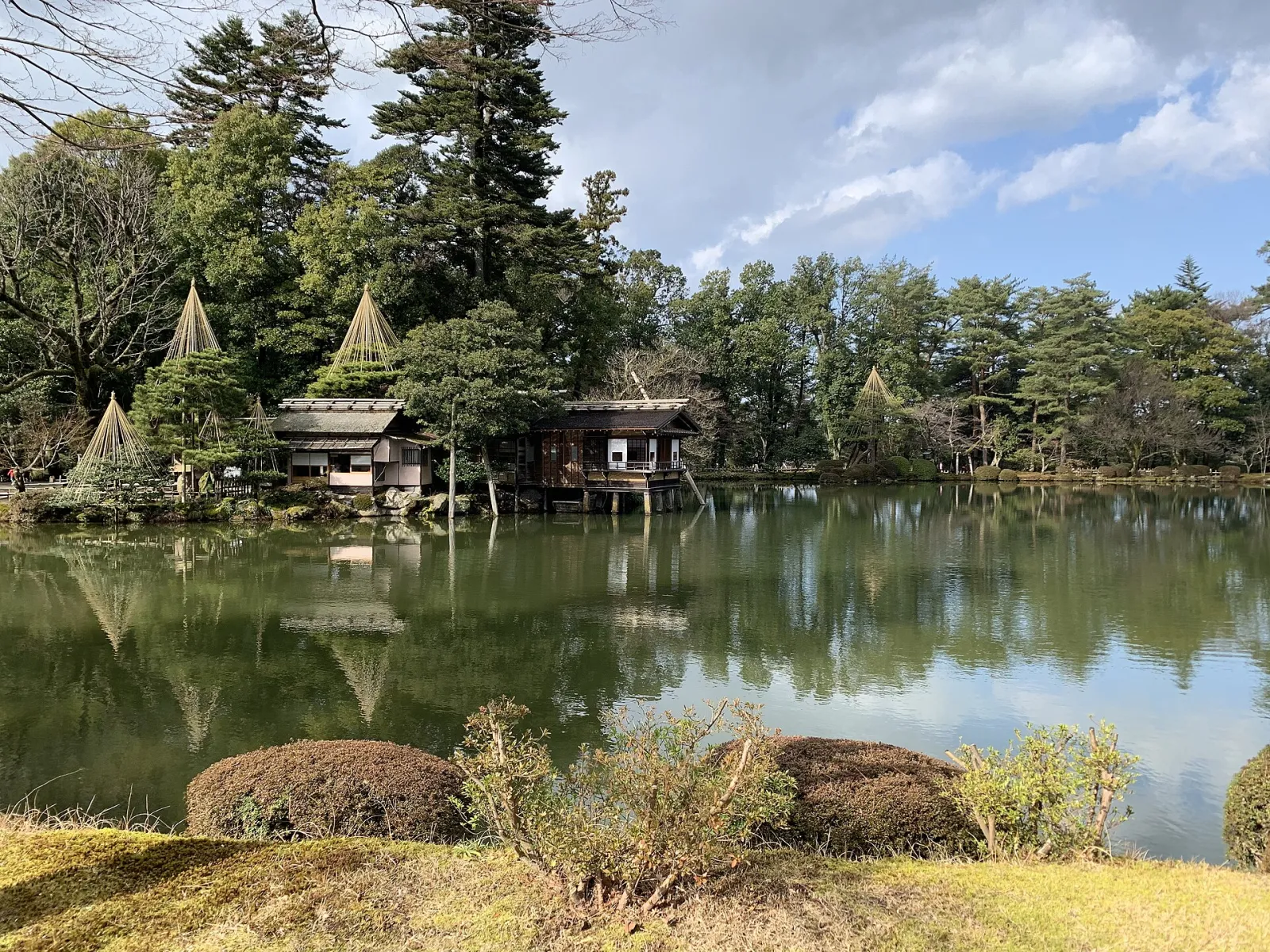
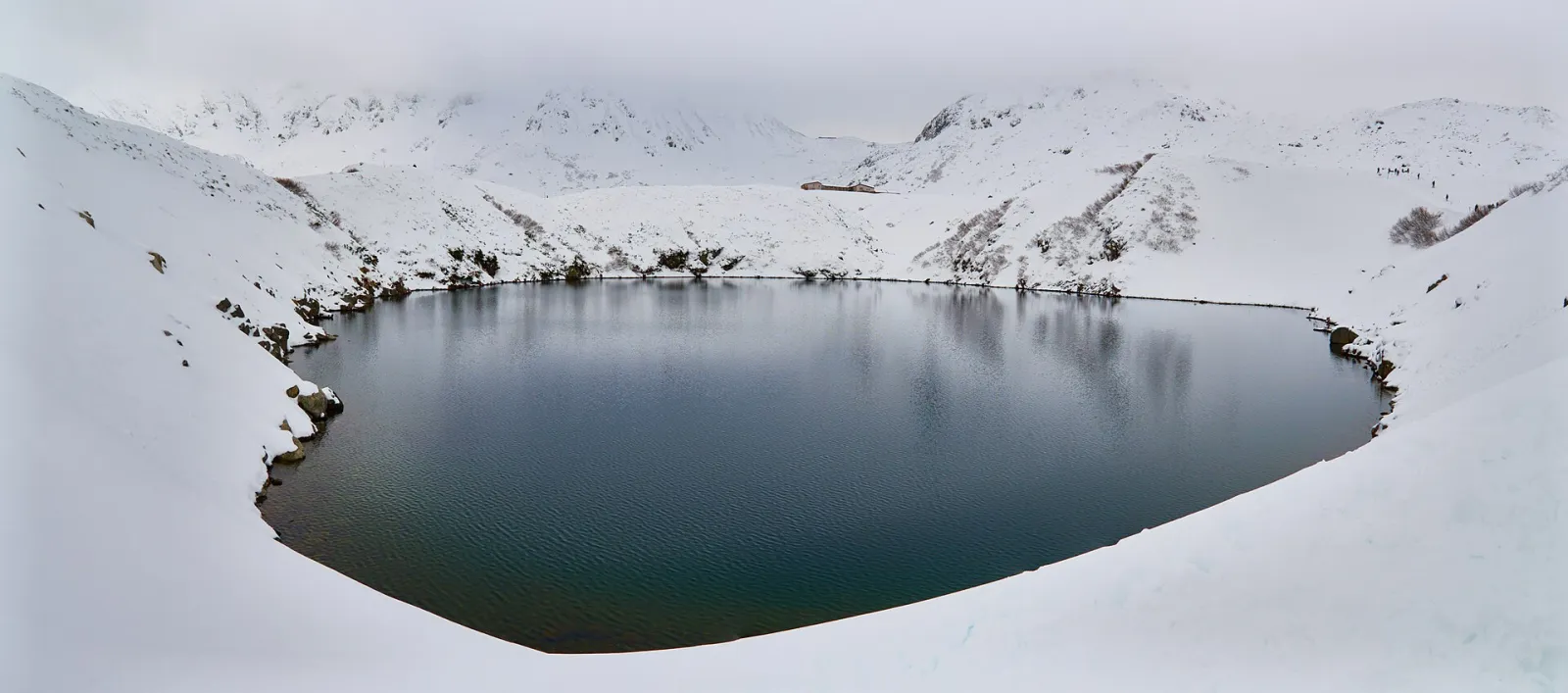
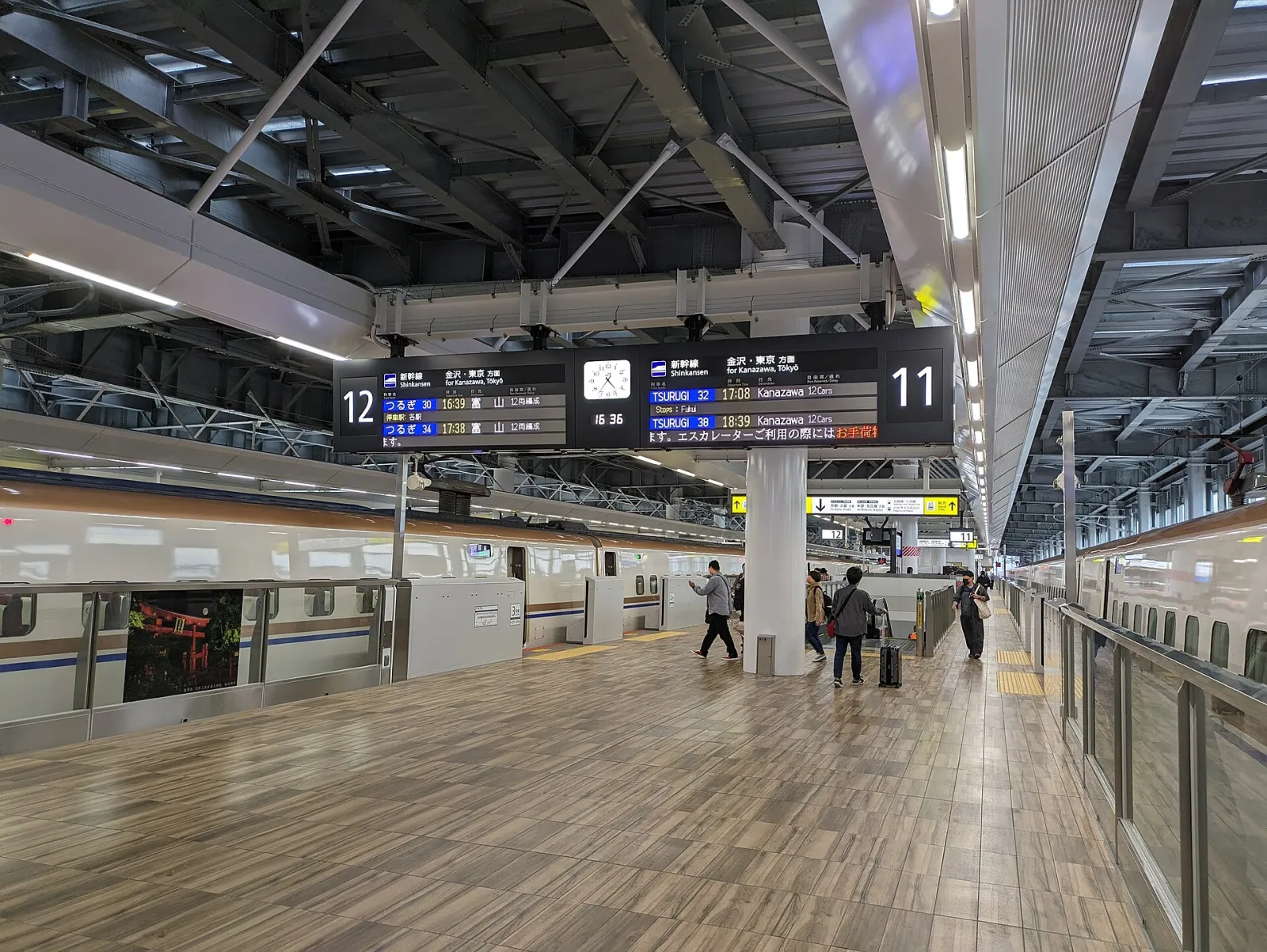
We are planning to travel to Kanazawa and Toyama this year, entering and leaving through Komatsu Airport. Before we go, I decided to do a little homework so that I can explore this region more deeply once I am there.
This is the first of the Hokuriku history notes and covers the Paleolithic through the Kofun period. It focuses on Kanazawa, Toyama, and Komatsu, the places on this trip. For a summary of all the notes, see the Hokuriku history overview.
Kanazawa, Toyama, and Komatsu sit within roughly 100 kilometers of each other along Hokuriku’s Japan Sea coast, with Kanazawa positioned between Toyama and Komatsu. Today’s sightseeing routes tend to emphasize the Maeda clan castle town, the medicine trade, and Kutani ware, but human activity in these three places can be traced back some 30,000 years.
This article arranges the major sites and research findings from the Paleolithic to the Kofun Period by archaeological period, as background for understanding the region over a much longer span of time.
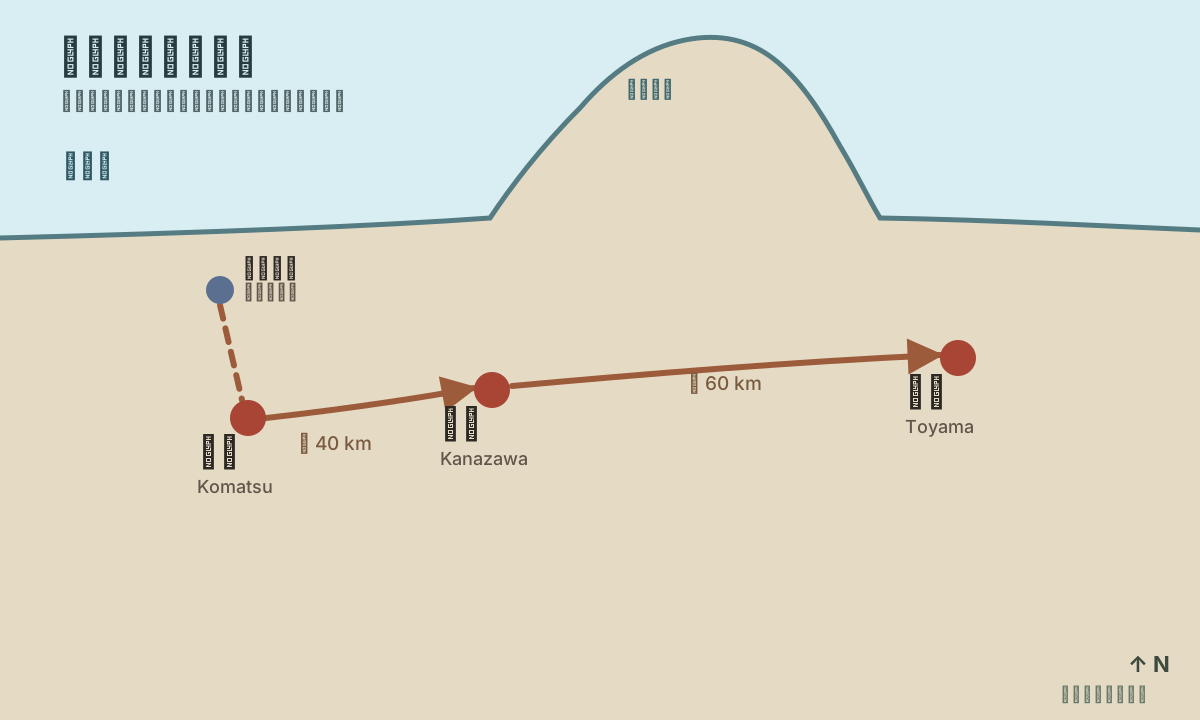
A schematic map showing Kanazawa, Toyama, Komatsu, and Komatsu Airport. It is not drawn to scale; the emphasis is on the travel route and relative positions of the three cities.
1. The first documentary appearances of the place names
The names “Kanazawa,” “Toyama,” and “Komatsu” entered the historical record in the late medieval period, which is very late compared with the archaeological evidence for human activity in these places.
| Place name | First appearance in the record | Source |
|---|---|---|
| Kanazawa | 1546, “Kanazawa-bōsha” | Tenmon Nikki, entry for the 29th day of the 10th month of Tenmon 151 |
| Toyama | 1398, “Toyama-gō jito-shiki” | Yoshimi Akiyori’s donation document, entry for the 3rd day of the 5th month of Ōei 52 |
| Komatsu | Estimated 1564, “Komatsu-guchi kassen” | Asakura Yoshikage’s letter of appreciation, estimated around Eiroku 73 |
“Kaga Province” itself was separated from Echizen Province only in 8234 (see the Heian note). The southern part of present-day Ishikawa Prefecture, where Kanazawa and Komatsu are located, belonged earlier to the wider “Koshi” region; Toyama is understood in the context of ancient Ecchu Province, which was established under the ritsuryō system in the second half of the seventh century. The 1546 “Kanazawa bōsha” in the table was the Honganji temple Kanazawa Midō, covered in the Muromachi note.
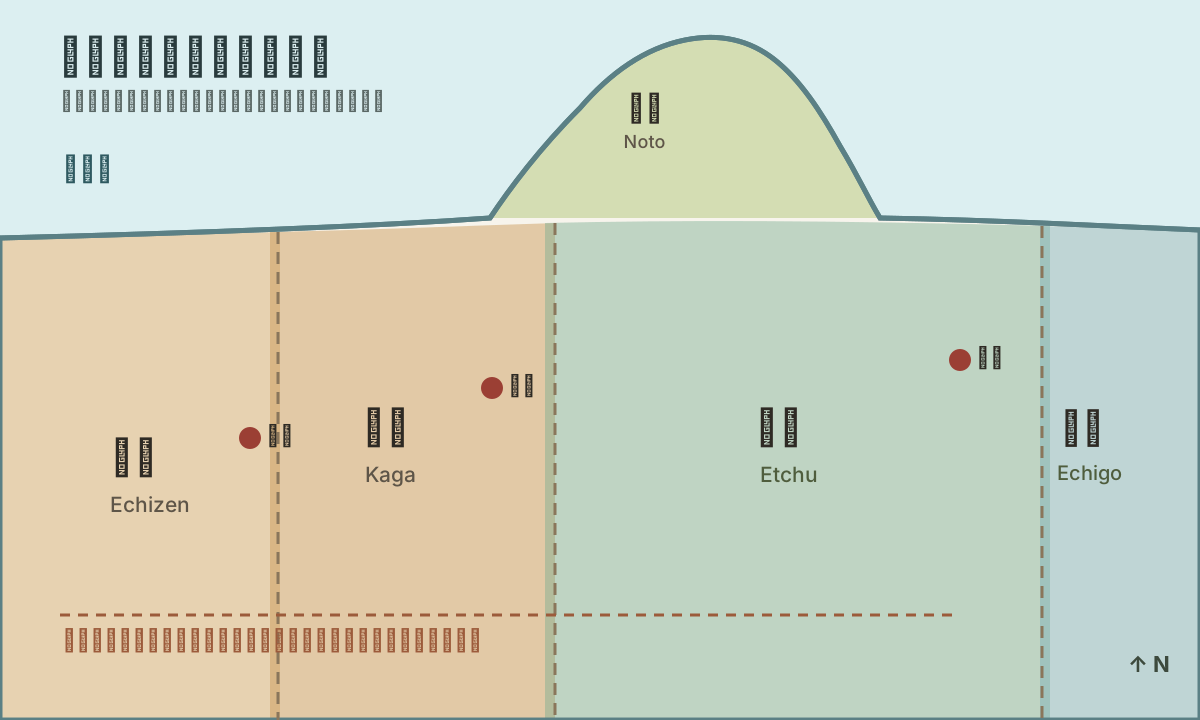
A schematic map of the relationship between Koshi, Kaga, and Ecchu in ancient Hokuriku. The diagram is not drawn to scale; the point is the relationship between “Koshi” as a broad region and the later ritsuryō provinces.
2. The Paleolithic Period (approx. 30,000-15,000 years ago)
In the Paleolithic Period, people moved along rivers, hills, terraces, and stone procurement sites, leaving behind primarily scatters of stone tools. All three cities have relevant archaeological records:
- Toyama: About 60 known sites dating from roughly 30,000 to 15,000 years ago5. Representative sites include the Sugusaka Site, the Sugitani F Site, and the Furusawa Site.
- Kanazawa: Lithic scatters such as the Tateyama Uenoyama Site and the Yoshihara Nanatsutsuka Site6.
- Komatsu: The Kawadayama Site yielded knife-shaped stone tools and wing-shaped flakes; the Yasato Mukaiyama B/C/D/E sites are classified as Paleolithic7.
Toyama has the densest body of evidence. According to Toyama Prefecture, it is a zone where “East Japan-type blade stone-tool complexes” and “West Japan-type Setouchi stone-tool complexes” are found side by side, showing that Hokuriku’s Japan Sea coast was already within the contact zone of two major lithic traditions in the Paleolithic8.
Visitor note: Most Paleolithic sites are data points in excavation reports rather than places with visible remains on the ground. The municipal buried cultural property centers do have related publications, but there is very little to see in person at the sites themselves.
3. The Jomon Period (approx. 13,000-2,300 years ago)
Jomon sites in Hokuriku are among the most important archaeological materials in Japan, especially for woodworking, lacquerware, pottery, and ritual architecture with large post circles. They span from early Jomon phases through the Final Jomon Period, roughly 12,000 to 2,500 years ago.
Kanazawa: Ring-shaped post circles and preservation in low-wetland conditions
The Chikamori Site (Saigawa alluvial fan in Kanazawa; Late to Final Jomon, approx. 3,000-2,500 years ago) yielded enormous timber posts more than one meter in diameter, arranged in a ring and generally interpreted as a ritual structure or building9.
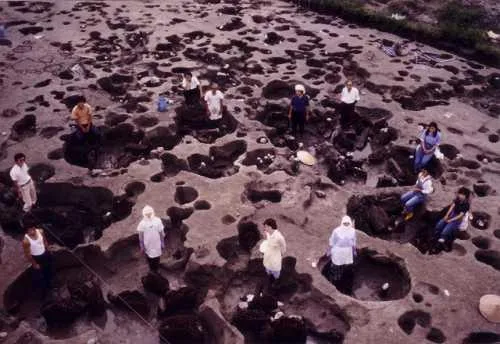
The ring-shaped post circle discovered at the Chikamori Site during excavation. Source: Kanazawa City Board of Education
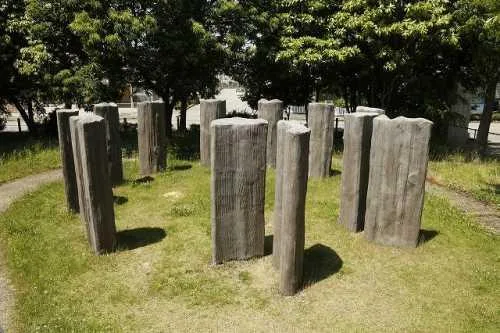
The restored ring-shaped post circle at the same site. Source: Kanazawa City Board of Education
The Nakaya Sawa Site (Kanazawa, same period) preserved rare wooden objects and lacquerware thanks to the anaerobic environment of a low-wetland setting, allowing organic materials to survive for more than 3,000 years9.
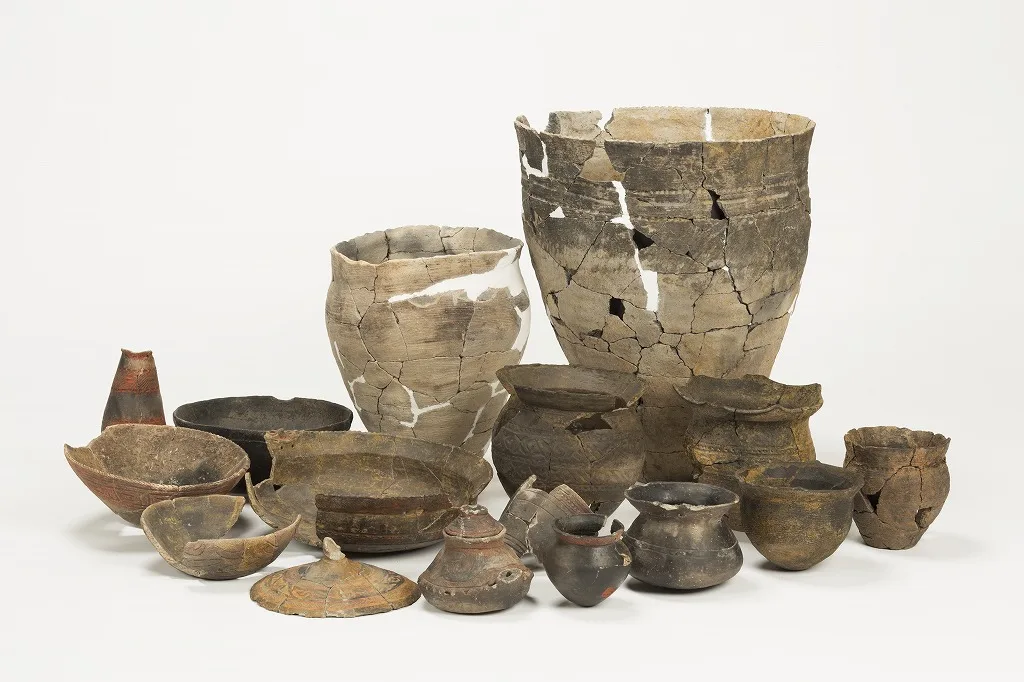
A variety of Jomon pottery excavated from the Nakaya Sawa Site. Source: Kanazawa City Board of Education
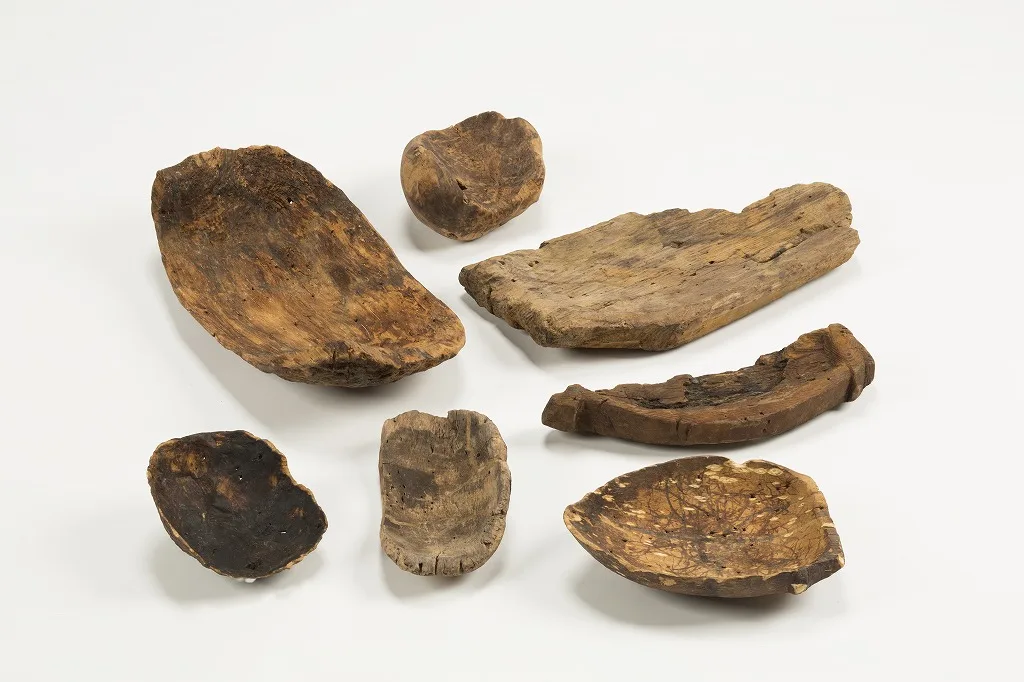
Wooden objects from the Jomon period excavated at the Nakaya Sawa Site. The preservation conditions unique to low wetlands allowed organic materials to remain intact. Source: Kanazawa City Board of Education
Toyama: Large settlements, burials, and shakoki-dogu
The Kitadai Site (Toyama City, Middle Jomon, approx. 5,000 years ago) was a large settlement, and Toyama City has preserved reconstructed buildings at the Kitadai Jomon Hiroba on the original site10.
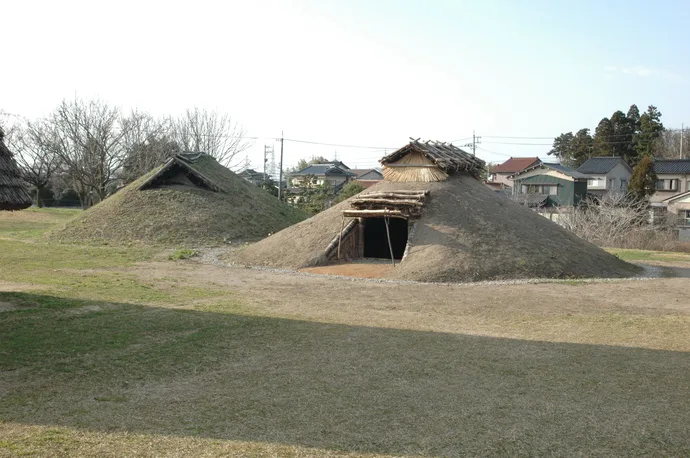
A reconstructed Jomon-period building at Kitadai Jomon Hiroba. Source: Toyama City Buried Cultural Property Center
The Odake Shell Mound (Toyama City, Early Jomon, approx. 5,500-5,000 years ago) yielded more than 90 human skeletons, making it one of the largest Jomon burial assemblages in Japan11. mtDNA analysis shows both southern and northern lineages, and the pottery assemblage includes imported styles from the Kinki, Kanto, and Tohoku regions, reflecting long-distance movement of people and goods.
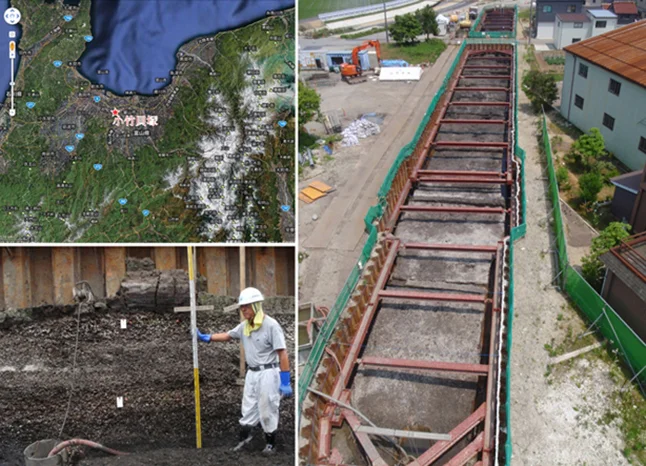
The location, shell layer, and overall view of the Odake Shell Mound. Source: National Museum of Nature and Science
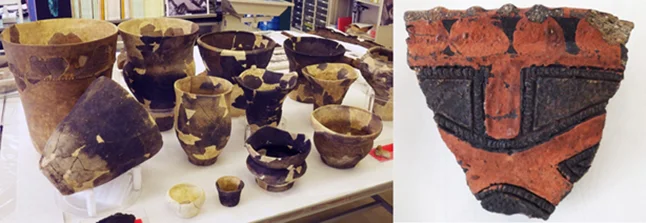
Pottery from the Odake Shell Mound (left: plain pottery, right: lacquered pottery). Source: National Museum of Nature and Science
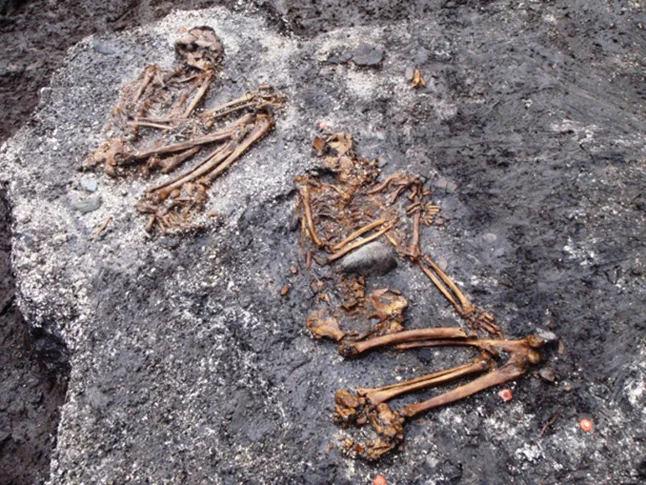
Burial context of human remains at the Odake Shell Mound. More than 90 Jomon skeletons were excavated here. Source: National Museum of Nature and Science
Toyama’s Jomon record does not only document large settlements and burials; it also preserves traces of Tohoku-style dogu forms. Toyama City currently knows of three shakoki-dogu examples, from Mizuhashi Tatemachi, the Hamakurosaki Noda and Hiranoki Site, and the Hyakuzuka Site12. The city’s explanation places shakoki-dogu in the Final Jomon Period as representative artifacts of the Kamegaoka culture, which developed mainly in northern Tohoku; the Toyama Folk and Folkcraft Village Archaeological Museum has likewise described the Mizuhashi Tatemachi and Hamakurosaki Noda and Hiranoki examples as concrete evidence of Kamegaoka cultural influence reaching Toyama13.
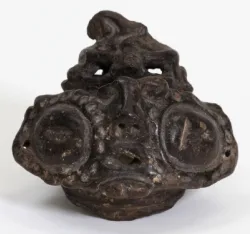
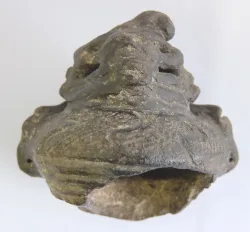
Taken together with the imported pottery from the Odake Shell Mound, these materials make Toyama an important place for observing contact between Hokuriku and outside cultural spheres. Jomon pottery from the Early Jomon Period shows styles connected to Kinki, Kanto, and Tohoku, while the Late Jomon shakoki-dogu points to influence from Tohoku forms. Even so, the presence of shakoki-dogu should be read as evidence that Kamegaoka-culture influence reached Hokuriku and left material remains in Toyama, not as proof of frequent, sustained direct contact with Tohoku. Among the three cities discussed here, Toyama is the only place where Tohoku-style shakoki-dogu influence can be clearly confirmed.
Komatsu: Shell mounds and wooden post circles on the Tsukizu terrace
The Otaniyama Shell Mound (Komatsu City, Early Jomon) is located on a lagoon terrain formed during the Jomon transgression and is centered on clam shells, reflecting long-term fishing activity14. The Rokkyo Site (Early to Late Jomon) yielded a large wooden post circle, similar in form to the Chikamori Site15.
Jomon pottery exchange among the three cities
According to the Komatsu City explanation of the Nenbutsubayashi Site, the first half to middle phases of the Middle Jomon in Hokuriku shared common pottery traditions from northern Fukui to Niigata, with partial overlaps with pottery styles from the Kanto and Chubu regions16. The Kofu-style pottery from Kanazawa is a representative type from the middle phase of the Middle Jomon in Hokuriku, while the imported pottery at the Odake Shell Mound is direct evidence of long-distance exchange.
Based on the current evidence, the three cities clearly belong to the Hokuriku-Japan Sea Jomon cultural sphere, with shared traditions in pottery styles, wooden post-circle technology, lacquerware, and low-wetland settlements. Whether there were direct one-to-one exchange relationships among the three cities remains difficult to determine from the archaeological record at present.
4. The Yayoi Period (approx. 2,300-1,700 years ago)
How rice cultivation entered the archipelago
A 2024 whole-genome study by the University of Tokyo on Yayoi human remains from the Doigahama site in Yamaguchi Prefecture showed that people from the Korean Peninsula mixed with Jomon-related populations in the archipelago during the Yayoi Period, forming part of the ancestry of modern Japanese populations17. The mainstream model today is a “mixed model”: rice-farming technology and some people came from the Korean Peninsula, mainly through northern Kyushu, then spread eastward along the Japan Sea coast and merged with local Jomon populations.
The National Museum of Japanese History and other sources describe what arrived as a set of techniques: irrigated paddy fields, farming tools, polished stone axes, and settlement organization18.
Komatsu: The Yokaichi-jikata Site
The Yokaichi-jikata Site (Komatsu City, east of Komatsu Station) is one of the largest moated settlements of the Middle Yayoi Period on the Japan Sea side, covering about 15 hectares. It has yielded multiple moats, raised-floor buildings, square moated graves, and large quantities of pottery, stone tools, wooden implements, and magatama production materials19. Ishikawa Prefecture describes it as “the largest Middle Yayoi settlement in the Hokuriku region”20.
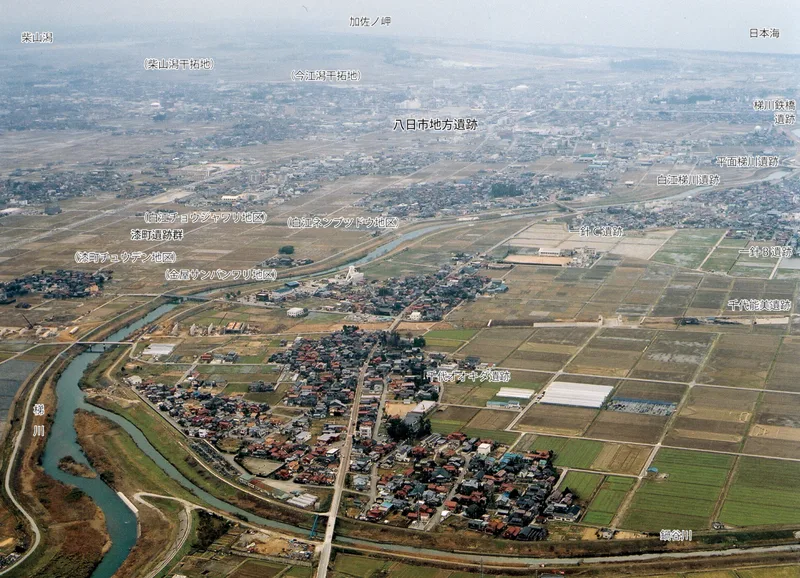
An aerial view of the Yokaichi-jikata Site. The remains are located among rice fields and residential areas. Source: Komatsu City
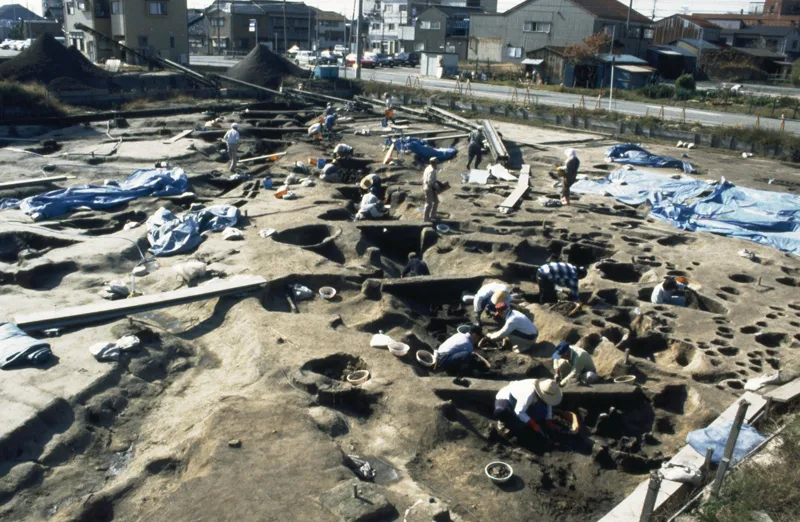
Excavation of the moat system (Komatsu City investigation, Areas 17, 1993-2000). Source: Komatsu City
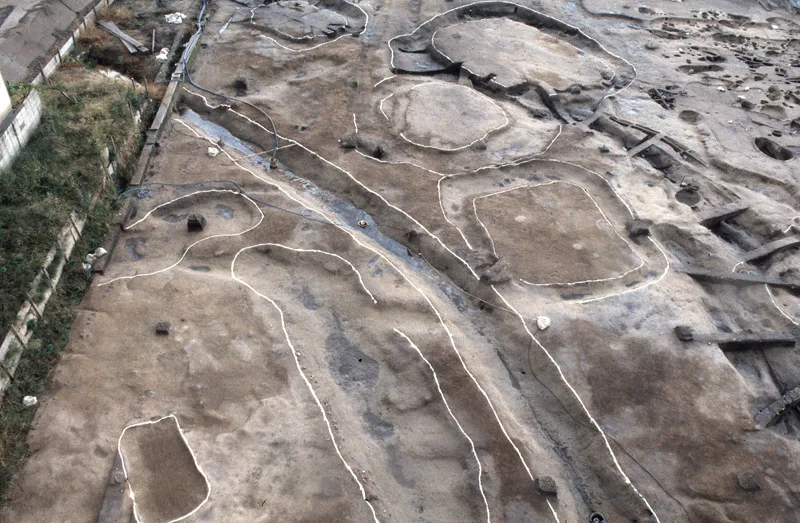
A square moated grave discovered at the site. Source: Komatsu City
The artifacts include production-stage materials for jasper tube beads, showing that the site functioned both as a node in wide-area exchange and as a craft-production center.
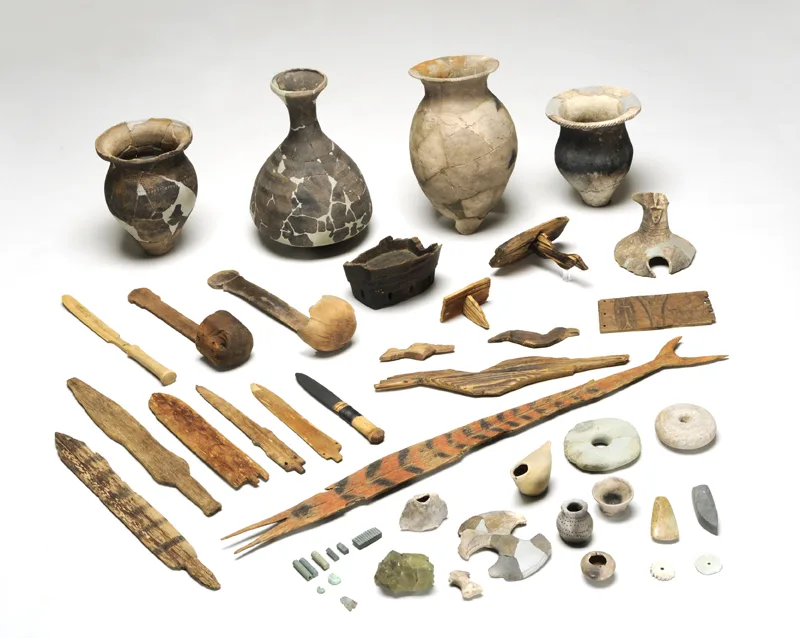
The rich assemblage designated as Important Cultural Properties. Source: Komatsu City
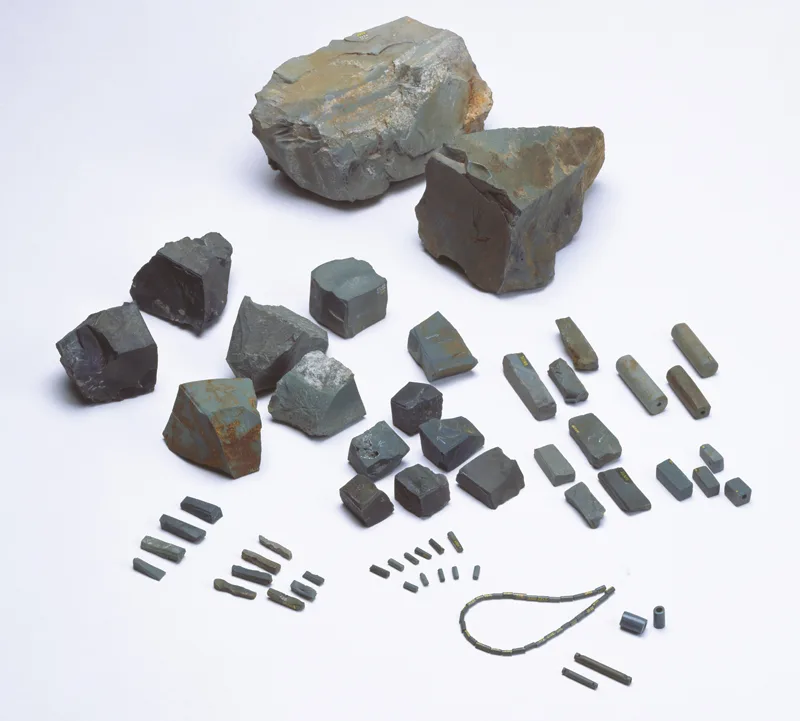
Artifacts that reveal the tube-bead production process. The sequence from jasper working to finished product is fully represented. Source: Komatsu City
The site also yielded dogu fragments. These materials can be used as an example of ordinary dogu from Komatsu; the Komatsu City source does not identify them as shakoki-dogu21. In other words, Komatsu’s dogu evidence is real, but it should not be treated as the same type as Toyama’s shakoki-dogu.
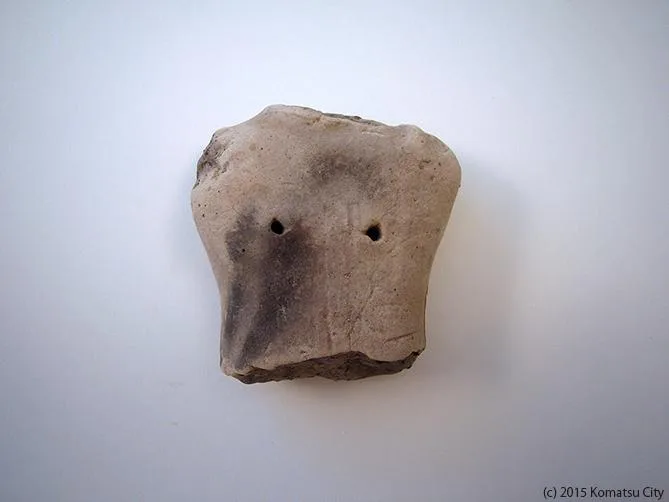
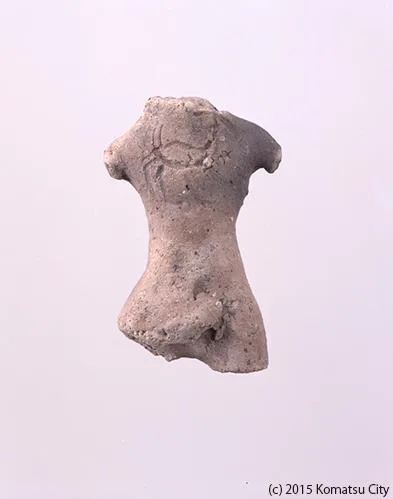
Other representative finds from the same site include the following two nationally designated Important Cultural Properties:
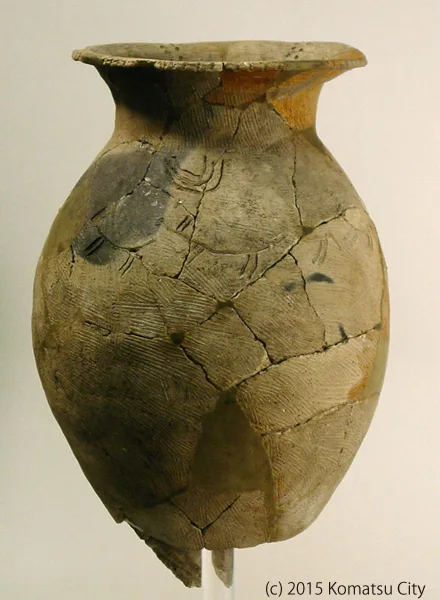
Painted pottery depicting a deer and a hunter. This is an especially valuable source for concrete scenes of Yayoi-period life. Source: Komatsu City
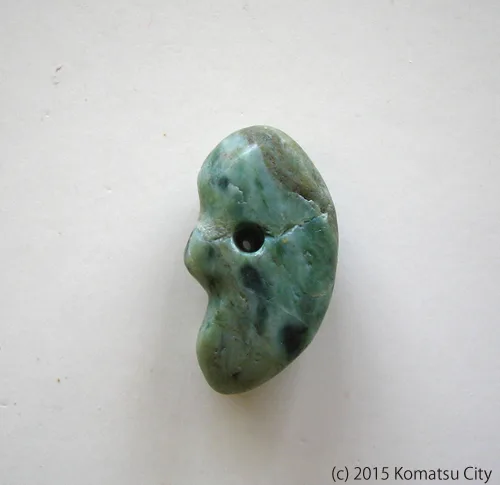
An animal-shaped magatama. Magatama in animal form are rare nationwide. Source: Komatsu City
Kanazawa: The Sainen and Minamishimbo Site
The Sainen and Minamishimbo Site (Kanazawa City) is identified by Ishikawa Prefecture as “a core settlement in northern Kaga”22. The excavated materials include 18 square moated graves, 38 pit graves, ditches, weirs, waterways, and wooden farm tools, reflecting a settlement with full agricultural infrastructure.
Toyama: The Nei region in the late Yayoi Period
The number of Yayoi sites in Toyama City increases sharply in the late and final phases. Toyama City explains this as the result of “migration into new frontier land”23.
In the final Yayoi Period, the Otsuka-Senbozan Site Cluster in the Nei region of southwest Toyama City, a National Historic Site with a total area of 110,878 m², was the largest Yayoi settlement in the prefecture. The Senbozan Site alone had 24 pit dwellings24. Toyama City positions this cluster as an important material for understanding the “formation of the state in the Hokuriku region,” representing the transition from multiple settlements to a chiefdom structure in the final Yayoi Period.
Social organization in the Yayoi Period
Archaeological evidence shows that by the end of the Yayoi Period, large settlements, chiefs, and regional communities had emerged in Hokuriku. Chinese historical texts such as the Book of the Later Han and the Wei Zhi Woren Zhuan describe a political landscape of more than a hundred polities and small-state alliances in the second and third centuries25. However, there is still no direct archaeological link between the three Hokuriku cities and that textual framework.
5. The Kofun Period (mid-3rd century-7th century)
How archaeology identifies a political alliance with the Yamato court
In archaeology, the political relationship between a local ruler and the Yamato court is assessed through a comprehensive evaluation of mound shape, scale, surrounding moats, fukiishi (paving stones), haniwa, burial facilities, grave goods, chronology, and distribution patterns26. A summary from Tottori Prefecture puts it this way: “Local chieftains formed political alliances with the Yamato polity, and burial rites such as tomb forms served as shared proof of that relationship”27.
Toyama: Zenpō-kōhō-fun and chiefdom tomb clusters
The Chokushizuka Kofun (Toyama City) is one of the largest zenpō-kōhō-fun on the Japan Sea side. The Otsuka Kofun in the same city is also a zenpō-kōhō-fun, with a scale roughly one-fifth that of the Hashihaka Kofun28. Together with the Senbozan Site Cluster, these tombs form the material evidence for Toyama City’s notion of “state formation in the Hokuriku region.”
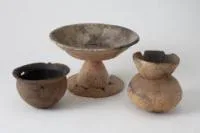
Haniwa excavated from Kofun-period tombs in Toyama City. Source: Toyama City Buried Cultural Property Center
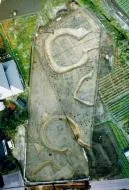
An aerial view of Zenjizawa Kofun, one example of the distribution of Kofun-period tombs in Toyama City. Source: Toyama City Buried Cultural Property Center
Kanazawa: The Kamiyachi Kofun Cluster
The Kamiyachi Kofun Cluster (Kanazawa City) includes an early zenpō-kōen-fun in northern Kaga, with grave goods such as bronze mirrors, iron swords, iron axes, iron arrowheads, and beads29. These materials are standard equipment in the wider Kofun culture and show that the local elite adopted burial customs and grave-good combinations shared with the Yamato court sphere.
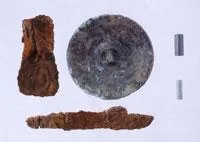
Bronze mirrors and iron weapons excavated from the Kamiyachi Kofun Cluster. Source: Kanazawa City Board of Education
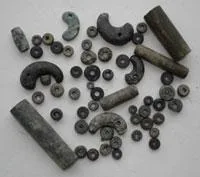
Magatama, tubular beads, and small beads excavated from the Uneda Teranaka Site. These were status markers in the Kofun Period. Source: Kanazawa City Board of Education
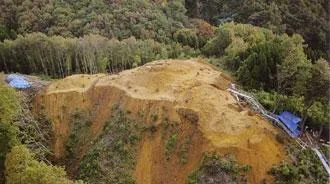
Overall view of the Kamiyachi Kofun Cluster. The tombs are distributed continuously along a hill ridge. Source: Kanazawa City Board of Education
Komatsu and southern Kaga: Haniwa and stone chambers with Korean Peninsula roots
The Yatano Ejiri Kofun (Komatsu City) yielded haniwa that are recognized as some of the earliest on the Japan Sea side30, making them important for chronology in the distribution history of haniwa ritual networks.
The horizontal stone chamber in Tomb No. 12 of the Kawadayama Kofun Cluster uses an arched cut-stone masonry structure. Komatsu City’s explanation suggests that this form may have been modeled on royal tombs on the Korean Peninsula; the Japan Heritage story Shards and Jewels Walking Together further points to similarities with Baekje royal tombs, suggesting a direct connection with the continent31.
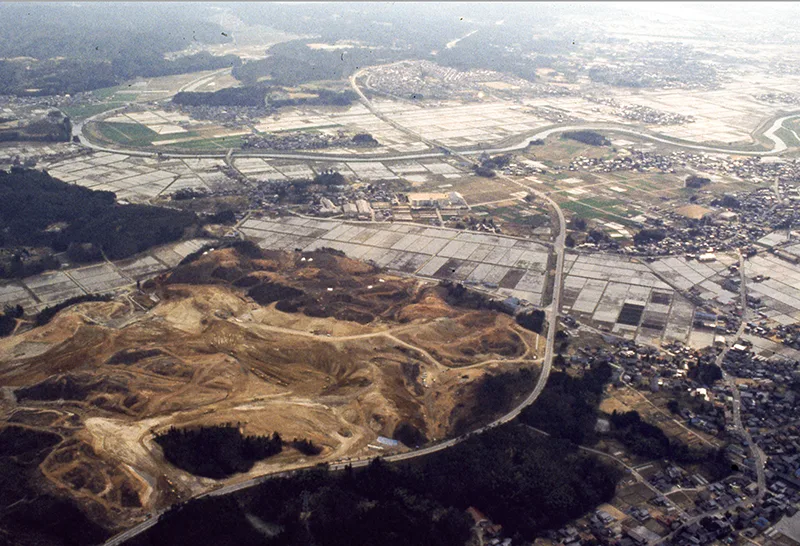
An aerial view of the Kawadayama Kofun Cluster. The tombs are densely distributed on the hills. Source: Komatsu City
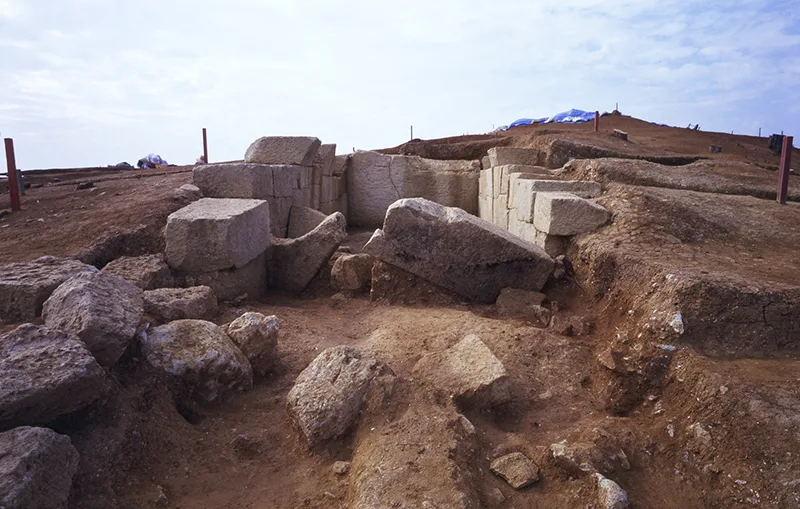
The arched ceiling of the stone chamber in Tomb No. 12. Research suggests similarities to Baekje royal tombs. Source: Komatsu City
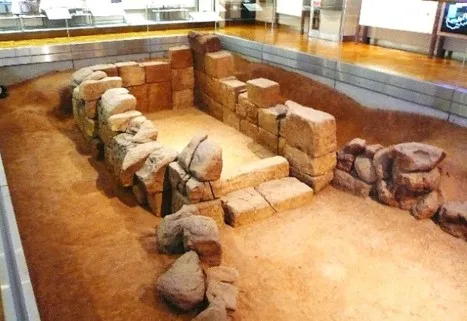
The stone chamber of the Kawadayama Kofun Cluster, included in the Japan Heritage story “Shards and Jewels Walking Together.” Source: Japan Heritage portal, Agency for Cultural Affairs
Nearby Nomi City preserves the Nomi Kofun Cluster (62 tombs), and Tumulus No. 1 of the Akitsuneyama cluster is regarded as one of the largest zenpō-kōen-fun in Hokuriku.
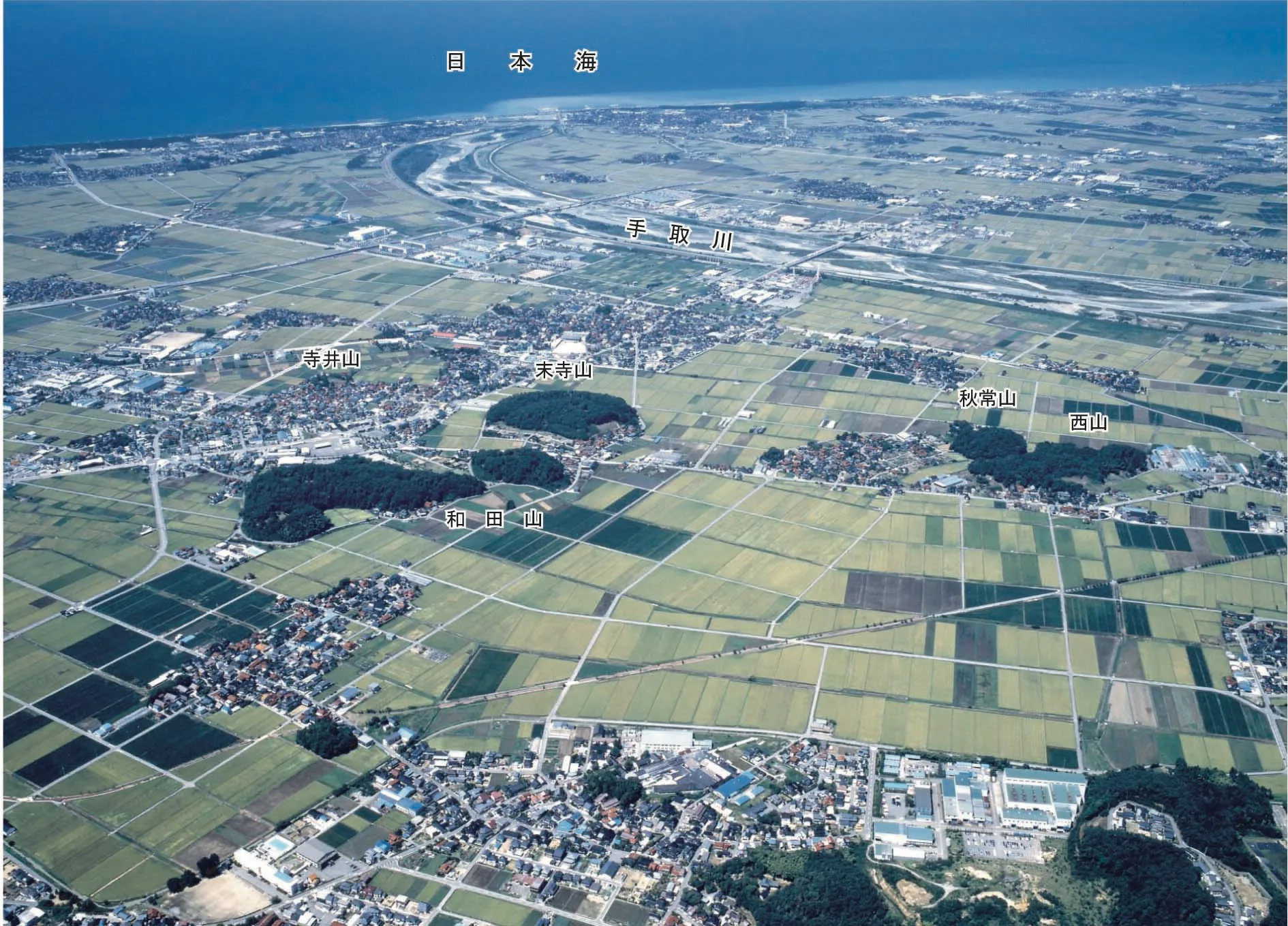
An aerial view of the Nomi Kofun Cluster. Sixty-two tombs are distributed across independent hills. Source: Nomi City
The Iwade horizontal tombs in Kanazawa and ancient DNA
In 2021, Science Advances published “Ancient genomics reveals tripartite origins of Japanese populations,” which analyzed samples including those from the Iwade horizontal tombs in Kanazawa City and showed that new East Asian ancestry flowed in during the Kofun Period. The study supports the tripartite ancestry model for modern Japanese populations: Jomon, Yayoi immigrants, and Kofun-period immigrants32.
The 570 shipwreck of a Goguryeo mission
In 570, a diplomatic mission from Goguryeo to Wa (the Yamato court) was caught in a storm at sea and drifted onto the coast of Koshi. The original text in Nihon Shoki for the 31st year of Emperor Kinmei simply says “arrived at the coast of Koshi,” so the exact location is unknown. Later discussions have usually placed the event in Kaga, Enuma, or Nomi contexts, because the local official who reported it, Enu no Omi Sodeshiro, and the local magnate Michi no Kimi who was involved in the incident, were both connected with this area33.
Michi no Kimi falsely presented himself as a king and took the mission’s tribute goods; the Yamato court later investigated the matter. A Korean study argues that this may reflect Goguryeo’s attempt in the 570s to use a “Tōkai-Koshi-Yamato” route for diplomatic contact with Wa34. This is an early record of the present-day Ishikawa area in the context of diplomacy across the Sea of Japan. The Heian note covers the founding of Kaga Province in 823, when the power of the Michi no Kimi who served as district chiefs of Kaga was reduced; the sources cited here do not say whether they descended from the Michi no Kimi of 570.
Hokuriku after the end of the Kofun period continues in the Asuka note.
6. Places to visit today
| City | Facility | Main period | Notes |
|---|---|---|---|
| Kanazawa | Kanazawa City Buried Cultural Property Center / Kanazawa Jomon World | Jomon, Yayoi | Chikamori post bases, Nakaya Sawa lacquerware35 |
| Toyama | Kitadai Jomon Hiroba | Jomon | Large Middle Jomon settlement with reconstructed buildings36 |
| Toyama | Toyama Folk and Folkcraft Village Archaeological Museum | Jomon | Archaeological materials excavated in Toyama City, including shakoki-dogu-related exhibits37 |
| Toyama | Otsuka-Senbozan Site Cluster | Final Yayoi to early Kofun | Material evidence for the process of chiefdom formation38 |
| Komatsu | Kaga Kokufu Story House / Kawadayama Kofun Park | Yayoi, Kofun, ritsuryō | Exhibits from the Yayoi to ritsuryō periods, including a kofun stone chamber39 |
| Komatsu City area | Yokaichi-jikata Site (east of Komatsu Station) | Middle Yayoi | The largest moated settlement site in Hokuriku40 |
| Nomi (near Komatsu) | Nomi Furusato Museum / Nomi Kofun Cluster | Kofun Period | Kofun cluster in southern Kaga, including the largest zenpō-kōen-fun in Hokuriku41 |
Each facility has regular closing days or winter shutdown periods, so please check the opening information before you go.
References
Note: This article is translated from Traditional Chinese.
Footnotes
-
Kanazawa City Library Reference Database, “On the Origin of Kanazawa”: https://crd.ndl.go.jp/reference/entry/index.php?id=1000225450&page=ref_view ↩
-
Kotobank / Nihon Rekishi Chimei Taikei, “Toyama-gō”: https://kotobank.jp/word/%E5%AF%8C%E5%B1%B1%E9%83%B7-3051546 ; Japan Search, “Yoshimi Akiyori donation document”: https://jpsearch.go.jp/item/tpada_kenmei-0000047678 ↩
-
Kotobank / Nihon Rekishi Chimei Taikei, “Komatsu Castle Ruins”: https://kotobank.jp/word/%E5%B0%8F%E6%9D%BE%E5%9F%8E%E8%B7%A1-3027799 ↩
-
Historist, “Kaga Province”: https://www.historist.jp/word_j_ka/entry/049022/ ; Kotobank, “Kaga Province”: https://kotobank.jp/word/%E5%8A%A0%E8%B3%80%E5%9B%BD-43381 ↩
-
Toyama City Buried Cultural Property Center, “The Paleolithic Period”: https://www.city.toyama.toyama.jp/etc/maibun/center/rekishi/kyusekki/kyusekki.htm ↩
-
National Cultural Properties Survey, “Tateyama Uenoyama Site”: https://sitereports.nabunken.go.jp/cultural-property/428260 ; “Yoshihara Nanatsuzuka Site”: https://sitereports.nabunken.go.jp/cultural-property/133685 ↩
-
Komatsu City, “Kawadayama Kofun Cluster (Paleolithic to Jomon Periods)”: https://www.city.komatsu.lg.jp/soshiki/1052/kokabetsurekishijiman/kkf_k/kdy_t.html ; “List of sites in the Kokufu school district”: https://www.city.komatsu.lg.jp/soshiki/1052/kokabetsurekishijiman/kkf_k/index.html ↩
-
Toyama Prefecture, “The Paleolithic Period”: https://www.pref.toyama.jp/3009/miryokukankou/bunka/bunkazai/digital/02-gallery_009/02-gallery_009_3.html ↩
-
Kanazawa City, “Chikamori Site”: https://www4.city.kanazawa.lg.jp/soshikikarasagasu/bunkazaihogoka/gyomuannai/3/1/1/siteibunkazai/5/5837.html ; “Jomon-period Sites”: https://www4.city.kanazawa.lg.jp/soshikikarasagasu/bunkazaihogoka/gyomuannai/3/1/3/9174.html ↩ ↩2
-
Toyama City, “Kitadai Jomon Hiroba”: https://www.city.toyama.lg.jp/bunka/bunka/1010546/1007511.html ↩
-
National Museum of Nature and Science, “A Large Early Jomon Site Discovered in Hokuriku”: https://www.kahaku.go.jp/pickup-science/nid00000967.html ↩
-
Toyama City Buried Cultural Property Center, “Shakoki-dogu excavated from Toyama City”: https://www.city.toyama.toyama.jp/etc/maibun/center/now/syakou/syakou.htm ↩
-
Toyama Folk and Folkcraft Village Archaeological Museum, “Special Exhibition: Toyama’s Jomon Kingdom”: https://www.city.toyama.toyama.jp/etc/minzokumingei/tenji_kouko290825.html ↩
-
Komatsu City, “Otaniyama Shell Mound”: https://www.city.komatsu.lg.jp/soshiki/1052/kokabetsurekishijiman/aw_k/oty.html ↩
-
Komatsu City, “Rokkyo Site”: https://www.city.komatsu.lg.jp/soshiki/1052/kokabetsurekishijiman/stm_k/rk.html ↩
-
Komatsu City, “Jomon pottery excavated at the Nenbutsubayashi Site (observations)”: https://www.city.komatsu.lg.jp/soshiki/1052/shozoushiryou/nenbutsu/topic.html ; Kanazawa City, “Kofu-style pottery”: https://www4.city.kanazawa.lg.jp/soshikikarasagasu/bunkazaihogoka/gyomuannai/3/1/1/siteibunkazai/5/5821.html ↩
-
University of Tokyo 2024 press release, “Whole-genome analysis of the Doigahama Yayoi human remains”: https://www.s.u-tokyo.ac.jp/ja/press/10527/ ; Scientific Reports 2019 (Jomon/Yayoi admixture model): https://www.nature.com/articles/s41598-019-44473-z ↩
-
National Museum of Japanese History, “What is Yayoi?!” https://archive.rekihaku.ac.jp/exhibitions/project/old/140715/index.html ; Shin-ichiro Fujio, “The outline of Yayoi culture”: https://cir.nii.ac.jp/crid/1390009224089252992 ↩
-
Komatsu City, “Yokaichi-jikata Site”: https://www.city.komatsu.lg.jp/soshiki/1052/kokabetsurekishijiman/rojo_koka/ykj.html ; “Important Cultural Property: Artifacts from the Yokaichi-jikata Site”: https://www.city.komatsu.lg.jp/soshiki/1052/shozoushiryou/4281.html ↩
-
Ishikawa Prefecture, “Artifacts from the Yokaichi-jikata Site”: https://www.pref.ishikawa.lg.jp/kyoiku/bunkazai/kouko/k-7.html ; Komatsu Tourism Navi, “Yokaichi-jikata Site and craftsmanship”: https://www.komatsuguide.jp/feature/detail_16.html ↩
-
Komatsu City Buried Cultural Property Center, “Dogu excavated from the Yokaichi-jikata Site”: https://www.city.komatsu.lg.jp/soshiki/1052/shozoushiryou/yokaichi_ibutsu/4/774.html ↩
-
Ishikawa Prefecture, “Artifacts from the Sainen and Minamishimbo Site”: https://www.pref.ishikawa.lg.jp/kyoiku/bunkazai/kouko/k-18.html ↩
-
Toyama City Buried Cultural Property Center, “The Yayoi Period”: https://www.city.toyama.toyama.jp/etc/maibun/center/rekishi/yayoi/yayoi.htm ↩
-
Toyama City, “Overview of the Otsuka-Senbozan Site Cluster”: https://www.city.toyama.toyama.jp/etc/maibun/ouduka-sennbouyama/gaiyou/gaiyou.htm ↩
-
Kotobank, “Yamataikoku”: https://kotobank.jp/word/%E9%82%AA%E9%A6%AC%E5%8F%B0%E5%9B%BD-144146 ↩
-
Mozu-Furuichi Kofun Group, “What is a kofun?”: https://www.mozu-furuichi.jp/jp/learn/about.html ; CiNii/KAKEN, “Political history of the Kofun Period based on chronology and distribution of zenpō-kōen-fun”: https://cir.nii.ac.jp/crid/1040282257326646272 ↩
-
Tottori Prefecture, “What is the Kofun Period?”: https://www.pref.tottori.lg.jp/322577.htm ↩
-
Toyama City, “Overview of the Kofun Period”: https://www.city.toyama.toyama.jp/etc/maibun/center/rekishi/kofun/kofun.htm ; National Cultural Properties Survey, “Otsuka Kofun”: https://sitereports.nabunken.go.jp/cultural-property/267931 ; “Chokushizuka Kofun”: https://sitereports.nabunken.go.jp/cultural-property/131303 ↩
-
Kanazawa City, “Sites from the Kofun Period”: https://www4.city.kanazawa.lg.jp/bunka_sports_kanko/rekishi_bunkazai/6/4/18123.html ; Kamiyachi Kofun Cluster C-subgroup report: https://sitereports.nabunken.go.jp/79860 ↩
-
Ishikawa Prefecture, “Haniwa from the Yatano Ejiri Kofun”: https://www.pref.ishikawa.lg.jp/kyoiku/bunkazai/kouko/k-2.html ↩
-
Komatsu City, “Kawadayama Kofun Cluster”: https://www.city.komatsu.lg.jp/soshiki/1052/kokabetsurekishijiman/kkf_k/kdy_t.html ; Japan Heritage “Shards and Jewels Walking Together”: https://japan-heritage.bunka.go.jp/ja/stories/story027/ ↩
-
Science Advances 2021, “Ancient genomics reveals tripartite origins of Japanese populations”: https://pmc.ncbi.nlm.nih.gov/articles/PMC8448447/ ; Kanazawa University press release: https://www.kanazawa-u.ac.jp/latest-research/97449 ↩
-
Nihon Shoki, entry for the 31st year of Emperor Kinmei: https://nihonsinwa.com/page/1716.html ; Ishikawa Prefectural Library SHOSHO, “Michi no Kimi”: https://www.library.pref.ishikawa.lg.jp/shosho/furucolle/list/prsn15445 ↩
-
Article, “The meaning of Goguryeo’s diplomatic contacts with Wa in the 570s”: https://www.kci.go.kr/kciportal/ci/sereArticleSearch/ciSereArtiView.kci?sereArticleSearchBean.artiId=ART001960716 ↩
-
Kanazawa City, “Guide to using Kanazawa Jomon World”: https://www4.city.kanazawa.lg.jp/bunka_sports_kanko/rekishi_bunkazai/6/4/18152.html ↩
-
Toyama City, “Kitadai Jomon Hiroba”: https://www.city.toyama.lg.jp/bunka/bunka/1010546/1007511.html ↩
-
Toyama Folk and Folkcraft Village, “Archaeological Museum”: https://www.city.toyama.toyama.jp/etc/minzokumingei/kouko/kouko.html ↩
-
Toyama City, “Otsuka-Senbozan Site Cluster”: https://www.city.toyama.toyama.jp/etc/maibun/ouduka-sennbouyama/gaiyou/gaiyou.htm ↩
-
Komatsu City, “Kaga Kokufu Story House”: https://www.city.komatsu.lg.jp/soshiki/1052/2300.html ↩
-
Komatsu City, “Yokaichi-jikata Site”: https://www.city.komatsu.lg.jp/soshiki/1052/kokabetsurekishijiman/rojo_koka/ykj.html ↩
-
Nomi City, “Nomi Kofun Cluster”: https://www.city.nomi.lg.jp/docs/829.html ↩