This note follows ten earlier ones on Hokuriku, from prehistory to the Meiji era, and covers the Taishō era (1912–1926). To explain what happened to the Maeda family after the domains were abolished, that section starts in early Meiji, and it follows the Komaba residence and the Kaetsunō Collection to 1930 and 1948. The later lives of Qiu Niantai, Hatta Yoichi, and others get one sentence each. The focus is Kanazawa, Toyama, and Komatsu, with Uozu, Namerikawa, Takaoka, Himi, and Nanao as well.
The Taishō era lasted a little over fourteen years. The rice riots of 1918 broke out one after another along the Toyama coast at Uozu, Namerikawa, and elsewhere, and more than 3,000 people gathered in Kanazawa. Kanazawa got city trams, permanent cinemas, kafē, and its first department store, and Saigawa Bridge, Asanogawa Bridge, and the prefectural office building were completed in the later Taishō years and still stand in the city. The 9th Division went to Siberia, the universal suffrage movement held rallies and marches in Kanazawa, and Komatsu Seisakusho was founded in Komatsu.
1. The Taishō Era and Hokuriku
The Meiji Emperor died on 30 July 1912, and the era name changed to Taishō the same day1. The Taishō Emperor died on 25 December 1926, and the era name changed to Shōwa2.
Two transport events mark the start of the era in Hokuriku. In April 1913 the Hokuriku Main Line opened along its whole length from Maibara to Naoetsu, and in September the Toyama Electric Tramway (the Toyama city line) opened, the first street tramway on the Sea of Japan side. Its opening was timed for the joint exhibition of one fu and eight prefectures (ippu hakken rengō kyōshinkai)3.
2. The Rice Riots of 1918
Uozu and Namerikawa
Source: Wikimedia Commons (public domain, resized and converted to WebP)
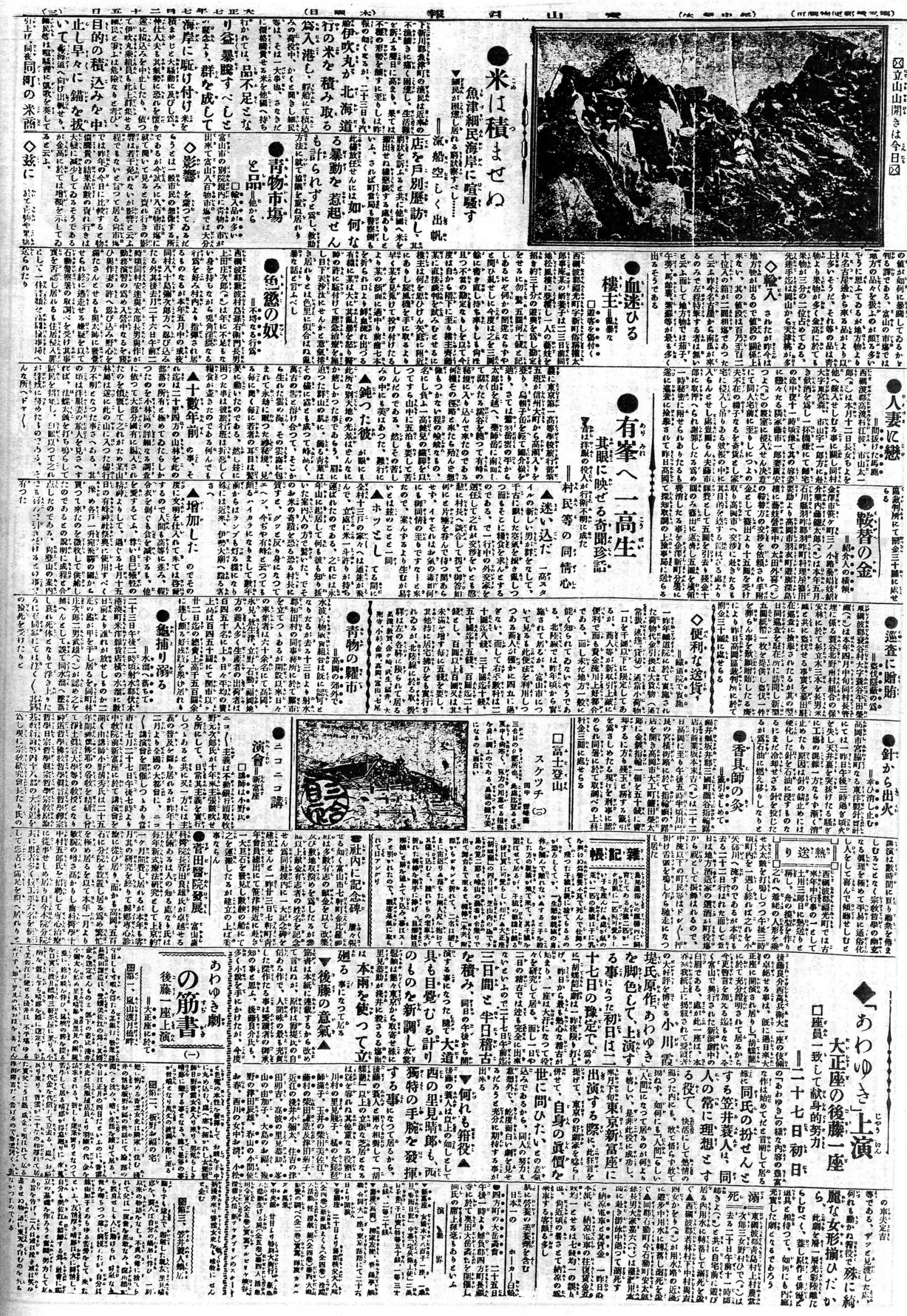
At about 8 a.m. on 23 July 1918, women in Uozu who saw dockworkers loading rice onto a ship gathered one after another; about 60 of them held on to the workers and the rice bales to stop the shipment. After 9 a.m. nearly 50 women argued with dockworkers in front of the Twelfth Bank’s warehouse4. The Toyama Nippō reported the Uozu events prominently on 24 and 25 July. The Takaoka Shinpō reported riots in Namerikawa and Mizuhashi on 7 August and was banned from sale the same day4.
The Uozu Board of Education booklet says that in official and police records and newspapers the Uozu events of 23 July are the earliest, which is why Uozu is called the “birthplace of the rice riots”. The same booklet’s chronology also lists testimony that there was activity in Higashi-Mizuhashi in late June or early July4. The riots then spread across the prefecture, and on 6 August a disturbance of about 2,000 people broke out in Namerikawa4.
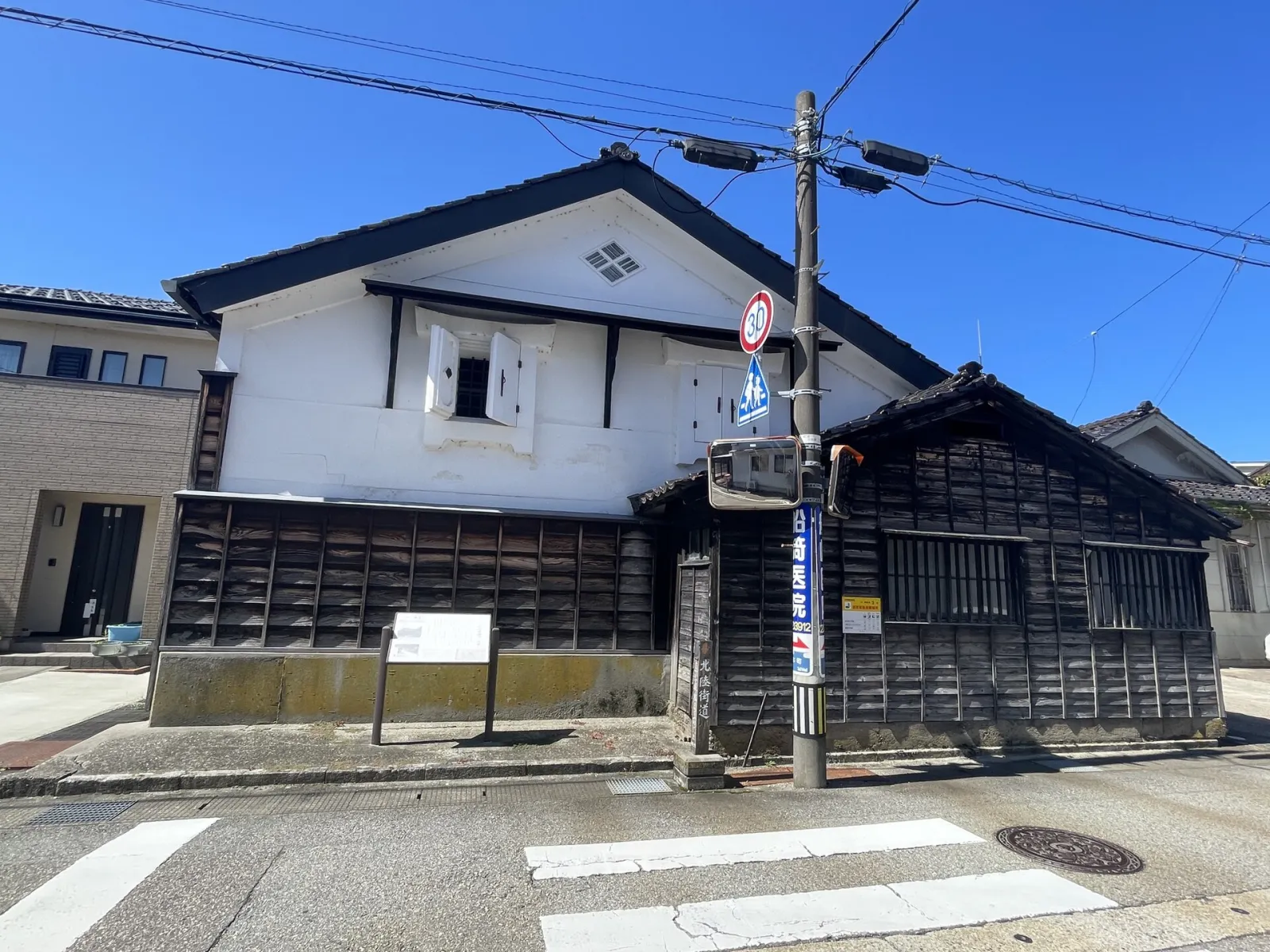
Photo: Ujigis, licence: CC BY-SA 4.0, resized and converted to WebP. Source: Wikimedia Commons
The Twelfth Bank warehouse still stands as the “former Twelfth Bank Uozu branch office and rice warehouse”, and the interior can be visited with a guide by advance booking5.
Kanazawa
On the evening of 12 August, more than 3,000 residents from the Utatsu and Daishumen areas gathered at Udasu Shrine in Yawatamachi, then went to the governor’s residence, the mayor’s house, and more than 20 houses of wealthy families and rice dealers, demanding that white rice be sold at 25 sen per shō1. The city bought domestic rice with donations from wealthy residents and from the 16th sold it at 10 sen below the average price. In two days 13,248 people collected the city’s discount ration books; on the first day, the 16th, 8,049 people bought rice at 28 sen per shō, limited to 3 shō each1.
On 20 August the Maeda family gave 20,000 yen to the city of Kanazawa and 10,000 yen each to Ishikawa Prefecture, Toyama Prefecture, and Tokyo Prefecture, and the city used the money to buy rice1. On the same day the Maeda family also gave 200,000 yen toward founding the Kanazawa Higher Technical School, which was a separate donation1.
That summer’s national middle-school baseball tournament was cancelled because of the rice riots, after the regional representatives had been decided6.
3. The Maeda Family after the Domains
The Meiji note covered the abolition of the domains in 1871 but not what became of the Maeda family, the lords of Kaga.
The last lord, Maeda Yoshiyasu (1830–1874), succeeded as head of the family in 1866 and became governor of Kanazawa Domain after the return of the domain registers7. He died in Atami in 1874. Near the entrance of Zenigo Park in Kanaiwa stands a memorial stone to him, built by the domain’s boatmen foot soldiers whom he had treated kindly; it originally stood in Kanaiwa Ofunemachi8.
His eldest son Toshitsugu (1858–1900) succeeded in 1874 as the 15th head of the Maeda family, became a marquis in July 1884, and sat in the House of Peers from 18909. In 1883 he set up the Maeda family’s compilation office, which copied and collected records of the former domain government, former retainers, and the former domain lands10.
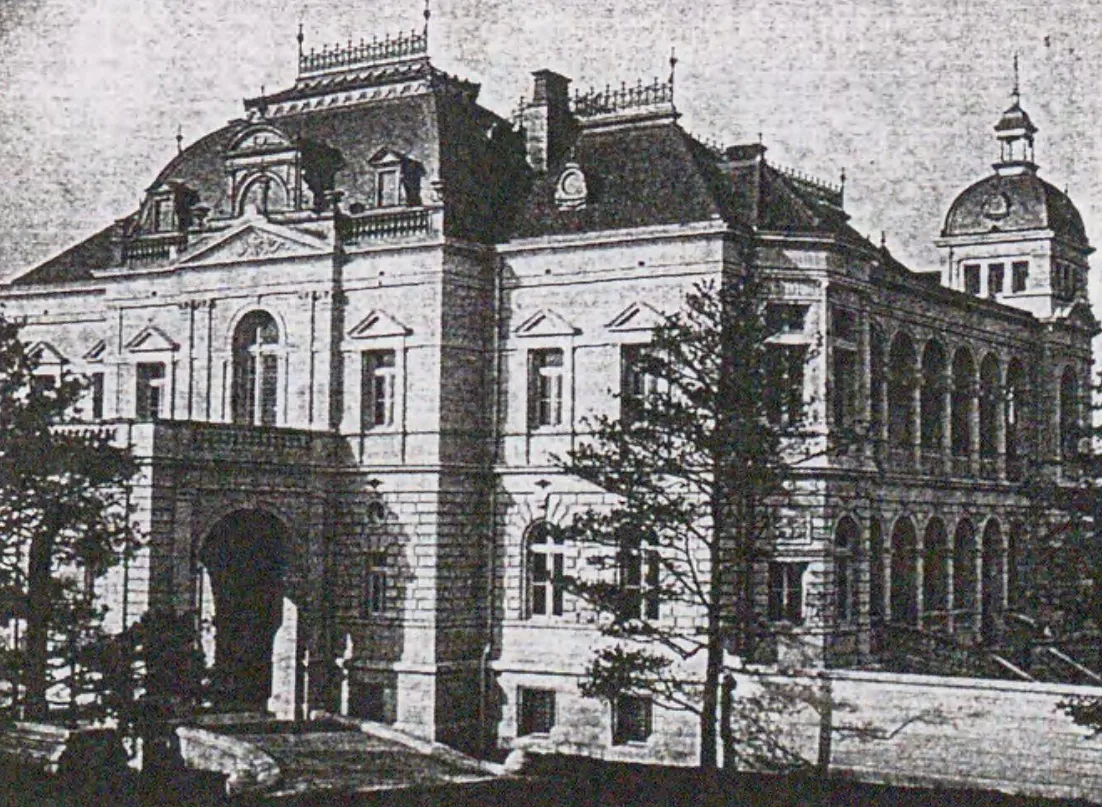
Source: Wikimedia Commons (public domain, converted to WebP)
The 16th head, Toshinari (1885–1942), was the fifth son of Toshiaki, 12th lord of the former Nanokaichi Domain. He became Toshitsugu’s adopted son in 1900 and succeeded after Toshitsugu’s death11. The family then lived in Hongō, Tokyo, where the Kaga Domain’s main Edo residence had been. Toshinari carried on Toshitsugu’s plan to rebuild the Hongō residence: the Japanese-style house was finished first and the Western-style house in December 190711. On 8 July 1910 the Meiji Emperor visited the residence12.
After the Great Kantō Earthquake, Tokyo Imperial University wanted to expand its Hongō campus, so the Maeda Hongō residence was exchanged for the Faculty of Agriculture’s land at Komaba, and in 1926 the Hongō site became university land13. The family built a new main residence at Komaba; the Western-style house was completed in 1929 and the Japanese-style house in 193014. In the same year, 1926, Toshinari founded the Ikutoku Foundation, today the Maeda Ikutokukai15.
The records gathered by Toshitsugu’s compilation office were later kept by the Maeda Ikutokukai and given to the city of Kanazawa in 1948 as the Kaetsunō Collection: 34,405 items, now at the Kanazawa City Tamagawa Library10.
4. The Army, Universal Suffrage, and Labour
The 9th Division
From March 1914 the 9th Division sailed from Nanao to garrison Korea, and it began returning to Kanazawa in May 19162.
In the Nikolayevsk Incident of March to May 1920, 378 Japanese soldiers and sailors and about 350 Japanese residents were killed; the residents included the vice-consul Ishida Toramatsu, from Komatsu2. On 31 March 1921 the 9th Division (commander Lieutenant General Matsuura Kan’i) received orders to go to Siberia216. From 8 April, with the 7th Infantry Regiment first, its units sailed from Nanao, landed at Vladivostok between 11 April and 7 May, and took over garrison duties from the 11th Division216. All units withdrew by 18 September 1922, and the division headquarters returned to Kanazawa on 8 October; the Kanazawa city chronology gives the division’s war dead as 108162. On 25 August, before the withdrawal, a commemorative photo album of the 9th Division’s Siberian expedition was issued to the troops16.
After the Great Kantō Earthquake of 1923, the 7th and 35th Infantry Regiments and other units of the 9th Division were sent to Tokyo and Kanagawa. In the Ugaki arms reduction of 1925 the 35th Infantry Regiment and other units were abolished17.
Universal suffrage and the labour movement
In the general election of April 1917, Nagai Ryūtarō, a professor at Waseda University, lost in the Kanazawa city constituency to Nakahashi Tokugorō by 1,116 votes to 1,319. He then held a thank-you meeting in Kenroku-en and said “I came, I saw, I was defeated” (kitari, mitari, yaburetari)2. In the election of May 1920 he won the Kanazawa city seat with 3,305 votes2.
On 1 July 1920 the Kanazawa branch of the Greater Japan General Federation of Labour (Yūaikai) held a rally on open ground at Takaokamachi; about 2,000 people attended and the president, Suzuki Bunji, spoke2. On 5 February 1922 the Ishikawa League for Immediate Universal Suffrage held a rally on the same ground, followed by a march with banners2. In 1925, after the universal suffrage bill passed the Diet, about 3,000 people gathered for a celebration at the former Hasegawa residence site in Kenroku-en on 3 April2. The General Election Law was promulgated on 5 May, removing the tax qualification and giving the vote to all men aged 25 and over18. The first general election under the new law was held on 20 February 1928, in the Shōwa era19.
On 5 July 1924 Kanazawa opened its first municipal day nursery in the Nishi Betsuin temple in Gohōmachi, with 50 children and 2 nursery teachers20.
5. Industry and Overseas Markets
Source: Wikimedia Commons (public domain, converted to WebP)
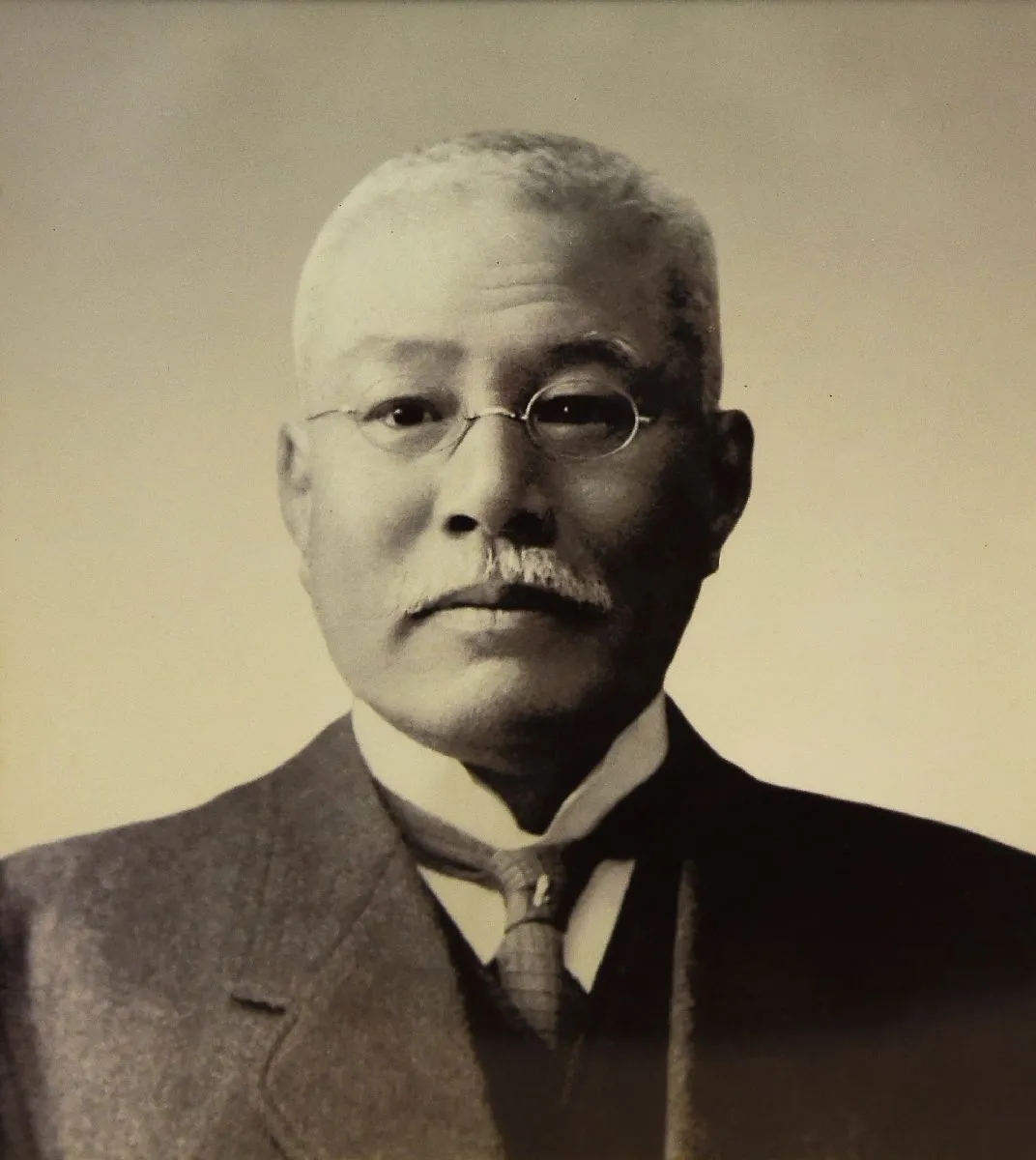
To make mining machinery for the Yūsenji copper mine, Takeuchi Meitarō founded the Komatsu Ironworks in 1917. In 1921, foreseeing the mine’s closure, he separated the ironworks and founded Komatsu Seisakusho Co., Ltd., today’s Komatsu21.
Source: Wikimedia Commons (public domain, converted to WebP)
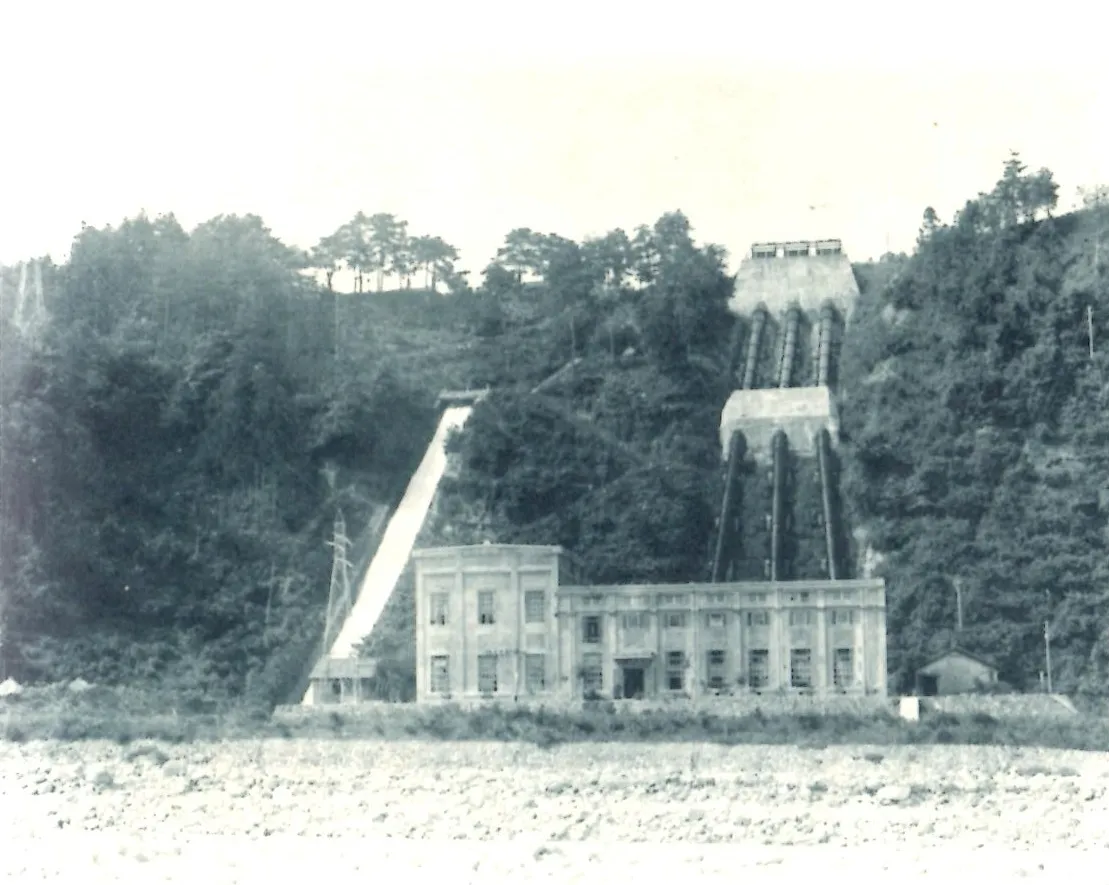
Kamidaki power station, part of Toyama Prefecture’s prefectural electricity business, was completed in 1924 on the left bank of the Jōganji River. It is a two-storey reinforced concrete building, registered as a Tangible Cultural Property in 2001, and owned by Hokuriku Electric Power22. In the same year the Nanbu foundry in Takaoka built a new cupola furnace that used a blower to supply air, which was preheated by the exhaust gases from melting metal; the cupola and chimney are registered Tangible Cultural Properties23.
Toyama’s medicine sellers were looking abroad in these years. On 12 December 1918 the Toyama Nippō listed the prefecture’s overseas medicine exporters and added that many others shipped medicine to Korea and Taiwan; annual production of export medicine was about 700,000 yen, of which Toyama city accounted for 580,000 yen24. In January 1919 the prefecture held a third conference on promoting overseas medicine exports and decided to set up a special committee24.
6. Schools and Literature
Schools
For its 30th anniversary in October 1917, the Fourth Higher School used donations and other funds to build the Museidō, a hall for judo, kendo, and archery, which has since been moved to the Meiji Mura museum25. The Kanazawa Higher Technical School opened in April 1921 with departments of civil engineering, mechanical engineering, and applied chemistry2, and in April 1923 the Kanazawa Medical College was raised to the Kanazawa Medical University20.
Murō Saisei, Takehisa Yumeji, Shimada Seijirō
Source: Wikimedia Commons (public domain, converted to WebP)
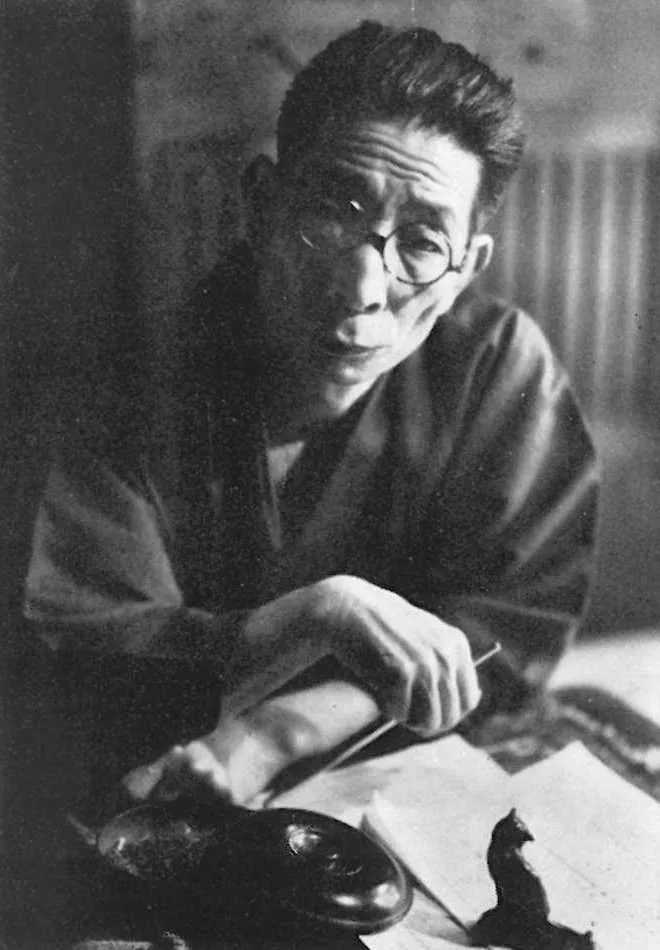
The Kanazawa-born poet Murō Saisei published Ai no shishū and Jojō shōkyokushū with the Kanjō Shisha in 1918, Daini ai no shishū with Bunbudō Shoten in 1919, and his short-story collection Sei ni mezameru koro with Shinchōsha in 192026. The Murō Saisei Memorial Museum opened in 2002 on the site of his birthplace in Sennichimachi, Kanazawa; nearby are the Uhōin temple where he grew up and the “Saisei no michi” path with a poem monument27.
Takehisa Yumeji and Kasai Hikono travelled through Hokuriku and Kaga for 66 days from August to October 1917, ending with about three weeks at Yuwaku hot spring outside Kanazawa. The stay is recorded in the 13 poems of “Satoi” in the illustrated poetry collection Yama e yosuru, published in February 1919, and there is a monument with one of Yumeji’s poems in the grounds of the Yakushi temple at Yuwaku28.
Shimada Seijirō was born in 1899 in Mikawa (now part of Hakusan) and moved to Kanazawa with his mother at the age of five29. In June 1919 he published Part 1 of his first novel, Chijō (“Chi ni hisomu mono”), with Shinchōsha on the recommendation of Ikuta Chōkō; the Kanazawa city chronology says it quickly became a bestseller. On 5 July acquaintances held a “Chijō party” for him at the Kikantei in Kenroku-en20. The Nishi Chaya Museum in Nomachi, Kanazawa, recreates the exterior of a teahouse and mainly displays material on Shimada Seijirō30.
7. City Life
Trams, cinemas, kafē, and a department store
The tram between Kanazawa and Kanaiwa opened in August 191420. On 1 February 1919 the Kanazawa city tram partly opened, with invited guests riding that day and regular service from the 2nd, running from Kanazawa Station via Owarichō to Kami-Kurumimachi20.
As early as 1912 some in Kanazawa argued that, because films and novels like Zigomar with a villain hero were popular with children, young people should be restricted from seeing films or borrowing such books at libraries20. In October 1913 the Kikusui Club in Kōrinbō began twice-daily screenings, the forerunner of permanent cinemas in Kanazawa; in 1914 came the Sumeru-kan in Kōrinbō and the Second Kikusui Club in Owarichō, and in 1921 the Daikatsu Club31. In Sōgawa, Toyama, the Teikokuza became a cinema on 1 June 1917, burned down in April 1924, and reopened as the Teikokukan after rebuilding in December32.
Kanazawa’s first kafē was the Kafē Burajiru, but there are two dates for its opening: the History of Kanazawa City (narrative vol. 3) says it opened in Kōrinbō in 1917, while A Hundred Years of Kanazawa says it opened in Ishiuramachi on 3 November 191933. On 1 November 1923 the Miyaichi Western goods store in Katamachi was rebuilt as the Miyaichi Department Store, Kanazawa’s first department store20. In July that year three municipal public markets opened at Kōrinbō, Asanogawa, and Tomoemachi20.
In autumn 1918 the Spanish flu reached Kanazawa and several classes at each of the Koshōmachi, Ishibikimachi, Moriyamachō, and Matsugaechō primary schools were suspended for a week. By mid-November 12,183 of the city’s more than 15,300 primary school children were absent with the flu1.
Parks and an amusement park
Utatsuyama Park opened in February 191434. On 16 April 1923 Honda Seiroku, chairman of the Japan Garden Society, inspected Utatsuyama at the invitation of the city; the next day he lectured on his design plans, and a newspaper reported his idea of a European- and American-style forest park under the headline “Make Utatsuyama a great park of the realm”35.
Source: Wikimedia Commons (public domain, converted to WebP)
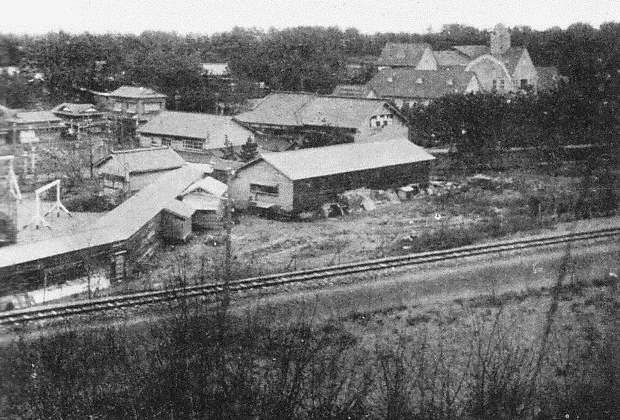
Hirasawa Katarō, a timber merchant in front of Kanazawa Station, was influenced by Kobayashi Ichizō, founder of Hankyū. In May 1925 he opened the first section of the Asanogawa Electric Railway, on 19 July opened the Awagasaki Yūen amusement park in Uchinada, and in September added the “Kodomo no Kuni” children’s area with a slide about 60 metres long36.
Schoolgirls and missionaries
Among Kanazawa schoolgirls the sokuhatsu hairstyle was popular from about 1900 to the mid-Taishō years. In 1922 Hokuriku Girls’ School became the first in the prefecture to adopt the sailor-suit uniform, and after that the sokuhatsu gradually disappeared37. Kanazawa Second Girls’ High School held its first hiking trip to Mount Kuragatake in 1917, with students walking for more than 12 hours in kimono, hakama, and wooden clogs; from 1920 it also held skiing practice on the school slope and at Daijōjiyama38.
Canadian women missionaries began work in Kanazawa in 1916, and in 1926 women evangelists of the United Church of Canada founded the “Jūyonban Kindergarten”, today’s Seisen Kindergarten39.
8. Taishō Buildings
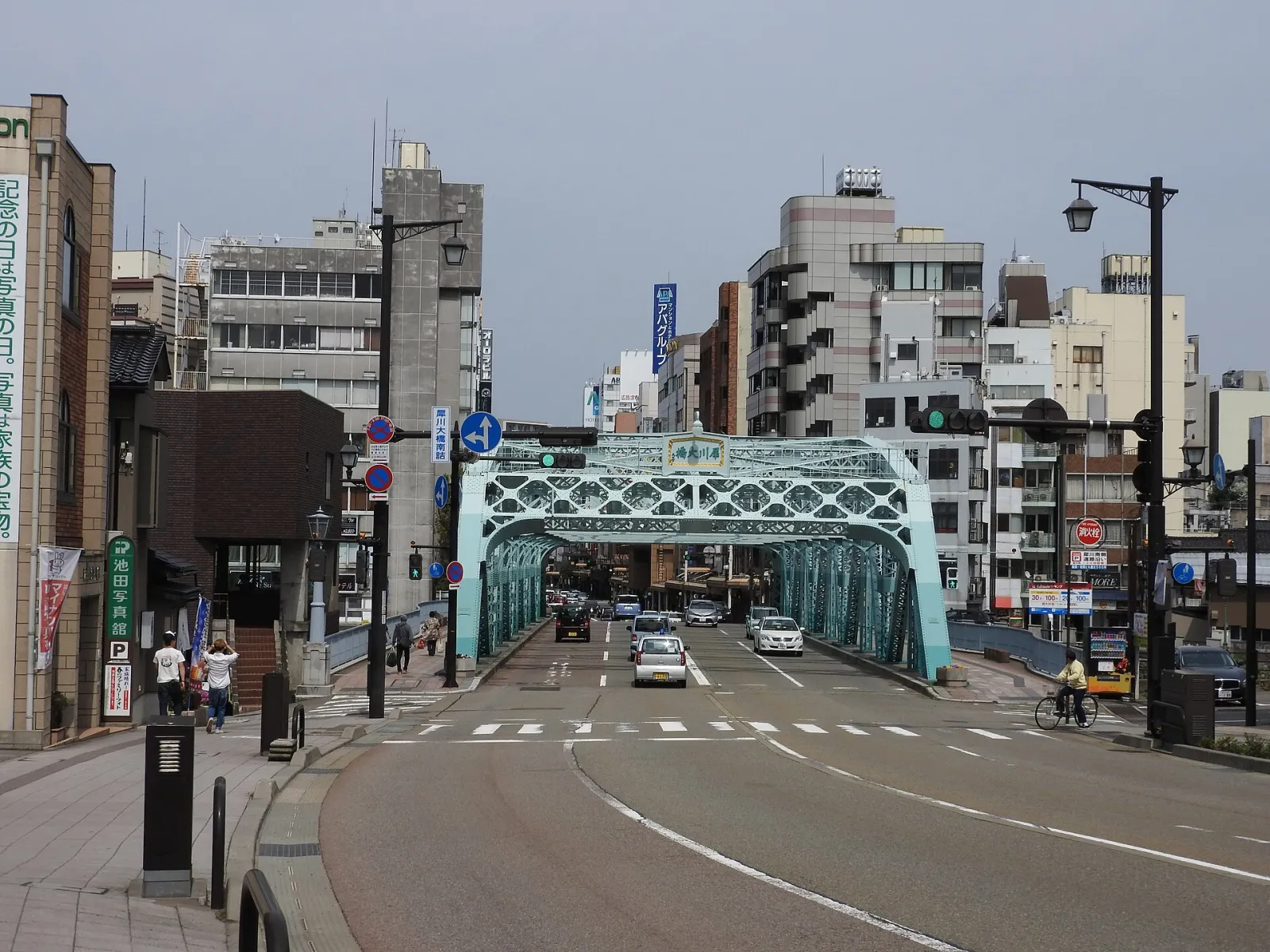
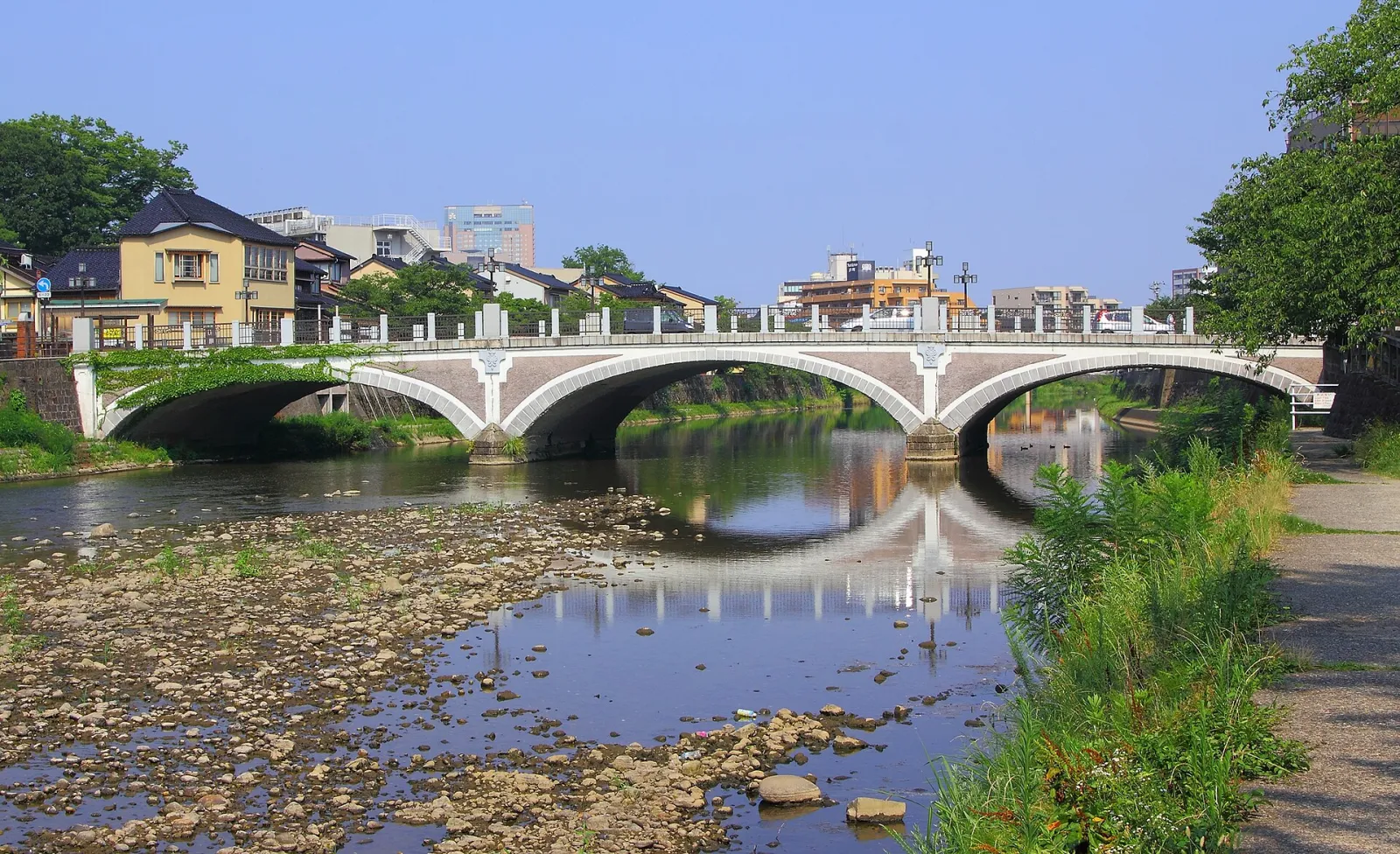
Both of Kanazawa’s main bridges were rebuilt in the Taishō era. Saigawa Bridge became a reinforced concrete bridge in 1919 but collapsed in a cloudburst in August 1922; the present Warren truss steel bridge, designed by Sekiba Shigeki, was completed in 192440. Asanogawa Bridge is a three-span continuous reinforced concrete arch bridge completed in December 192241. The tram’s Ōhi line opened before the bridge was finished, so two cars were taken apart on the Hashibachō side, carried across, and reassembled on the tracks at Morishitamachi20.
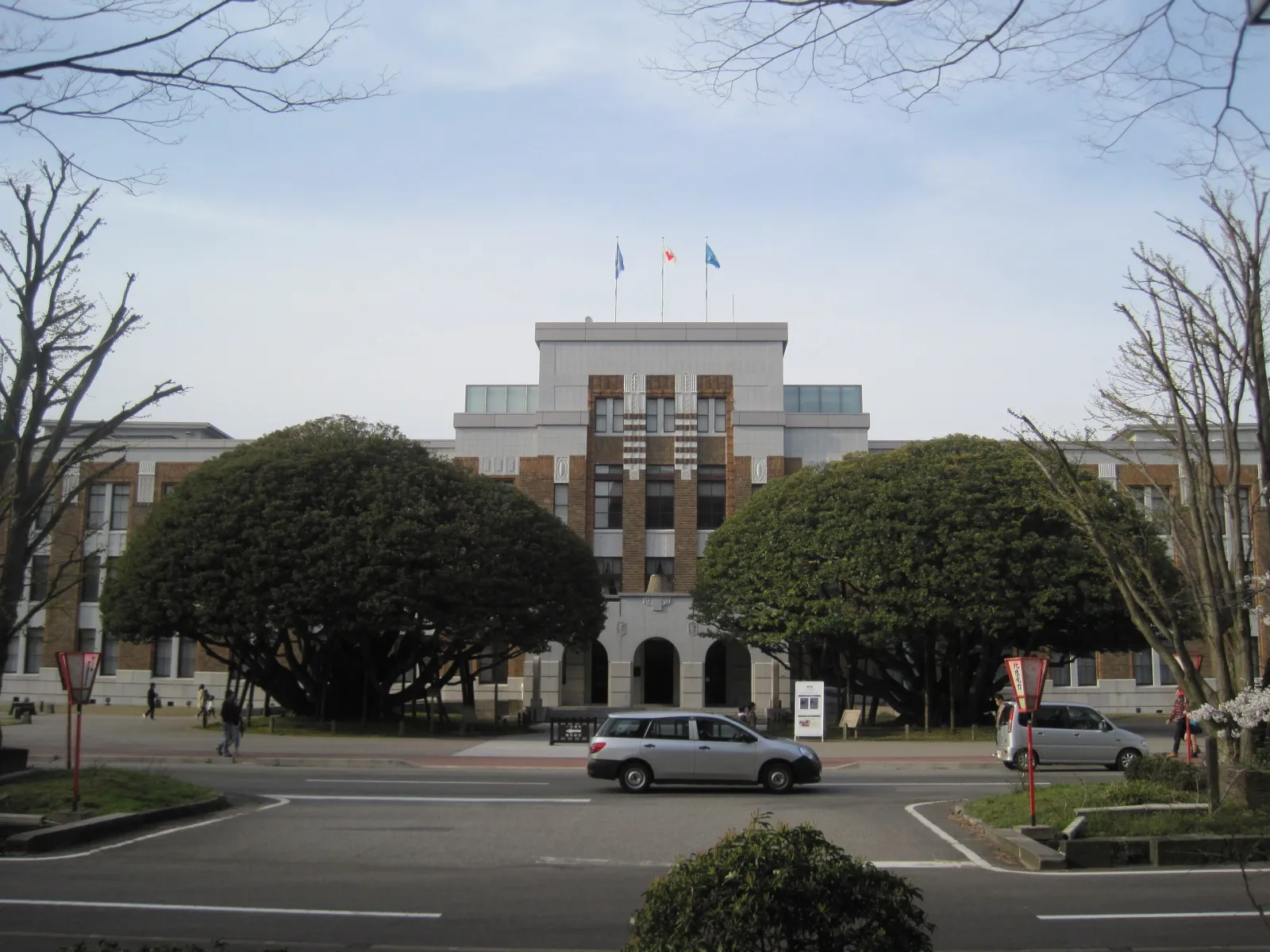
Photo: Hirorinmasa, licence: CC BY-SA 3.0, converted to WebP. Source: Wikimedia Commons
The former Ishikawa prefectural office, completed in 1924, is a reinforced concrete building designed by Yabashi Kenkichi, a Ministry of Finance engineer who worked on the National Diet Building. After the old building closed as the prefectural office in December 2002, part of it was preserved as the Shiinoki Cultural Complex42.
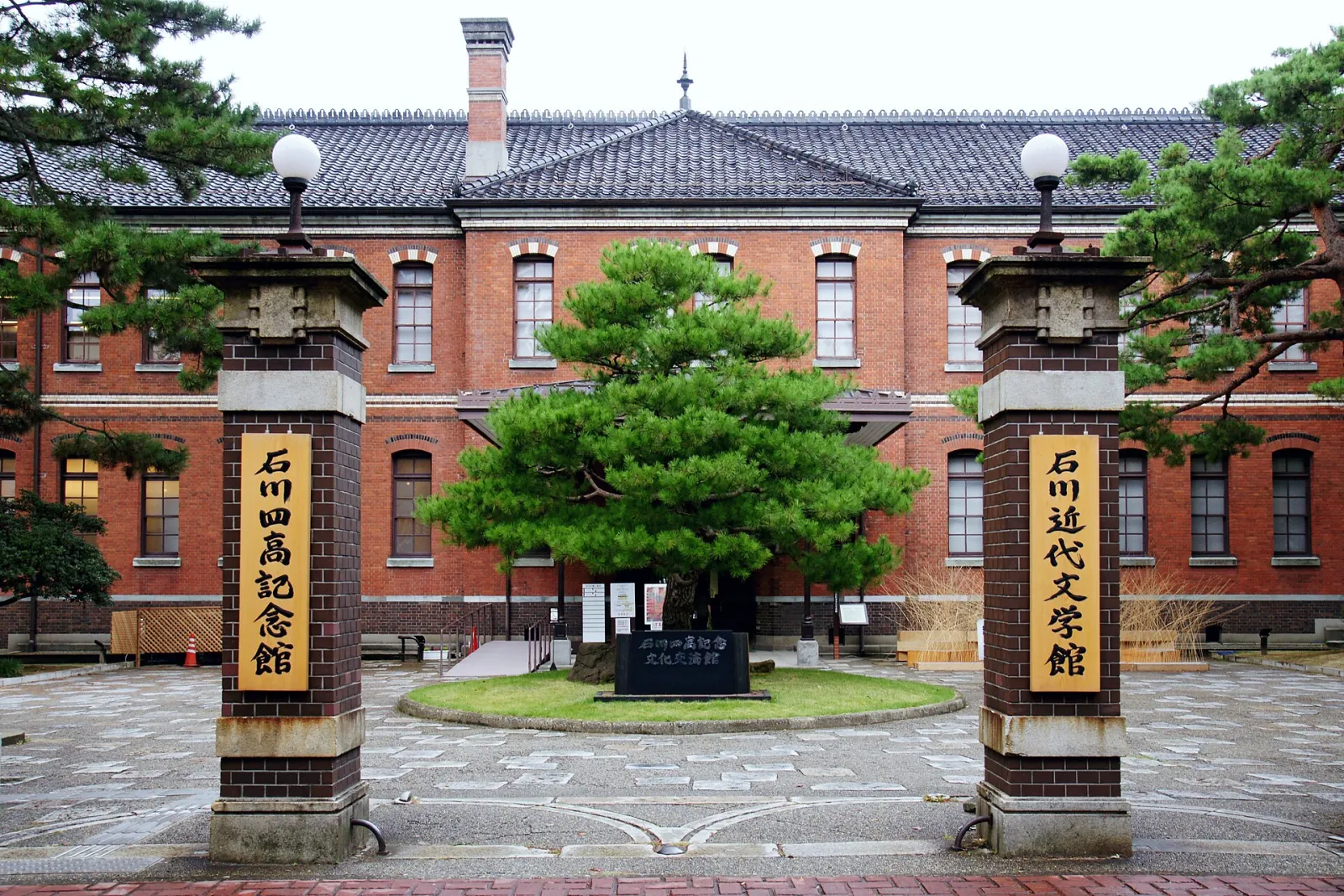
Of the three red-brick armouries of the Ishikawa Prefectural Museum of History, also mentioned in the Meiji note, the second building was completed in 1913 and the first in 1914; when they were converted into a museum the exteriors were restored to their original appearance and the interiors refitted43. Next door, the Hirosaka Annex was built in 1922 as the official residence of the 9th Division commander, was registered as a Tangible Cultural Property in 2016, and is now a free facility of the Ishikawa Prefectural Museum of Art44. The Nishi Kenban office in the Nishi chaya district also dates from 1922. It was built as a rehearsal hall and office for geisha, with a Western-style office wing and a Japanese-style rehearsal wing, and is normally closed to the public45.
Source: Wikimedia Commons (public domain, resized and converted to WebP)
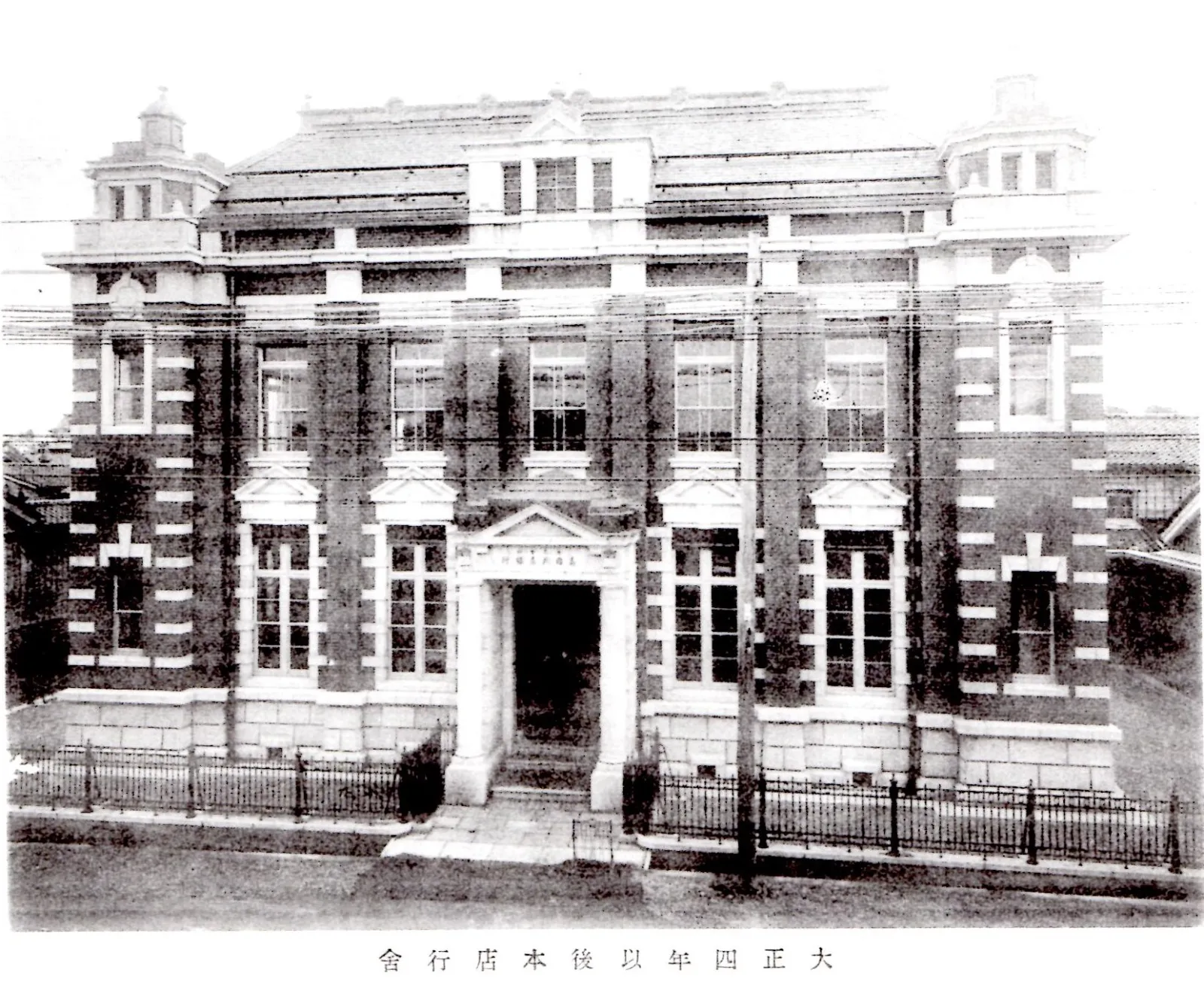
The former Takaoka Kyōritsu Bank on Yamachō-suji in Takaoka was built in December 1914 to a design by Tanabe Junkichi of Shimizu-gumi. It is the only full-scale brick building in the prefecture and has been known as the “red-brick bank”46. The city of Takaoka is working on a plan to reuse it46.
9. The Discovery of the Ōzakai Cave
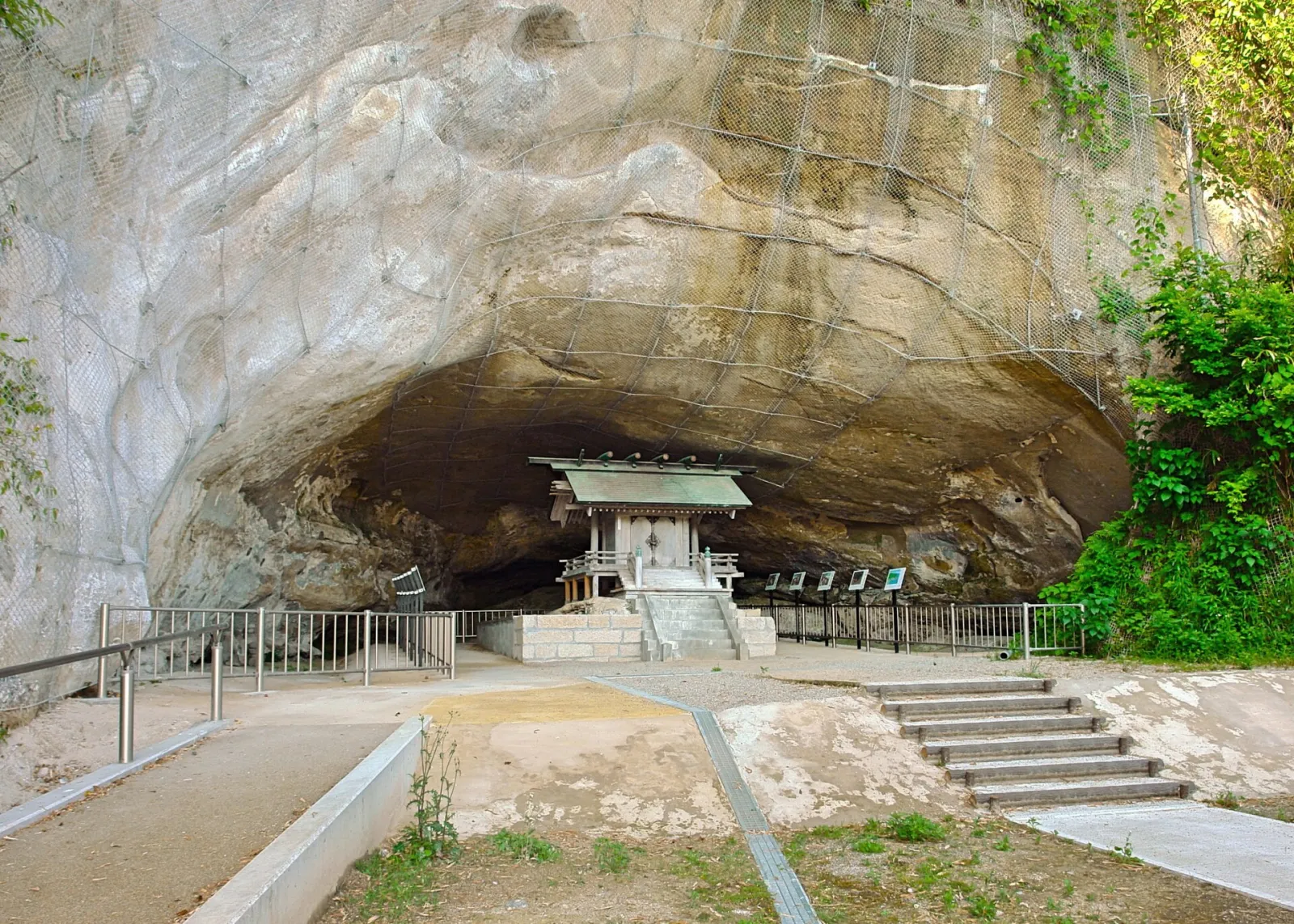
Photo: MChew, licence: CC BY-SA 3.0, resized and converted to WebP. Source: Wikimedia Commons
In 1918 human bones, animal bones, and pottery were dug up in a cave at Ōzakai, Unami village, Himi district, while the Hakusan shrine inside was being rebuilt47. Shibata Jōe of the anthropology department at Tokyo Imperial University noticed a short item in the Tokyo Asahi Shimbun on 1 July and took a night train to Himi on 3 July; his report appeared in the Journal of the Anthropological Society of Tokyo on 25 July4849. A full excavation led by Shibata followed that autumn and identified cultural layers from the Middle Jōmon to the early modern period. The site was designated a National Historic Site on 8 March 19224947.
10. Secondary-School Baseball
The national middle-school baseball championship was a national tournament for pre-war secondary schools and the predecessor of today’s summer high-school baseball championship. It began at Toyonaka in 1915, added a Hokuriku regional tournament in 1916, and moved to Naruo in 19176. Kōshien Stadium was completed in August 1924, and that year’s 10th tournament was the first played there506. The spring invitational tournament began in 1924 at Yamamoto Stadium in Nagoya and moved to Kōshien in 192551.
The Hokuriku schools that reached the national summer tournament in the Taishō era were, from Ishikawa, Kanazawa Commercial in 1923 and Kanazawa First Middle School in 1924, and from Fukui, Tsuruga Commercial in 1925 and 1926; no Toyama school took part52. Kanazawa Commercial lost 2–9 to Wakayama Middle School in the second round in 1923, and Kanazawa First Middle School lost 2–6 to Taipei Commercial in the first round in 1924; Taiwan had taken part since 1923, and Taipei Commercial was its representative53546. In 1925 Tsuruga Commercial beat Akita Commercial 5–4 in the second round and lost 4–11 to Waseda Jitsugyō in the quarter-final55.
11. Links with Taiwan
Source: Wikimedia Commons (public domain, resized and converted to WebP)
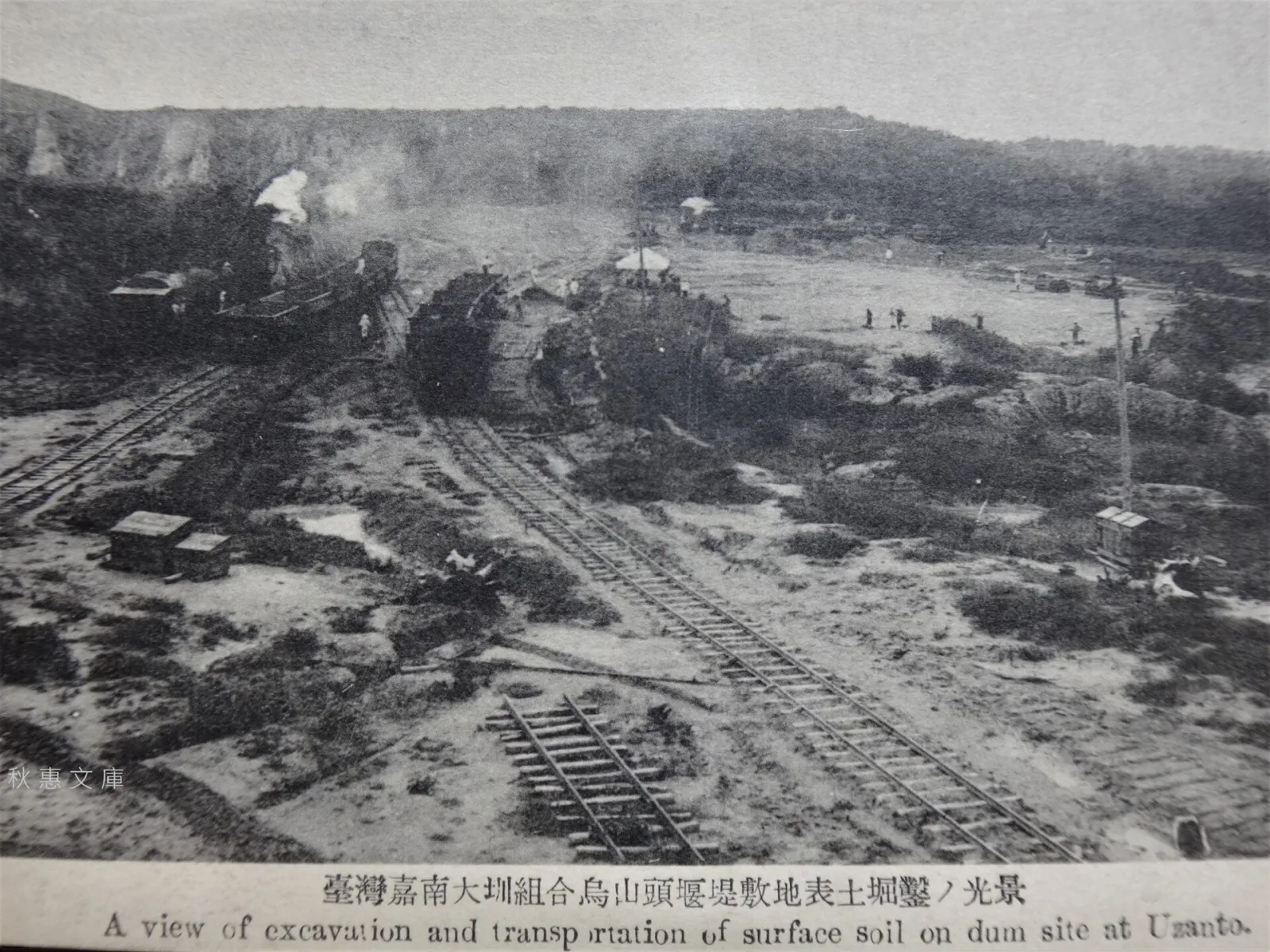
Hatta Yoichi, who appeared in the Meiji note, married Yonemura Toyoki in 1917 and surveyed sites for an irrigation dam on the Chianan plain that year. When the Kantianxi irrigation association was set up in 1920 he became its engineer, and work on the Chianan irrigation system began. In 1922 he toured the United States, Canada, and Mexico to study construction methods and buy large earth-moving machinery, and became head of the Wushantou field office56.
Qiu Niantai, son of Qiu Fengjia, was born in Tanzi, Taichung, in 1894. He went to Japan in 1913, passed into the preparatory course of the First Higher School the next year as a Guangdong provincial government scholarship student, and after one year was assigned to the Fourth Higher School in Kanazawa; he entered Tokyo Imperial University in 191957. After the war, in 1961, he and others including Yang Liang-kung and Hsiao I-shan founded the Feng Chia College of Engineering and Business, the forerunner of Feng Chia University58.
Toyama medicine reached Taiwan too: the 1918 Toyama Nippō article mentioned above says that many sellers shipped medicine to Korea and Taiwan24.
When Crown Prince Hirohito visited Taiwan in April 1923, the governor of Taihoku Prefecture, Takada Tomizō, presented him with a boat-shaped flower vessel modelled on the fishing boats of the Tao people and on the water buffalo of Taiwanese farm villages. The metal chasing was by Ametani Yūmin, from Toyama, and Watanabe Banri, from Chiba. It is now in the Museum of the Imperial Collections, Sannomaru Shōzōkan59.
12. Film and Later Works
Surviving Taishō-era footage of the Hokuriku mountains includes these mountaineering films. Itō Kōichi organised large climbing and filming parties in the later Taishō years and filmed the Northern Alps in the snow season. Yuki no Tateyama, Harinoki-goe was shot in 1923 and Yuki no Yakushi, Yari-goe in 1923–1924; the latter was re-edited with music and narration in 200060.
Nihon Arupusu jūsō: Eboshidake yori Yakedake e (30 minutes, silent), made by the Ministry of Education in 1925, has been released in full by the National Film Archive of Japan on its official YouTube channel6162.
Hokuriku events and places in later works:
- The film Dai kome sōdō (released 2021): based on the 1918 rice riots in Toyama and directed by Motoki Katsuhide, from Toyama city. It was shot in Toyama city from 26 to 31 October 2019, starting at Iwasehama63, and opened nationwide on 8 January 202164.
- Matsumoto Seichō, Nami no tō: a novel serialised in Josei Jishin from May 1959 to June 1960 that mentions the Ōzakai cave; its main character, a public prosecutor who likes visiting ancient sites, is written as having been there49.
The Taishō Emperor died on 25 December 1926, and the era name changed to Shōwa2.
13. Places to Visit Today
| Area | Place | Type | Notes |
|---|---|---|---|
| Uozu | Former Twelfth Bank rice warehouse | Building | The warehouse of the 1918 rice riots; interior visits normally 10:00–16:00, booked by phone at least a week ahead through the Uozu Station tourist information centre, with a guide (fee); closed 29 Dec–3 Jan5 |
| Kanazawa | Saigawa Bridge | Bridge | Warren truss steel bridge of 192440 |
| Kanazawa | Asanogawa Bridge | Bridge | Reinforced concrete arch bridge of 192241 |
| Kanazawa | Shiinoki Cultural Complex | Building | The 1924 prefectural office, partly preserved42 |
| Kanazawa | Hirosaka Annex (former 9th Division commander’s residence) | Building | 9:30–17:00 (last entry 16:30), free; closed 29 Dec–3 Jan and sometimes for events44 |
| Kanazawa | Ishikawa Prefectural Museum of History | Building / Museum | Red-brick armouries completed in 1913 and 191443 |
| Kanazawa | Nishi Chaya Museum and Nishi Kenban office | Museum / Building | Material on Shimada Seijirō; the Nishi Kenban is normally closed3045 |
| Kanazawa | Murō Saisei Memorial Museum | Museum | On Saisei’s birthplace27 |
| Kanazawa | Kanazawa Yuwaku Yumeji-kan Museum | Museum | Yuwaku, where Yumeji stayed in 191728 |
| Kanazawa | Utatsuyama Park | Park | Opened in 191434 |
| Kanazawa | Kanaiwa Zenigo Park | Park / Monument | Memorial stone to Maeda Yoshiyasu8 |
| Komatsu | Komatsu no Mori | Company facility | Founding site of Komatsu Seisakusho; check the official site for opening days21 |
| Takaoka | Former Takaoka Kyōritsu Bank | Building | The 1914 red-brick bank; no general opening found, exterior only46 |
| Himi | Ōzakai cave dwelling site | Historic site | Found in 1918, National Historic Site in 192247 |
References
Footnotes
-
Kanazawa City Library, “City history chronology: A Hundred Years of Kanazawa, Taishō–Shōwa” (change of era on 30 July 1912; Udasu Shrine gathering on 12 August 1918, discount sales on 15–16 August, Maeda family donations on 20 August including the Higher Technical School gift; influenza entries of 29 October and 15 November 1918): https://www2.lib.kanazawa.ishikawa.jp/reference/shishinenpyou_t.htm ↩ ↩2 ↩3 ↩4 ↩5 ↩6
-
Kanazawa City Library, “City history chronology: A Hundred Years of Kanazawa, Taishō–Shōwa” (9th Division to Korea in March 1914, return from 1 May 1916; election results and Nagai Ryūtarō on 22 April 1917 and 11 May 1920; Nikolayevsk Incident and Ishida Toramatsu, 12 March 1920; Yūaikai rally, 1 July 1920; orders on 31 March 1921 and shipment from Nanao from 8 April, and the opening of the Kanazawa Higher Technical School on 8 April 1921; suffrage rally on 5 February 1922 and return of the division headquarters with 108 war dead on 8 October 1922; suffrage celebration on 3 April 1925; change of era on 25 December 1926): https://www2.lib.kanazawa.ishikawa.jp/reference/shishinenpyou_t.htm ↩ ↩2 ↩3 ↩4 ↩5 ↩6 ↩7 ↩8 ↩9 ↩10 ↩11 ↩12 ↩13
-
Toyama Municipal Folkcraft and Local History Museum, exhibition “The city tram opens! 100 years of Toyama’s streetcars” (2013 exhibition; Hokuriku Main Line completed April 1913; Toyama Electric Tramway opened September 1913; the joint exhibition of one fu and eight prefectures): https://www.city.toyama.toyama.jp/etc/muse/kikakuhaku/list/h25/2502/2502.html ↩
-
Uozu Board of Education, The Rice Riots in Uozu (23 July 1918, about 60 and nearly 50 women, the Twelfth Bank warehouse; earliest in official records and newspapers, “birthplace of the rice riots”; Higashi-Mizuhashi in late June or early July; about 2,000 people in Namerikawa on 6 August; Toyama Nippō 24–25 July, Takaoka Shinpō banned 7 August): https://www.city.uozu.toyama.jp/attach/EDIT/036/036319.pdf ↩ ↩2 ↩3 ↩4
-
City of Uozu, “Visiting the former Twelfth Bank Uozu branch office and rice warehouse” (updated 9 July 2026; hours, booking a week ahead, guide fee, closing days): https://www.city.uozu.toyama.jp/guide/svGuideDtl.aspx?cd=3103&cdkb=ctg&servno=25798&topkb=G ↩ ↩2
-
Japan High School Baseball Federation, “History of the championship” (1st tournament at Toyonaka 1915; Hokuriku tournament added 1916; moved to Naruo 1917; 1918 cancelled after representatives were chosen because of the rice riots; Taiwan joined 1923; Kōshien Stadium completed 1924): https://www.jhbf.or.jp/sensyuken/history/ ↩ ↩2 ↩3 ↩4
-
Ishikawa Prefectural Library SHOSHO, “Maeda Yoshiyasu” (1830–1874; 14th and last lord of Kaga; governor of Kanazawa Domain; succeeded 1866): https://www.library.pref.ishikawa.lg.jp/shosho/furucolle/list/prsn11490 ↩
-
Hot Ishikawa Tabi Net, “Kanaiwa Zenigo Park” (memorial to Maeda Yoshiyasu, who died in Atami in 1874, built by boatmen foot soldiers, originally in Kanaiwa Ofunemachi): https://www.hot-ishikawa.jp/spot/detail_22466.html ↩ ↩2
-
Ishikawa Prefectural Library SHOSHO, “Maeda Toshitsugu” (1858–1900; 15th head of the Maeda family; succeeded 12 July 1874; marquis July 1884; House of Peers 1890): https://www.library.pref.ishikawa.lg.jp/shosho/furucolle/list/prsn11408 ↩
-
Ishikawa Prefectural Board of Education, “Kanazawa map of Kanbun 7 and the Kaetsunō Collection” (Toshitsugu set up the compilation office in 1883; donated to Kanazawa in 1948; 34,405 items; Kanazawa City Tamagawa Library): https://www.pref.ishikawa.lg.jp/kyoiku/bunkazai/rekishishiryou/k-17.html ↩ ↩2
-
Ishikawa Prefectural Museum of Art, “The collection of Maeda Toshinari” (2023 exhibition; Toshinari born 1885, fifth son of Toshiaki of the former Nanokaichi Domain, adopted by Toshitsugu 1900; Hongō Western-style house completed December 1907, Japanese house two years earlier): https://www.ishibi.pref.ishikawa.jp/exhibition/exhibition-14717/ ↩ ↩2
-
University Museum, University of Tokyo, “History and architecture of the Hongō campus” (Toshinari fulfilled Toshitsugu’s wish for an imperial visit; Meiji Emperor’s visit on 8 July 1910): https://umdb.um.u-tokyo.ac.jp/dkankoub/publish_db/1997Avantgarde/21.html ↩
-
University of Tokyo Archaeological Research Unit, “Sites of the University of Tokyo”, Hongō area (land exchange of the Hongō Maeda residence and the Komaba Faculty of Agriculture after the Great Kantō Earthquake; university land from 1926): https://www.aru.u-tokyo.ac.jp/utokyo-sites.html ↩
-
Tokyo Metropolitan Government lifelong learning site, “History of the buildings: former Maeda family residence” (Toshinari 1885–1942, 16th head; exchange and groundbreaking 1926; Western-style house completed 1929, Japanese house 1930): https://www.syougai.metro.tokyo.lg.jp/sesaku/maedatei/history.html ↩
-
Tokyo National Museum, special exhibition “Hyakumangoku! The Kaga Maeda Family” (2026 exhibition; Toshinari founded the Ikutoku Foundation, now the Maeda Ikutokukai, in 1926): https://www.tnm.jp/modules/r_free_page/index.php?id=2740&lang=ja ↩
-
National Institute for Defense Studies, Center for Military History, “Commemorative photo album of the 9th Division’s Siberian expedition” (orders 31 March 1921; commander Matsuura Kan’i [松浦寛威]; the reading follows Nihon jinmei daijiten and 20-seiki Nihon jinmei jiten (まつうら かんい), https://kotobank.jp/word/%E6%9D%BE%E6%B5%A6%E5%AF%9B%E5%A8%81-1110018 ; Japanese Wikipedia gives ひろたけ, citing Rikukaigun shōkan jinji sōran: Rikugun-hen, p. 85, which was not checked for this note, https://ja.wikipedia.org/wiki/%E6%9D%BE%E6%B5%A6%E5%AF%9B%E5%A8%81 ; departure from Nanao; landings at Vladivostok 11 April–7 May; relieved the 11th Division; withdrawal complete 18 September 1922; album issued 25 August): https://www.nids.mod.go.jp/publication/senshi/pdf/201403/02.pdf ↩ ↩2 ↩3 ↩4
-
Japan Center for Asian Historical Records, “9th Division” (sent to Vladivostok April 1921; 7th and 35th Infantry Regiments and others sent to Tokyo and Kanagawa after the 1923 earthquake; 35th Infantry Regiment and others abolished in the 1925 Ugaki reduction): https://www.jacar.go.jp/exhibition/glossary/term4/0010-0080-0100.html ↩
-
National Archives of Japan, “The General Election Law is enacted” (promulgated 5 May 1925; tax qualification removed; men aged 25 and over): https://www.archives.go.jp/ayumi/kobetsu/t14_1925_03.html ↩
-
National Archives of Japan, “The first general election under universal suffrage” (16th general election, 20 February 1928): https://www.archives.go.jp/ayumi/kobetsu/s03_1928_01.html ↩
-
Kanazawa City Library, “City history chronology: A Hundred Years of Kanazawa, Taishō–Shōwa” (Zigomar on 8 October 1912; Kanaiwa tram 11 August 1914; city tram 1–2 February 1919; Chijō 1 June 1919 and the “Chijō party” 5 July 1919; Ōhi line 13 July 1922; Kanazawa Medical University 1 April 1923, public markets 10 July 1923, Miyaichi Department Store 1 November 1923; municipal day nursery 5 July 1924): https://www2.lib.kanazawa.ishikawa.jp/reference/shishinenpyou_t.htm ↩ ↩2 ↩3 ↩4 ↩5 ↩6 ↩7 ↩8 ↩9
-
Komatsu, “Komatsu’s past and future” (Takeuchi Meitarō; Yūsenji copper mine; Komatsu Ironworks 1917; Komatsu Seisakusho founded 1921 in anticipation of the mine’s closure): https://www.komatsu.jp/ja/recruit/past-future/identity ↩ ↩2
-
Cultural Heritage Online, “Kamidaki power station” (1924; two-storey reinforced concrete; left bank of the Jōganji River; owned by Hokuriku Electric Power; registered Tangible Cultural Property 12 October 2001): https://online.bunka.go.jp/heritages/detail/115457 ↩
-
Japan Heritage portal, “Cupola and chimney of the former Nanbu foundry” (built 1924; air heated by the smoke from melting metal; registered Tangible Cultural Property): https://japan-heritage.bunka.go.jp/ja/culturalproperties/result/302/ ; Kanaya-machi Mangekyō, “Cultural properties associated with Kanayamachi” (the cupola’s blower and the preheating of air by the exhaust gases): https://nettoko.kanaya-machi.com/satoko/bunnka.html ↩
-
Toyama Prefecture, History of the Toyama Pharmaceutical Industry: Collected Sources, vol. 2 (1983), section V “Overseas medicine sales”, pp. 931–932: document 585, “Export medicine sellers, December 1918” (from the Toyama Nippō, 12 December 1918: “其他朝鮮及台湾地方へ移出する者少からざるが輸出売薬年産額約七十万円にして内富山市にて五十八万円を占め”), and document 586, “Conference on promoting overseas medicine exports, January 1919”: https://www.pref.toyama.jp/documents/28270/s_kaigaibaiyaku.pdf ↩ ↩2 ↩3
-
Kanazawa University Library, “Chronology of the Fourth Higher School” (30th anniversary and the Museidō, 26 October 1917, now moved to Meiji Mura): https://library.kanazawa-u.ac.jp/files/event/shiko120/history.htm ↩
-
Murō Saisei Memorial Museum, “List of Murō Saisei’s books” (Ai no shishū, Kanjō Shisha, 1 January 1918; Jojō shōkyokushū, Kanjō Shisha, 10 September 1918; Daini ai no shishū, Bunbudō Shoten, 5 May 1919; Sei ni mezameru koro 5 January 1920): https://www.kanazawa-museum.jp/saisei/saisei/chosholist.html ↩
-
Murō Saisei Memorial Museum, “About the museum” (on the site of his birthplace; opened 1 August 2002; Uhōin; Saisei no michi; 3-22 Sennichimachi): https://www.kanazawa-museum.jp/saisei/outline/index.html ↩ ↩2
-
Kanazawa Yuwaku Yumeji-kan Museum, “Yuwaku, a place of fond memory” (66-day journey through Hokuriku and Kaga, August–October 1917; three-week stay at Yuwaku from late September; “Satoi” 13 poems in Yama e yosuru, February 1919; poem monument at the Yakushi temple): https://www.kanazawa-museum.jp/yumeji/about/p03_yuwaku.html ↩ ↩2
-
City of Hakusan, “Brief chronology of Shimada Seijirō” (born 26 February 1899 in Minamimachi, Mikawa; moved to Kanazawa with his mother in 1904, aged five): https://www.city.hakusan.lg.jp/bunka/bunkashinko/1002773/1002802/1002803.html ↩
-
City of Kanazawa, “Nishi Chaya Museum” (2-25-18 Nomachi; recreated teahouse exterior; mainly material on Shimada Seijirō): https://www4.city.kanazawa.lg.jp/soshikikarasagasu/kohokochoka/gyomuannai/6/2/6335.html ↩ ↩2
-
Ishikawa Prefectural Museum of History, “Kanazawa cinema pamphlets” (Kikusui Club October 1913; Sumeru-kan July 1914; Second Kikusui Club June 1914; Daikatsu Club 1921): https://www.ishikawa-rekihaku.jp/collection/detail.php?cd=GI00361 ↩
-
Toyama City Library, “Reference cases: history”, Teikokukan (quoting Sōgawa kaikokan: Teikokuza 1 June 1917; burned April 1924; rebuilt as the Teikokukan in December): https://www.library.toyama.toyama.jp/reference/example-history/ ↩
-
Collaborative Reference Database (Kanazawa City Library), “Kanazawa’s first coffee shop” (History of Kanazawa City, narrative vol. 3, pp. 518–519: Kōrinbō, 1917; A Hundred Years of Kanazawa, Taishō–Shōwa, p. 53: Ishiuramachi, 3 November 1919): https://crd.ndl.go.jp/reference/entry/index.php?id=1000190327&page=ref_view ↩
-
City of Kanazawa, “Utatsuyama Park facilities” (opened February 1914): https://www4.city.kanazawa.lg.jp/soshikikarasagasu/midoritohananoka/gyomuannai/5/1/9410.html ↩ ↩2
-
City of Kuki, “Parks across Japan designed or remodelled by Dr Honda”, Utatsu Park (inspection 16 April 1923; lecture the next day; newspaper headline): https://www.city.kuki.lg.jp/miryoku/rekishi_bunkazai/honda_00/1006360.html ↩
-
Uchinada Town History and Folklore Museum, “The birth of Awagasaki Yūen” (Hirasawa Katarō; influence of Kobayashi Ichizō; first section of the Asanogawa Electric Railway 10 May 1925; opened 19 July; Kodomo no Kuni in September): https://www.town.uchinada.lg.jp/site/uchinada-history/12527.html ↩
-
Kanazawa Kurashi Museum, “Kanazawa schoolgirls” 3, uniforms and school customs (sokuhatsu popular from the late Meiji 30s to mid-Taishō; Hokuriku Girls’ School the first in the prefecture with sailor suits, 1922): https://www.kanazawa-museum.jp/minzoku/blog/past_202407.html ↩
-
Kanazawa Kurashi Museum, “Kanazawa schoolgirls” 7, outings and climbing (Second Girls’ High School: Kuragatake hike in 1917, more than 12 hours; skiing practice from 1920): https://www.kanazawa-museum.jp/minzoku/blog/past_202410.html ↩
-
Seisen Kindergarten, “About us” (Canadian women missionaries began work in 1916; Jūyonban Kindergarten founded 1926): https://seisen.net/about.php ↩
-
MLIT Kanazawa River and National Highway Office, “About Saigawa Bridge” (reinforced concrete bridge 1919–1922; collapsed in a cloudburst August 1922; designed by Sekiba Shigeki; completed 1924): https://www.hrr.mlit.go.jp/kanazawa/road/saigawa/about/ ↩ ↩2
-
MLIT Kanazawa River and National Highway Office, “Asanogawa Bridge data” (three-span continuous RC fixed arch; completed December 1922): https://www.hrr.mlit.go.jp/kanazawa/mb2_jigyo/bunkazai/asanogawa/data/data.html ↩ ↩2
-
Shiinoki Cultural Complex, “About” (completed 1924; designed by Yabashi Kenkichi; closed as prefectural office 27 December 2002; the chronology gives the move to the new Kuramitsu office as 2003; part of the old building preserved): https://shiinoki-geihinkan.jp/about/ ↩ ↩2
-
Ishikawa Prefectural Museum of History, “About the museum” (second building 1913, first building 1914; exteriors restored to their original appearance): https://www.ishikawa-rekihaku.jp/about/ ↩ ↩2
-
Ishikawa Prefectural Museum of Art, “Hirosaka Annex” (built 1922 as the 9th Division commander’s residence; hours, closing days, free): https://www.ishibi.pref.ishikawa.jp/guide/hirosaka/ ; Cultural Heritage Online, “Hirosaka Annex (former 9th Division commander’s residence)” (registered 29 November 2016): https://online.bunka.go.jp/heritages/detail/284346 ↩ ↩2
-
City of Kanazawa, “Nishi Kenban office” (Taishō 11; Western-style office wing and Japanese-style rehearsal wing; registered 2003): https://www4.city.kanazawa.lg.jp/soshikikarasagasu/bunkazaihogoka/gyomuannai/3/1/1/touroku/1/6087.html ; Kanazawa City Tourism Association, “Nishi chaya district” (normally closed): https://www.kanazawa-kankoukyoukai.or.jp/article/detail_76.html ↩ ↩2
-
City of Takaoka, “Representative traditional buildings of Yamachō-suji” (former Takaoka Kyōritsu Bank, December 1914; designed by Tanabe Junkichi of Shimizu-gumi; the only full-scale brick building in the prefecture): https://www.city.takaoka.toyama.jp/soshiki/kyoikuiinkai_bunkazaihogokatsuyoka/1/4/3/1/2372.html ; City of Takaoka, “Reuse of the red-brick building (former Takaoka Kyōritsu Bank)” (updated 1 September 2025): https://www.city.takaoka.toyama.jp/soshiki/kikakuka/2/17/12922.html ↩ ↩2 ↩3
-
Himi City Museum, “Nearby historic sites” (human and animal bones and pottery found when the Hakusan shrine was rebuilt in 1918; layers from the Middle Jōmon to the early modern period): https://www.city.himi.toyama.jp/section/museum/kinrin.html ↩ ↩2 ↩3
-
Shibata Jōe, “The Hakusan shrine cave at Ōzakai, Unami village, Himi district, Etchū”, Journal of the Anthropological Society of Tokyo 33(7), 25 July 1918, from p. 179 (opening: “七月一日の東京朝日新聞には、越中の高岡方面よりの通信として發掘に關する簡單なる記事が載つて居た”): https://doi.org/10.1537/ase1911.33.179 ↩
-
City of Himi, Kōhō Himi no. 777 (July 2018), pp. 4–5, “Ōzakai cave dwelling site: 100 years since its discovery” (Tokyo Asahi Shimbun of 1 July; night train on the 3rd; full excavation that autumn; National Historic Site 8 March 1922; Nami no tō serialised in Josei Jishin May 1959–June 1960): https://www.city.himi.toyama.jp/material/files/group/2/05266275.pdf ↩ ↩2 ↩3
-
Hanshin Electric Railway, “HANSHIN HISTORY” 1905–1924 (Naruo ground 1916; Kōshien Stadium 1924): https://www.hanshin.co.jp/company/history/history-story/ ↩
-
Japan High School Baseball Federation, “History of the invitational tournament” (1st tournament 1924 at Yamamoto Stadium, Yagoto, Nagoya; 2nd tournament 1925 at Kōshien): https://www.jhbf.or.jp/senbatsu/history/ ↩
-
Japan High School Baseball Federation, “Participating schools”, tournaments 6–10 and 11–15 (Ishikawa: Kanazawa Commercial 1923, Kanazawa First Middle School 1924; Fukui: Tsuruga Commercial 1925 and 1926; Toyama column blank; Taiwan: Taipei First Middle School 1923, Taipei Commercial 1924): https://www.jhbf.or.jp/sensyuken/outing/06-10.html ; https://www.jhbf.or.jp/sensyuken/outing/11-15.html ↩
-
Asahi Shimbun and Nikkan Sports, “9th national middle-school championship” (second round: Wakayama Middle 9–2 Kanazawa Commercial): https://smart.asahi.com/v/koshien/stats/summer/y1923.php ↩
-
Asahi Shimbun and Nikkan Sports, “10th national middle-school championship” (first round: Taipei Commercial 6–2 Kanazawa First Middle): https://smart.asahi.com/v/koshien/stats/summer/y1924.php ↩
-
Asahi Shimbun and Nikkan Sports, “11th national middle-school championship” (second round: Tsuruga Commercial 5–4 Akita Commercial; quarter-final: Waseda Jitsugyō 11–4 Tsuruga Commercial): https://smart.asahi.com/v/koshien/stats/summer/y1925.php ↩
-
Kanazawa Furusato Ijinkan, “Hatta Yoichi chronology” (marriage and Chianan plain survey 1917; association engineer and start of the Chianan irrigation work 1920; tour of the US, Canada, and Mexico and head of the Wushantou office 1922): https://www.kanazawa-museum.jp/ijin/exhibit/05hatta_history.html ↩
-
范智盈, “Hakka people in Japan before the Second World War: Qiu Niantai and the Dongning Society”, Global Hakka Studies 13 (November 2019), p. 156 (citing Qiu Niantai, Linghai weibiao, 1962, pp. 79–101): https://ghk.hakka.nycu.edu.tw/issueArticle.asp?CA_ID=536&P_No=50 ↩
-
Central News Agency, “Old photos: the founding of Feng Chia College of Engineering and Business” (13 January 2025; founded in 1961 by Qiu Niantai, Yang Liang-kung, Hsiao I-shan, and others): https://www.cna.com.tw/news/ahel/202501135002.aspx ↩
-
Museum of the Imperial Collections, Sannomaru Shōzōkan, “Boat-shaped flower vessel” (Taishō 12; design by 中川泳舟; chasing by Ametani Yūmin [飴谷有民, Toyama] and Watanabe Banri [渡邉萬里, Chiba]; readings from the museum’s earlier collection page, https://collection.shozokan.nich.go.jp/?artpic_id=&at=detail&ated=search&id=2727&rec_no=15 ; presented by the Taihoku governor Takada Tomizō [高田富蔵] during the crown prince’s visit to Taiwan in April 1923; reading from Japanese Wikipedia, https://ja.wikipedia.org/wiki/%E9%AB%98%E7%94%B0%E5%AF%8C%E8%94%B5): https://collection.shozokan.nich.go.jp/object/SZK002727 ↩
-
Tokyo Photographic Art Museum, “Mountain film special screening” (2014; Yuki no Tateyama, Harinoki-goe shot 1923; Yuki no Yakushi, Yari-goe shot 1923–1924, completed as a work in 2000; produced by Itō Kōichi): https://topmuseum.jp/movie/2271/ ↩
-
National Film Archive of Japan, “Film is a Document”, Nihon Arupusu jūsō: Eboshidake yori Yakedake e (1925; 30 minutes; silent; Ministry of Education): https://filmisadocument.jp/films/view/186 ; YouTube (official NFAJ channel): https://www.youtube.com/watch?v=e4cUryidAU4 ↩
-
National Film Archive of Japan, “About this site” (no procedure needed for streaming playback): https://filmisadocument.jp/pages/about ↩
-
City of Toyama, “Filming of Dai kome sōdō, a film about the Toyama rice riots, took place in the city” (26–31 October 2019; first day at Iwasehama; release planned for Reiwa 3): https://www.city.toyama.lg.jp/shisei/koho/1010848/1010852/1002727.html ↩
-
Sony Music, Kome Kome Club, “New single ‘Ai o kome te’ chosen as the theme song of Dai kome sōdō” (21 October 2020; nationwide release 8 January 2021): https://www.komekomeclub.net/artist/Komekome/info/523204 ↩