This note follows the one on late Shōwa and covers the Heisei era (8 January 1989 – 30 April 2019). For people active in Heisei, their later careers get one sentence. The focus is Kanazawa, Toyama, and Komatsu, with Fukui, Takaoka, Himi, Gokayama, and Noto as well.
In Heisei Hokuriku the first half was mostly about cultural facilities and the second half about the shinkansen and flights to Taipei. The thatched villages of Gokayama became a World Heritage Site in 1995, and Zuiryūji in Takaoka became Toyama’s first National Treasure in 1997. The 21st Century Museum of Contemporary Art opened in Kanazawa in 2004, and Toyama’s light rail line opened in 2006. Scheduled flights to Taipei began from Komatsu in 2008 and from Toyama in 2012, and the Hokuriku Shinkansen reached Kanazawa from Nagano in 2015. Disasters included the Fukui floods of 2004 and the Noto Peninsula earthquake of 2007.
1. Heisei and Hokuriku
The Shōwa emperor died on 7 January 1989, and the era name changed to Heisei on 8 January1. Heisei ended on 30 April 2019, and Reiwa began on 1 May2.
Mori Yoshirō, from Ishikawa, was the 85th and 86th prime minister from 5 April 2000 to 26 April 20013.
2. Cultural Facilities and World Heritage
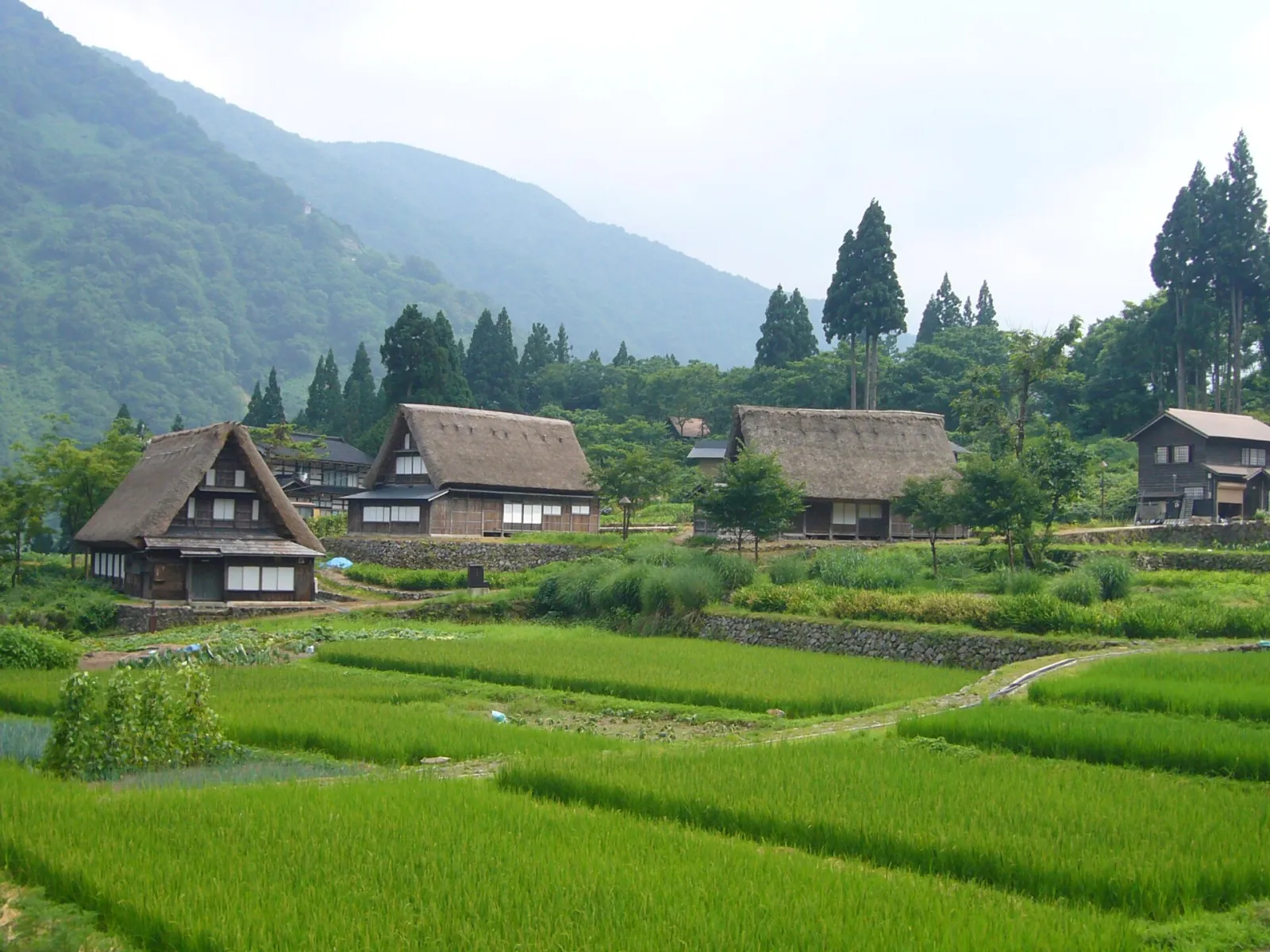
Photo: minque. Source: Wikimedia Commons (public domain, resized and converted to WebP)
Toyama Prefecture’s Heisei chronology records the opening of the Tateyama Museum in 1991, the listing of Gokayama’s thatched villages as a World Heritage Site in 1995, and the designation of Zuiryūji in Takaoka as the prefecture’s first National Treasure in 19974. The sail training ship Kaiwo Maru went on public display in Toyama in 1990, and the Shinminato Bridge opened in 20124. The same year saw the opening of the prefectural Itai-itai Disease Museum and the Kōshi no Kuni Literature Museum, and the completion of the restoration of cadmium-contaminated paddies4. Also in 2012, ice bodies in the Tateyama range were confirmed as Japan’s first glaciers, and the Midagahara and Dainichidaira wetlands of Tateyama were listed under the Ramsar Convention4.
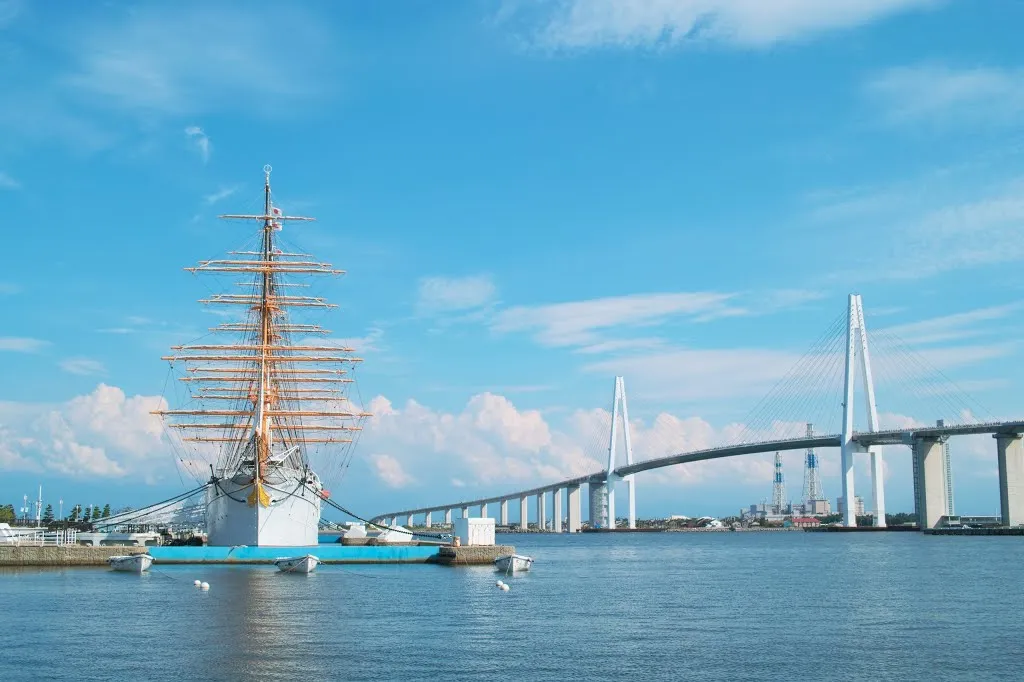
Photo: ESU, licence: CC BY-SA 3.0, converted to WebP. Source: Wikimedia Commons
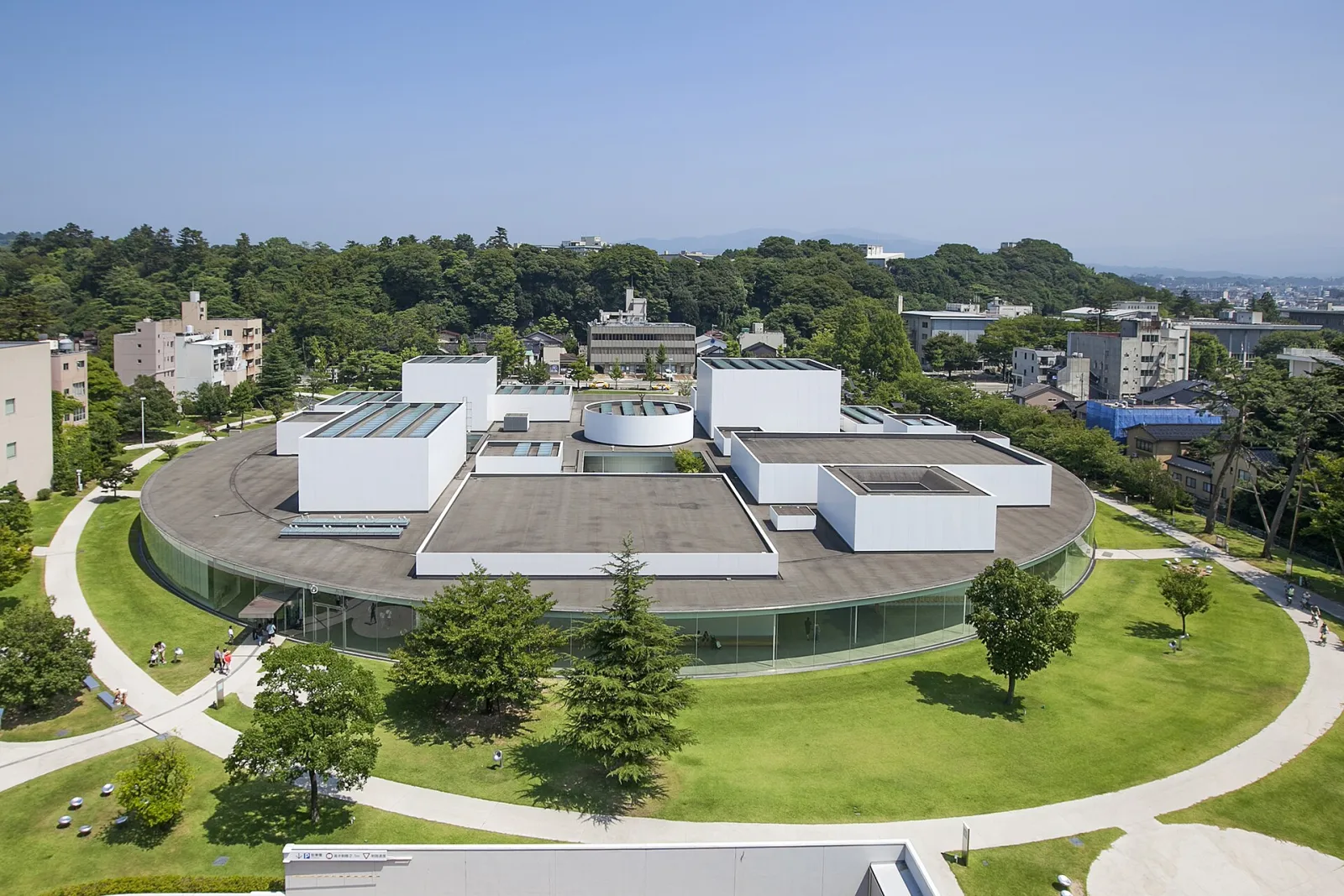
Photo: Kanazawa City, licence: CC BY 2.1 JP, resized and converted to WebP. Source: Wikimedia Commons
Kanazawa City’s chronology lists the 46th National Sports Festival in Ishikawa in 1991, Kanazawa becoming a core city in 1996, the 21st Century Museum in 2004, and the Kanazawa Noh Museum in 2006. In 2009 Kanazawa became the first city recognized by the state as a “historic city” and the first in the world named a UNESCO City of Crafts, and the D. T. Suzuki Museum opened in 20115. The 21st Century Museum was designed by SANAA, and its ground floor is a free public zone6.
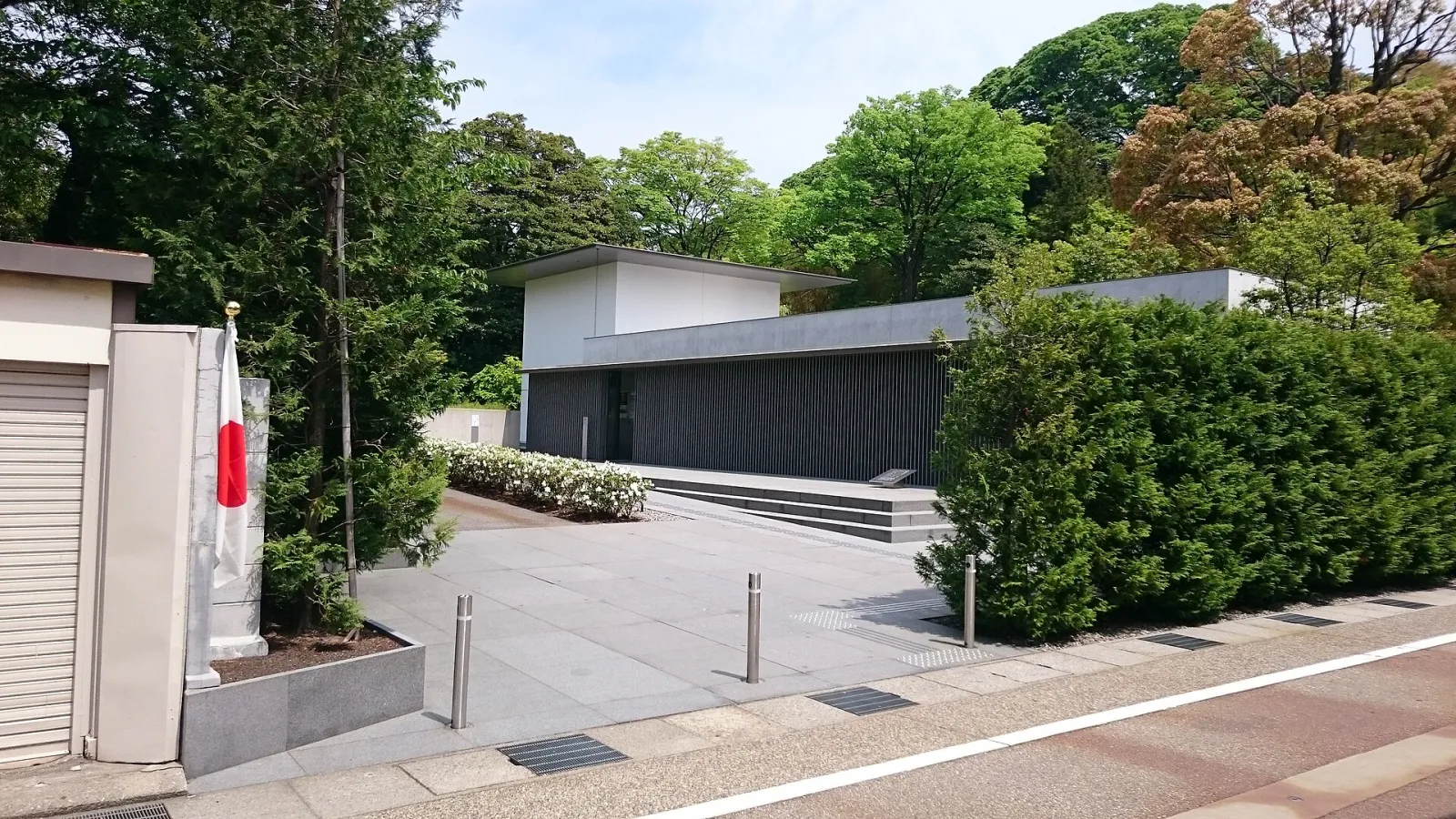
Photo: Masayuki (Yuki) Kawagishi, licence: CC BY 2.0, resized and converted to WebP. Source: Wikimedia Commons
3. Municipal Mergers and Trams
Toyama Prefecture went through a series of mergers between 2004 and 2006. On 1 November 2004 eight towns and villages, including Jōhana, Inami, Fukuno, Fukumitsu, Taira, Kamitaira, Toga, and Inokuchi, became Nanto City; on 1 April 2005 Toyama merged with Ōyama, Ōsawano, Yatsuo, Fuchū, Yamada, and Hosoiri. In November 2005 Fukuoka joined Takaoka and five municipalities including Shinminato formed Imizu City, and in April 2006 Unazuki joined Kurobe7. Yatsuo and Toga, which appeared in the late Shōwa note, are now parts of Toyama City and Nanto City.
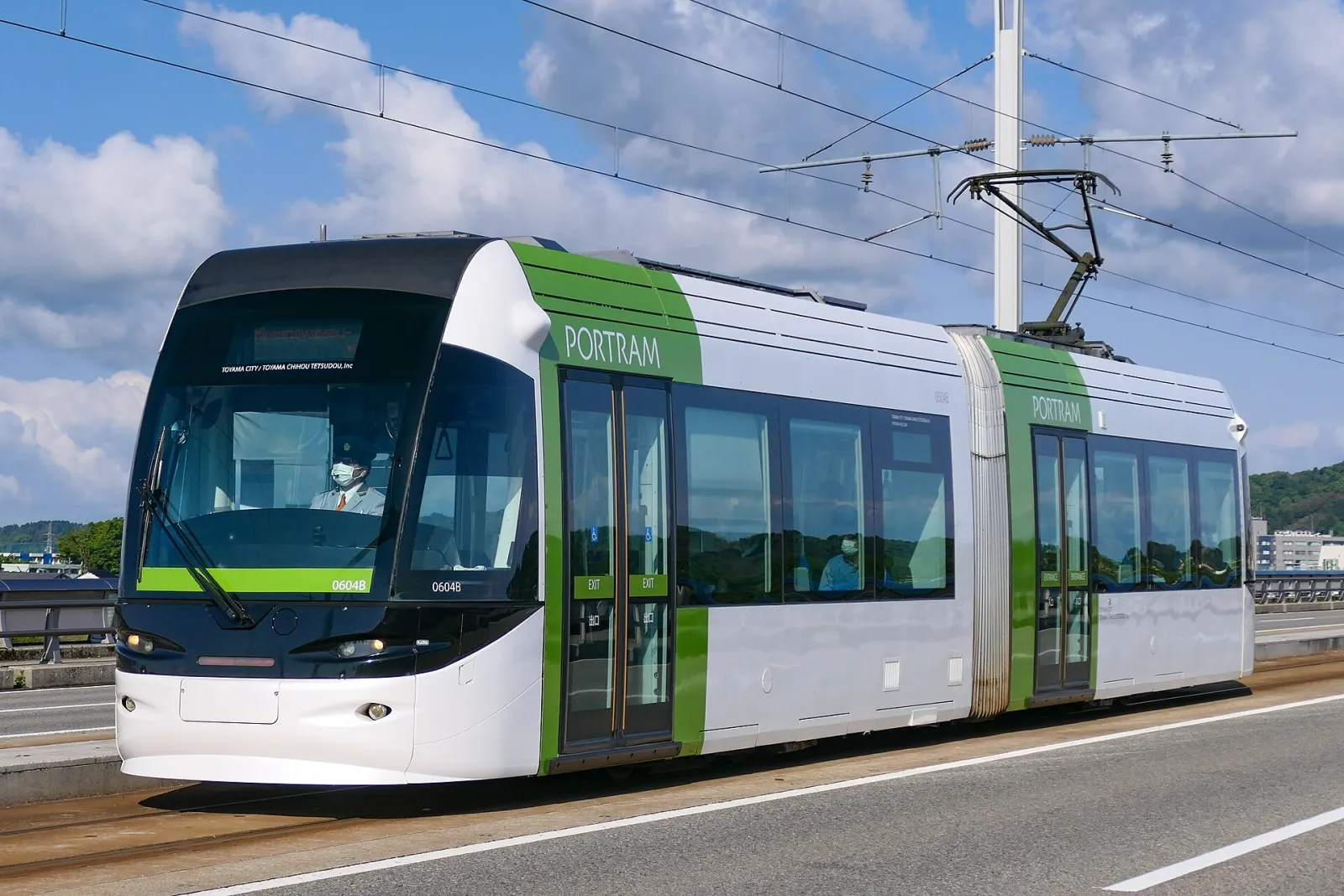
Photo: MaedaAkihiko, licence: CC BY-SA 4.0, resized and converted to WebP. Source: Wikimedia Commons
The Toyama Light Rail opened in April 2006, and a loop line on the city tram network opened in December 2009. Toyama City aims to link them, and to run through onto the Kamidaki line, to form a light rail network of about 25.3 km8.
4. The Hokuriku Shinkansen
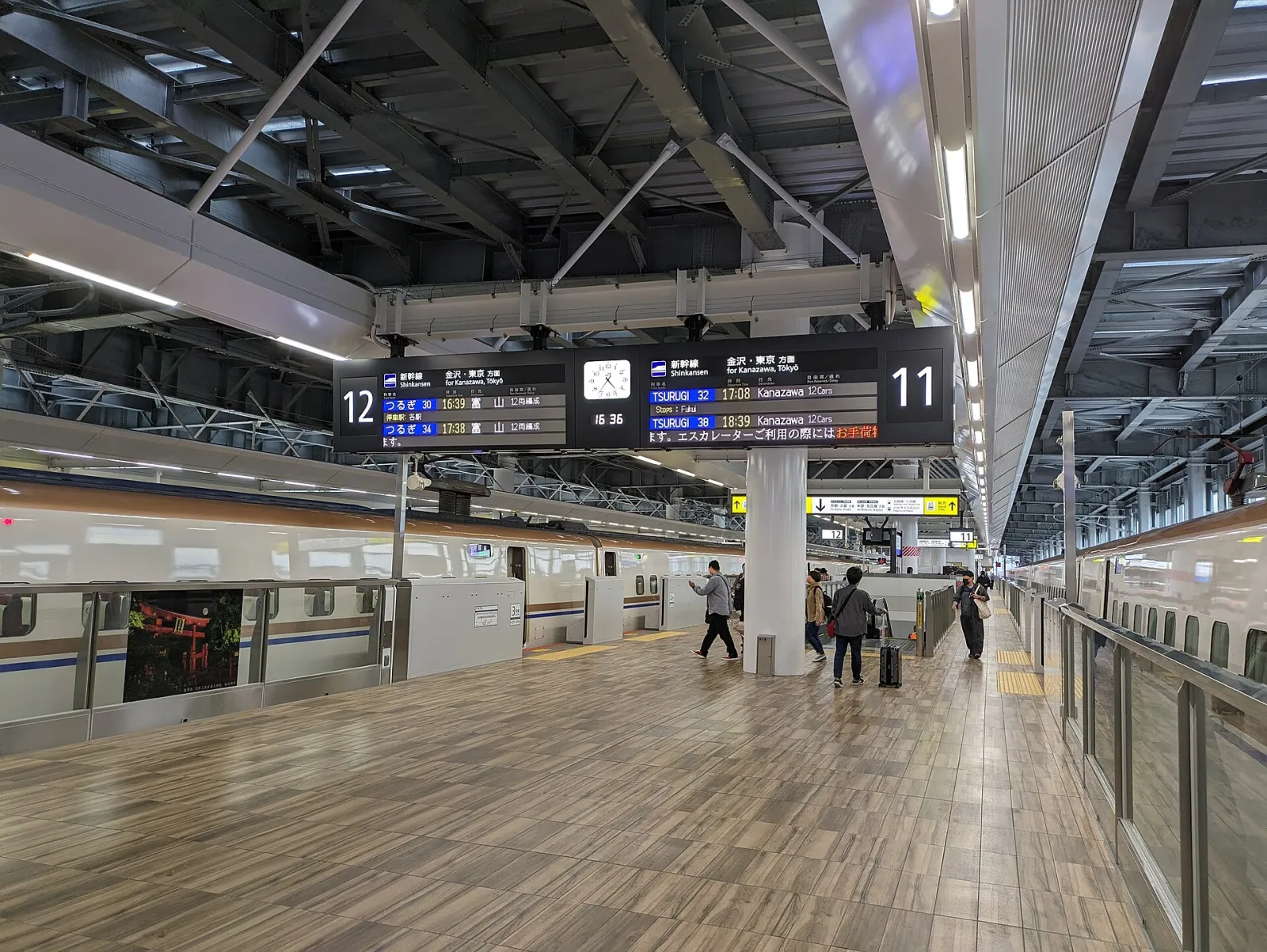
The Hokuriku Shinkansen chronology compiled by Ishikawa Prefecture shows construction starting between Karuizawa and Nagano in September 1991 and between Isurugi and Kanazawa in August 1992, and the Takasaki–Nagano section opening first in October 19979. Work began between Toyama and Kanazawa in June 2005 and between Kanazawa and Tsuruga in August 2012, and the train names Kagayaki, Hakutaka, and Tsurugi were chosen in October 20139.
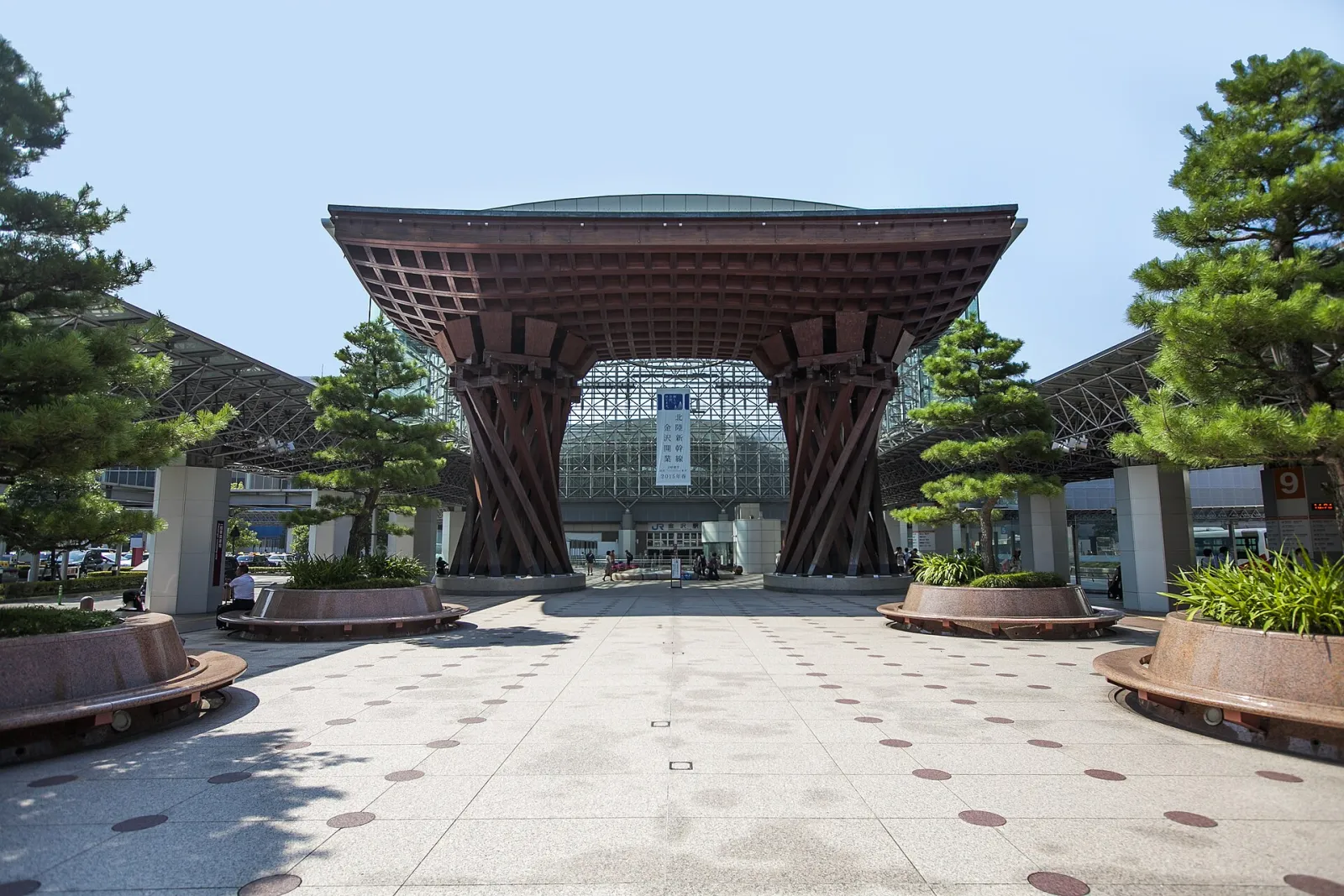
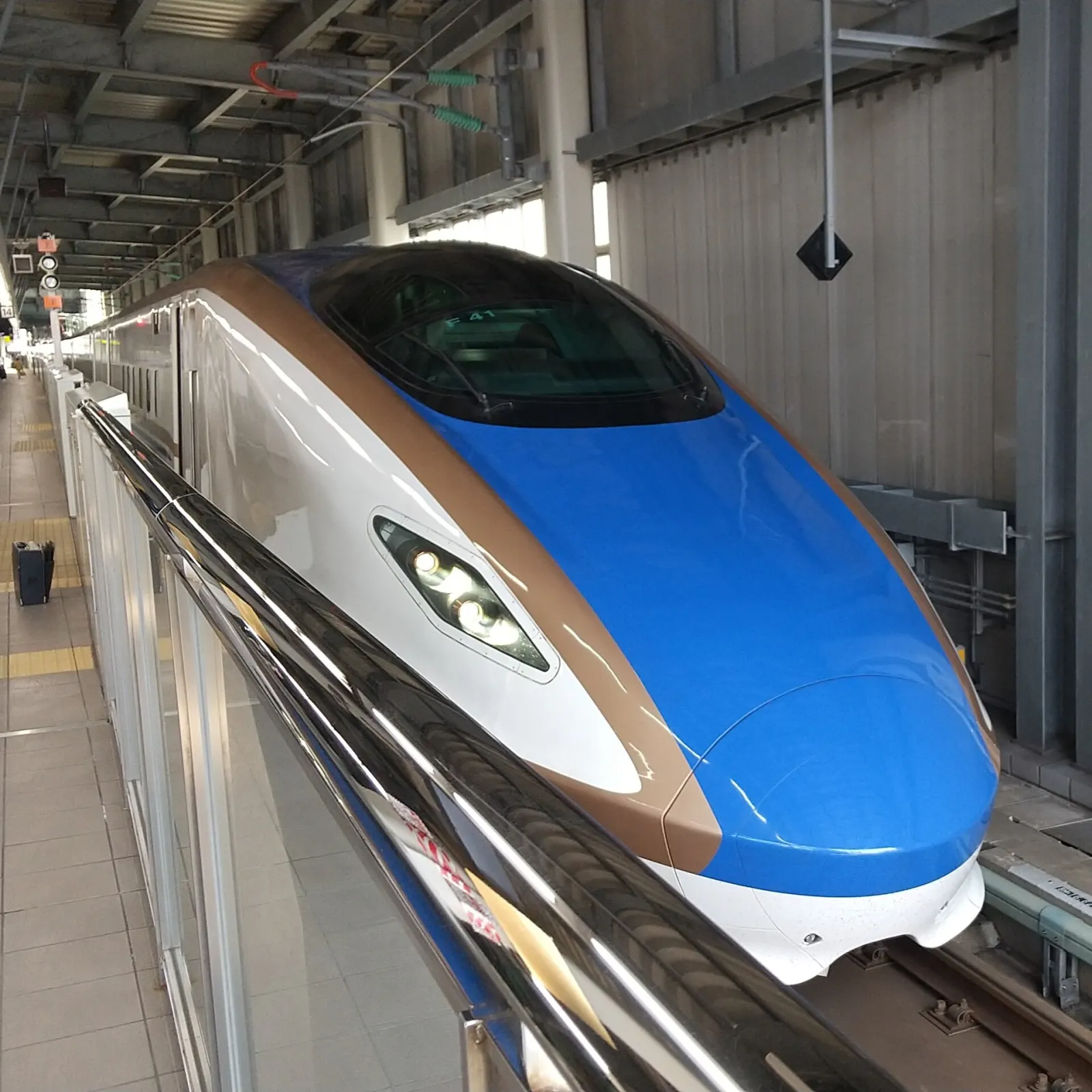
The Nagano–Kanazawa section of the Hokuriku Shinkansen opened in March 201594. The east plaza of Kanazawa Station had been completed earlier, in 20055.
5. Flights to Taipei and Tourism
A 2006 feature by Toyama Prefecture notes that the national government had made Taiwan, China, and South Korea priority markets for inbound tourism. Foreign group tourists on the Tateyama Kurobe Alpine Route numbered about 24,000 in 2003, 46,000 in 2004, and 74,000 in 2005, about 90 percent of them from Taiwan10. The prefecture put the jump in Taiwanese overnight guests in 2005 down to tour packages sold in Taiwan that combined the Aichi Expo with the Alpine Route, and to more charter flights from Taiwan to Toyama Airport10.
Scheduled flights between Komatsu and Taipei began in 20081112. In September that year the governor of Ishikawa told the prefectural assembly that average load factors had exceeded 80 percent in the first three months, and announced that a goodwill group of junior high school students would visit Taiwan the following spring11. Ishikawa’s chronology for 2018 records the launch of Tigerair Taiwan’s Komatsu–Taipei service on 18 January and the tenth anniversary of EVA Air’s Komatsu–Taipei service in June12.
International scheduled flights between Toyama Airport and Taipei began in April 2012. The first flight, on 16 April, was timed for the day before the Alpine Route opened for the season, and in May there were two flights a week13.
6. Disasters and Nuclear Power
In the Fukui floods of July 2004, 338 mm of rain fell in 24 hours in the Ichijō district of Fukui City. The damage reported by the governor to an extraordinary session of the assembly included 5 dead or missing, 19 injured, 341 households with homes destroyed or damaged, more than 14,000 households flooded, and losses of about 60.6 billion yen14.
At about 9:42 a.m. on 25 March 2007 a magnitude 6.9 earthquake struck the Noto Peninsula, with seismic intensity upper 6 in Nanao, Wajima, and Anamizu. Ishikawa’s chronology records 1 death, 338 injured, 684 buildings destroyed, and 1,732 half-destroyed15.
Unit 1 of the Shika nuclear power station had suffered a criticality accident during its fifth periodic inspection in 199916. In June 2007 the governor of Ishikawa told the assembly that both the accident and its eight-year concealment had overturned trust in nuclear power; the government ordered Hokuriku Electric Power to change its safety regulations, and the company presented measures including moving its nuclear headquarters to Shika17.
After the Great East Japan Earthquake of 2011, Fukui Prefecture had taken in 503 evacuees by 31 July18.
7. People and Works
Fujiko Fujio Ⓐ (Abiko Motoo, 1934–2022), who appeared in the late Shōwa note, was named an honorary citizen of Himi in June 2008. Himi has a Ninja Hattori-kun mechanical clock and a Ninja Hattori-kun train on the JR Himi Line, and the Shiokaze Gallery holds exhibitions of his manga19.
In 2009 Toyama Prefecture gave its citizens’ honour award to the film director Takita Yōjirō after he won the Academy Award for Best Foreign Language Film4.
Fujita Yoshinaga, a writer from Fukui City, debuted in 1986 with the hard-boiled novel Yabō no labyrinth, won the Naoki Prize in 2001 for the love story Ai no ryōbun and the Yoshikawa Eiji Prize in 2017 for Taisetsu monogatari, and died in 202020.
On 1 May 2019 the era name changed to Reiwa2.
8. Places to Visit Today
| Area | Place | Type | Notes |
|---|---|---|---|
| Kanazawa | 21st Century Museum of Contemporary Art | Museum | Opened 2004; the public zone is free, exhibitions charge by show6 |
| Kanazawa | D. T. Suzuki Museum | Museum | Opened 20115 |
| Kanazawa | Kanazawa Noh Museum | Museum | Opened 20065 |
| Kanazawa | Tsuzumi-mon gate, Kanazawa Station | Structure | East plaza completed 20055 |
| Toyama | Toyama Light Rail line | Tram | Opened 20068 |
| Toyama | Fugan Canal Kansui Park | Park | Completed 20114 |
| Toyama | Kōshi no Kuni Literature Museum | Museum | Opened 2012; exhibition on the manga artist Ima Ichiko, 12 Sep – 23 Nov 2026, closed Tuesdays421 |
| Tateyama | Tateyama Museum of Toyama | Museum | Opened 19914 |
| Nanto | Ainokura, Gokayama | World Heritage | Listed 19954 |
| Takaoka | Zuiryūji | National Treasure | Designated 19974 |
| Imizu | Kaiwo Maru Park and Shinminato Bridge | Park / Bridge | Ship on display from 1990, bridge opened 20124 |
| Himi | Himi Shiokaze Gallery | Museum | Fujiko Fujio Ⓐ manga exhibition19 |
References
Footnotes
-
Kanazawa City Library, “City history chronology: Shōwa sequel” (emperor’s death 7 January and Heisei 8 January 1989): https://www2.lib.kanazawa.ishikawa.jp/reference/shishinenpyou_s.htm ↩
-
Wikipedia (Japanese), “Reiwa” (from 1 May 2019, when Naruhito acceded): https://ja.wikipedia.org/wiki/%E4%BB%A4%E5%92%8C ↩ ↩2
-
Prime Minister’s Office, “85th prime minister Mori Yoshirō” (born in Ishikawa; 5 April – 4 July 2000): https://www.kantei.go.jp/jp/rekidainaikaku/085.html ; “86th prime minister Mori Yoshirō” (4 July 2000 – 26 April 2001): https://www.kantei.go.jp/jp/rekidainaikaku/086.html ↩
-
Toyama Prefecture, “Toyama chronology: Heisei” (Kaiwo Maru 1990; Tateyama Museum 1991; Gokayama World Heritage 1995; Zuiryūji National Treasure 1997; award to Takita Yōjirō 2009; Kansui Park completed 2011; Shinminato Bridge, Taipei flights, Itai-itai Disease Museum, Kōshi no Kuni Literature Museum, glaciers, and Ramsar listing 2012; Hokuriku Shinkansen 2015): https://www.pref.toyama.jp/1021/kensei/kouhou/naruhodo/politics-4.html ↩ ↩2 ↩3 ↩4 ↩5 ↩6 ↩7 ↩8 ↩9 ↩10 ↩11 ↩12
-
Kanazawa City, “Local chronology” (sports festival 1991; core city 1996; 21st Century Museum 2004; station east plaza 2005; Noh Museum 2006; first “historic city” and UNESCO City of Crafts 2009; D. T. Suzuki Museum 2011; Hokuriku Shinkansen 2015): https://www4.city.kanazawa.lg.jp/soshikikarasagasu/kohokochoka/gyomuannai/5/5/12/2048.html ↩ ↩2 ↩3 ↩4 ↩5
-
Kanazawa City Tourism Association, “21st Century Museum of Contemporary Art, Kanazawa” (SANAA; free public zone above ground; exhibition fees vary): https://www.kanazawa-kankoukyoukai.or.jp/everyone/spot/detail_10066.html ↩ ↩2
-
Toyama Prefectural Institute for Public Health, “Changes in municipal names after mergers” (Nanto and Tonami 1 November 2004; Toyama 1 April 2005; Takaoka and Imizu 1 November 2005; Kurobe 1 April 2006): https://www.pref.toyama.jp/1279/kansen/hc.html ↩
-
Toyama City, “Revitalising public transport (compact city plan)” (Toyama Light Rail opened April 2006; city tram loop opened December 2009; through running onto the Kamidaki Line; an LRT network of about 25.3 km): https://www.city.toyama.lg.jp/shisei/machizukuri/1015396/1017397.html ↩ ↩2
-
Ishikawa Prefecture, “Hokuriku Shinkansen: the story so far” (Karuizawa–Nagano work from September 1991; Isurugi–Kanazawa August 1992; Takasaki–Nagano opened October 1997; Toyama–Kanazawa work June 2005; Kanazawa–Tsuruga August 2012; train names October 2013; Nagano–Kanazawa opened March 2015): https://www.pref.ishikawa.jp/shink/zensen/history/index.html ↩ ↩2 ↩3
-
Toyama Prefecture, feature “Attracting visitors from abroad” (2006; priority markets; Alpine Route foreign group tourists about 24,000 in 2003, 46,000 in 2004, 74,000 in 2005, about 90 percent from Taiwan; Aichi Expo packages and charter flights): https://www.pref.toyama.jp/sections/1015/ecm/back/2006aug/tokushu/index2.html ↩ ↩2
-
Ishikawa Prefecture, governor’s address to the assembly, 11 September 2008, “On the Komatsu–Taipei flights” (three months in service, load factor over 80 percent, student goodwill visit): https://www.pref.ishikawa.lg.jp/chiji/gikai/h20_9_11/02.html ↩ ↩2
-
Ishikawa Prefecture, “Prefectural chronology 2018” (Tigerair Taiwan Komatsu–Taipei from 18 January; tenth anniversary of EVA Air Komatsu–Taipei in June): https://www.pref.ishikawa.lg.jp/kouhou/nenpyo/h30.html ↩ ↩2
-
Toyama Prefecture, feature “Attracting visitors from abroad” (June 2012; Toyama–Taipei scheduled flights from April 2012, first flight 16 April, two a week): https://www.pref.toyama.jp/sections/1015/ecm/back/2012jun/tokushu/index1.html ↩
-
Fukui Prefecture, governor’s statement to the 339th extraordinary assembly (Fukui floods: 338 mm in 24 hours at Ichijō; 5 dead or missing; 19 injured; 341 households with homes destroyed or damaged; over 14,000 flooded; about 60.6 billion yen): https://www.pref.fukui.lg.jp/doc/seiki/h16-8teianriyuu.html ↩
-
Ishikawa Prefecture, “Prefectural chronology 2007” (about 9:42 a.m. 25 March; M6.9; upper 6 in Nanao, Wajima, and Anamizu; 1 dead; 338 injured; 684 destroyed; 1,732 half-destroyed): https://www.pref.ishikawa.lg.jp/kouhou/nenpyo/h19-1.html ↩
-
Ishikawa Prefecture nuclear safety council, “Shika Unit 1 criticality accident of fiscal 1999” (accident during the fifth periodic inspection): https://atom.pref.ishikawa.lg.jp/resource/genan/rinkai.html ↩
-
Ishikawa Prefecture, governor’s address to the assembly, 12 June 2007, “On the Shika criticality accident” (concealed for eight years; order to change safety regulations; nuclear headquarters moved to Shika): https://www.pref.ishikawa.lg.jp/chiji/gikai/h19_6_12/09.html ↩
-
Fukui Prefecture, “Support for disaster areas by the prefecture and local groups” (503 evacuees received as of 31 July 2011): https://www.pref.fukui.lg.jp/doc/kikitaisaku/shienjoukyou.html ↩
-
Himi City, “Honorary citizens of Himi” (Fujiko Fujio Ⓐ, named 11 June 2008, 1934–2022; mechanical clock, Hattori-kun train, Shiokaze Gallery exhibitions): https://www.city.himi.toyama.jp/gyosei/shisei/himi/4/2468.html ↩ ↩2
-
Fukui Prefectural Furusato Literature Museum, “Fujita Yoshinaga, five years on” (from Fukui City; debut 1986; Naoki Prize 2001 for Ai no ryōbun; Yoshikawa Eiji Prize 2017 for Taisetsu monogatari; died 2020): https://www.library-archives.pref.fukui.lg.jp/bungaku/category/kikaku2025/41217.html ↩
-
Toyama Prefecture, “Advance tickets for the exhibition ‘The World of Manga Artist Ima Ichiko’ at the Kōshi no Kuni Literature Museum” (13 August 2026; 12 September – 23 November 2026, 9:30–18:00, closed Tuesdays): https://www.pref.toyama.jp/1740/kensei/kouhou/houdou/2026/8gatsu/imaitiko_maeuri.html ↩