This note follows seven earlier ones on Hokuriku: prehistory, Asuka, Nara, Heian, Kamakura, Muromachi, and late Sengoku. It moves into the early and middle Edo period, from the early seventeenth century to about 1780. The focus stays on Kanazawa, Toyama, and Komatsu, the places this trip passes through, with Zuiryū-ji in Takaoka, the Hakusan foothills, and Inotani in southern Toyama added. Month and day dates follow the Japanese calendar of the time and are not converted to Gregorian dates unless noted; years are given with their Western equivalents.
The late Sengoku note ended in 1600, with Nomi district also passing to Maeda Toshinaga after the Battle of Asainawate. In the Edo period most of Kaga, Noto, and Etchū were Maeda lands. The three towns had different roles. Kanazawa was the castle town of the Kaga domain; Toyama became the seat of the Toyama branch domain around 1639; and Komatsu was where the third lord, Maeda Toshitsune, retired.
1. The Edo Period and the Kaga Domain
The Edo period is usually defined as the 265 years from 1603, when Tokugawa Ieyasu became shogun and set up his government in Edo, to the change of era name to Meiji in 18681. A common subdivision is early (1603 to about 1690), middle (about 1690 to about 1780), late (about 1780 to about 1850), and final (1853–1868)1. This note covers the first two.
According to the permanent exhibition of the Ishikawa Prefectural Museum of History, the Kaga domain began in 1581 when Maeda Toshiie received the province of Noto; with two districts of northern Kaga and three of Etchū granted by Hideyoshi, and two districts of southern Kaga gained after Sekigahara, its lands exceeded a million koku. The Maeda were tozama (outside) daimyo, but they married into the shogun’s family and were treated within the shogunate on a level close to the three senior Tokugawa branch houses2.
2. 1639: Toshitsune’s Branch Domains and Retirement to Komatsu
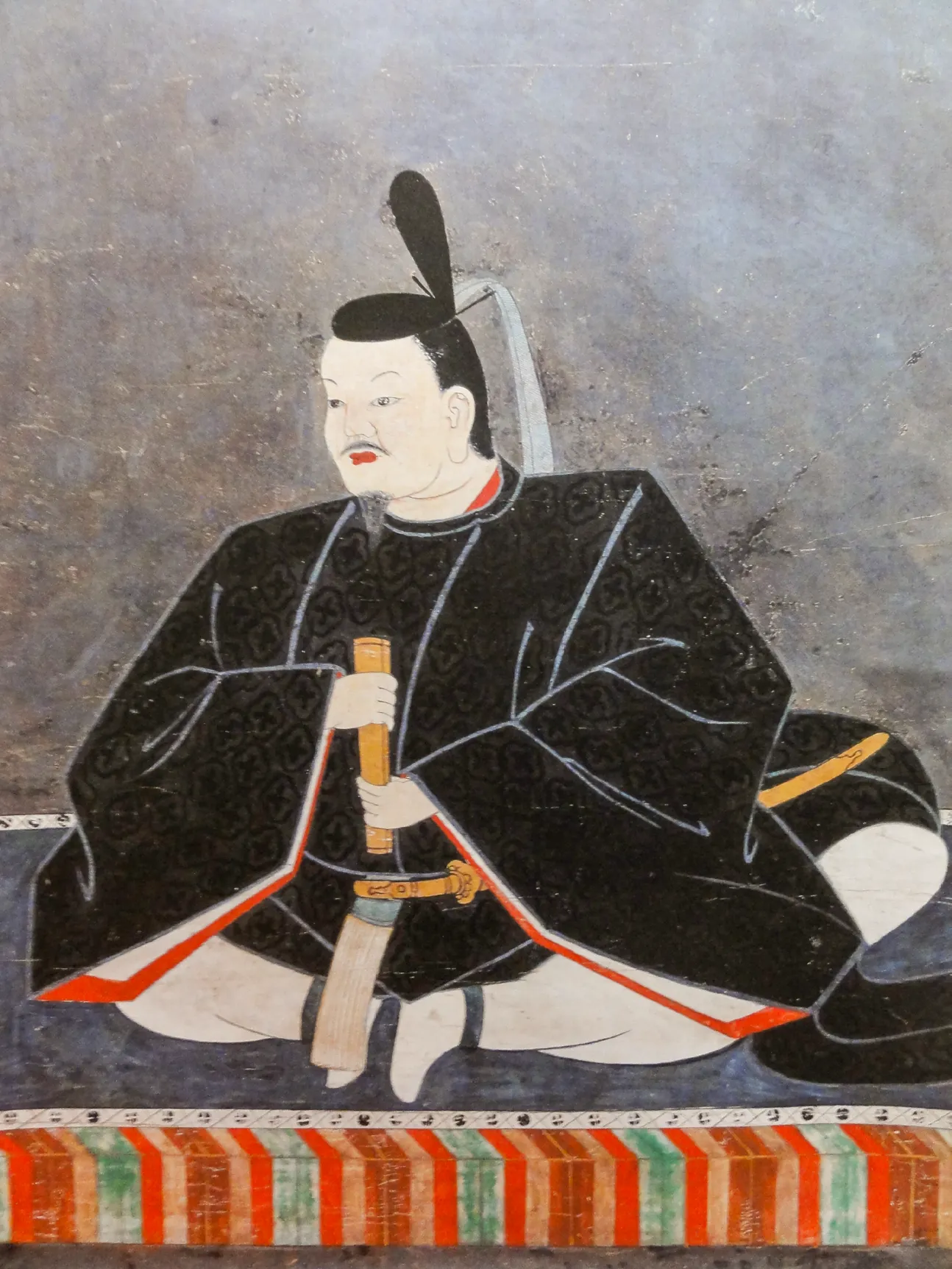
Maeda Toshitsune, third lord of Kaga. He split off the Toyama and Daishōji domains and then retired to Komatsu. Source: Wikimedia Commons
Toyama City’s account says the Toyama domain was created in Kan’ei 16 (1639) with the permission of the third shogun, Tokugawa Iemitsu. Maeda Toshitsune, third lord of Kaga, retired and granted Toyama, worth 100,000 koku, to his second son Toshitsugu and Daishōji, worth 70,000 koku, to his third son Toshiharu; no other branch house received as much as 100,000 koku3. Toshitsugu first had shogunal permission to build a new castle at Hyakuzuka in Toyama but abandoned it, and through an exchange of lands with Kaga was formally allowed to make the disused Toyama Castle his seat, which it remained until the end of the shogunate3. The chronology of the Toyama Medicine Museum dates the separation of the Toyama domain from Kaga to Kan’ei 17 (1640)4. The two Toyama City sources differ by a year, so both are given here.
Toshitsune himself retired to Komatsu. According to Komatsu City, when the shogunate allowed him in Kan’ei 16 (1639) to make Komatsu Castle his retirement castle, full-scale construction began; he moved in the next year and used it until his death in Manji 1 (1658). The castle was then surrounded by wetlands and the Kakehashi River, and was also called Ashi-jō or the “floating castle” of Komatsu5. It is the same castle Niwa Nagashige held in the late Sengoku note.
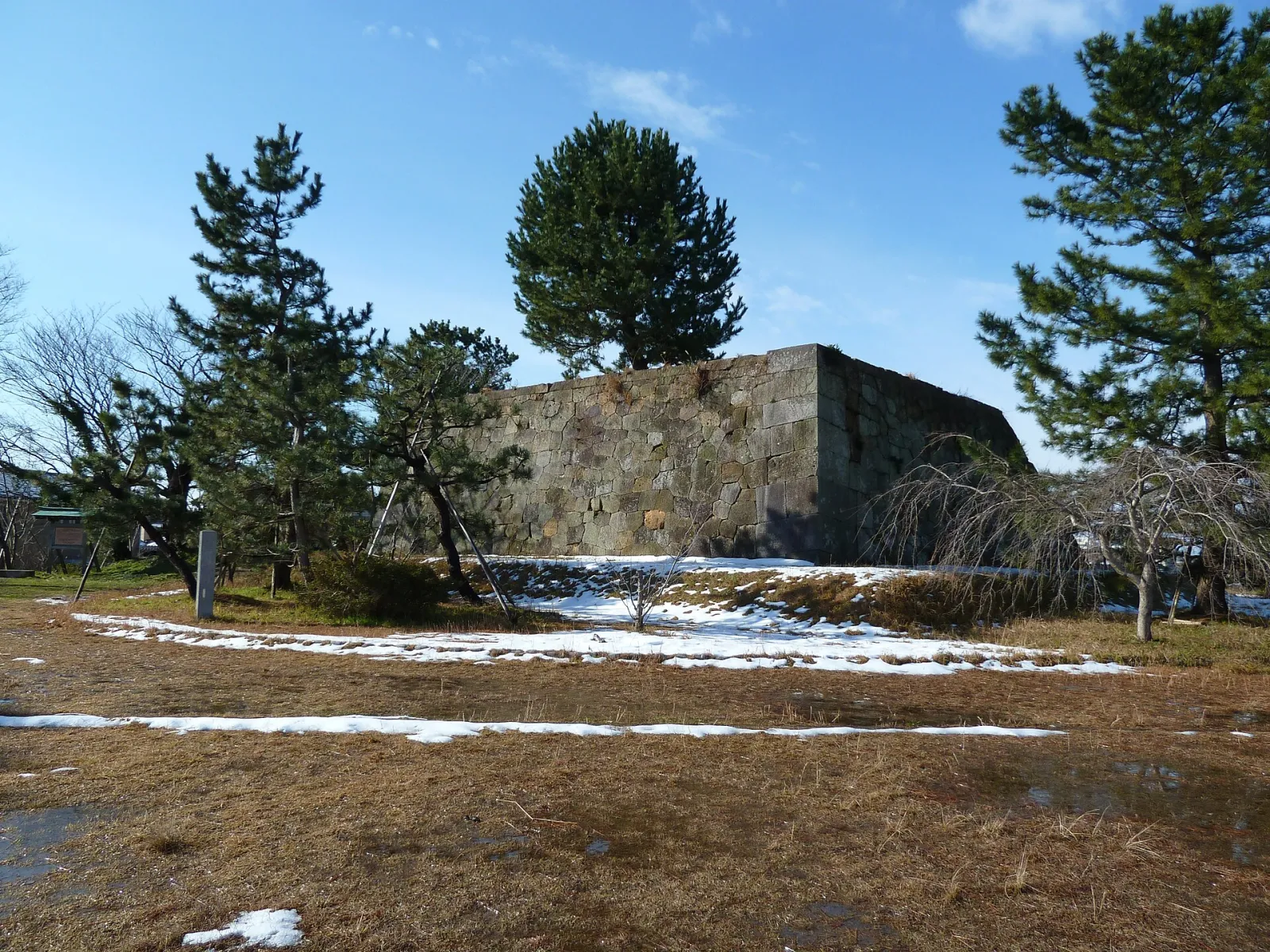
The surviving turret-base wall stands on the grounds of Komatsu High School. Source: Wikimedia Commons (CC0)
The only surviving structures and walls are the Unagibashi Gate, moved to Raishō-ji as its temple gate, and the turret-base wall of the main enclosure on the grounds of the prefectural Komatsu High School; excavations have found stone walls, moats, and smoked roof tiles underground6. Komatsu City advises asking each facility whether the site can be visited6.
Komatsu City also writes that after Toshitsune retired to Komatsu in Kan’ei 17 (1640), samurai, craftsmen, and merchants began to settle in the castle town7. In Meireki 3 (1657) Toshitsune built Komatsu Tenmangū, said to have been placed precisely on the line of the unlucky northeast direction from Komatsu and Kanazawa castles to protect the domain8. The renga poet Nōjun, a priest of Kitano Tenmangū, was invited to run it5. Toshitsune also restored Natadera in Kan’ei 17, building its three-storey pagoda, main hall, goma hall, bell tower, and study hall5; the Muromachi note recorded the temple’s ruin in the Ikkō ikki wars.
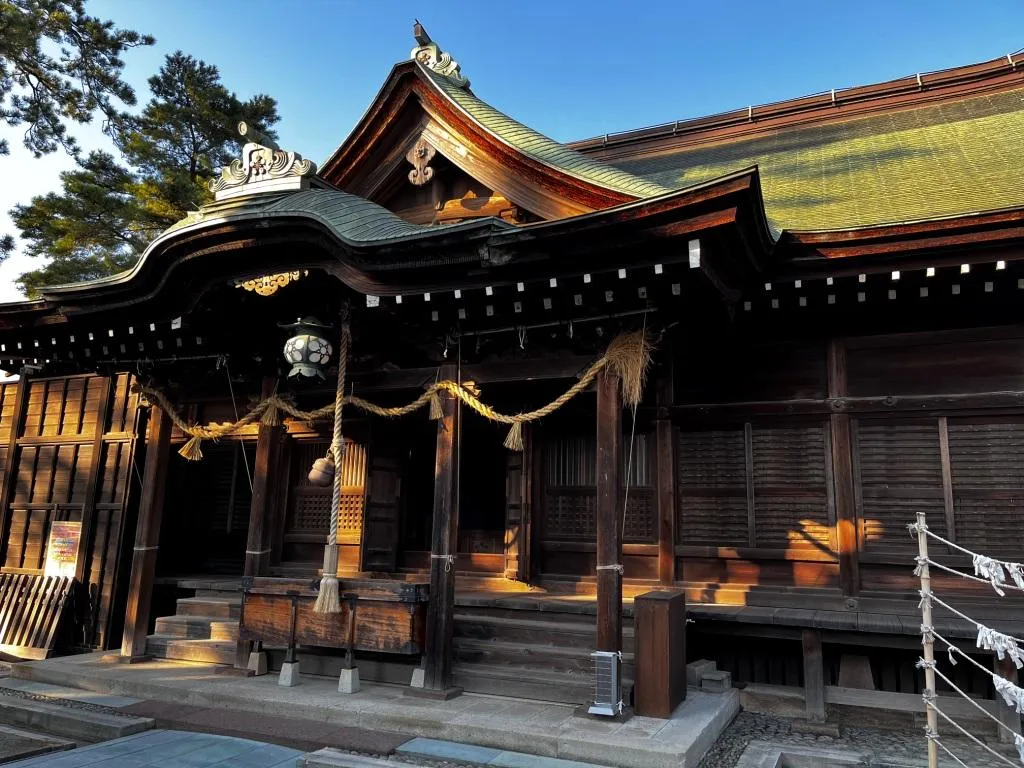
Komatsu Tenmangū by the Kakehashi River. Photo: Towacoco, licensed under CC BY 4.0, converted to WebP. Source: Wikimedia Commons
In Takaoka, between Kanazawa and Toyama, is Zuiryū-ji, the family temple Toshitsune built up for his elder brother Toshinaga. Takaoka City’s account says Toshinaga built Takaoka Castle in Keichō 14 (1609) and died in Keichō 19 (1614). For Toshinaga’s sanjūsankai-ki (thirty-third memorial observance, counted with the year of death as the first) in Shōhō 3 (1646), thirty-two years after his death, Toshitsune laid out his tomb and began a major rebuilding of the temple, appointing the domain’s master carpenter Yamagami Zen’emon Yoshihiro to lead it9. According to the Takaoka Machizu no Ben of Meiwa 8 (1771), the main buildings, including the gate, Buddha hall, and lecture hall, were built in the Shōhō, Meireki, and Manji eras, and the corridors were finished by Kanbun 3 (1663) at the latest; a newer view puts the start of work in Jōō 2 (1653)9. The Buddha hall, lecture hall, and gate are National Treasures; the present gate was rebuilt in Bunsei 1 (1818) after a fire9.
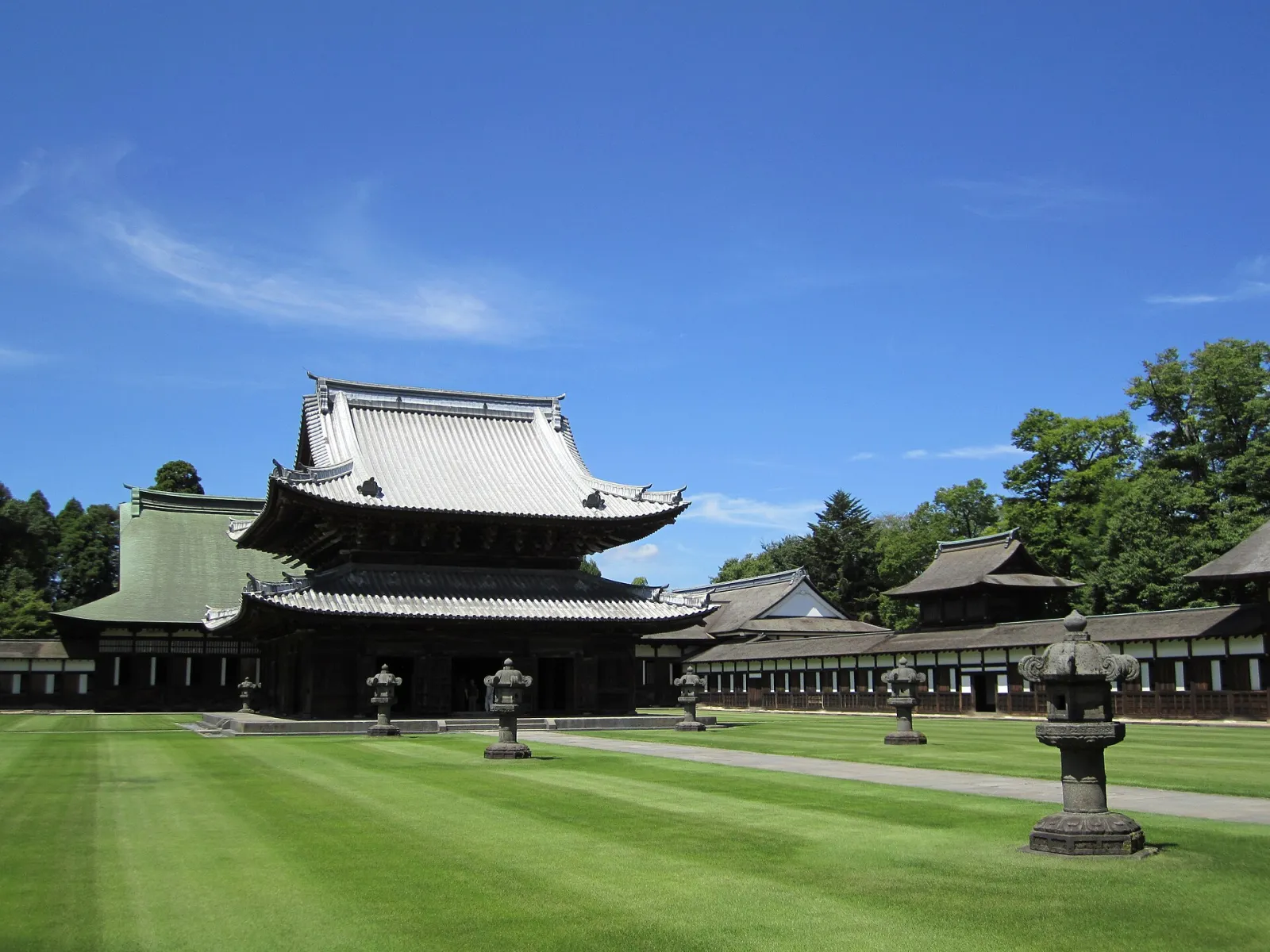
Toshinaga’s family temple, laid out under Toshitsune. Photo: 柑橘類, licensed under CC BY-SA 3.0, resized and converted to WebP. Source: Wikimedia Commons
3. Kanazawa: Canal, Garden, Tōshōgū, and Town Maps
Kanazawa Castle burned in a fire in the town in Kan’ei 8 (1631), and the following year, Kan’ei 9 (1632), the Tatsumi Canal was completed to bring water into the castle10. Kanazawa City, citing the Mitsubo Kikigaki (三壺聞書), says the canal was built after the Hōsenji fire of 1631 to improve the castle’s water supply; it used a tunnel in its upper course and an inverted siphon (fusekoshi) at its lowest section, and was finished in less than a year11. The siphon was first made of wooden pipes and later replaced with stone ones11. The intake is on the right bank of the upper Sai River at Kamitatsumi-machi, and the canal still feeds the winding stream in Kenroku-en; about 2 km of its middle course, from Nishiki-machi to Daidōwari, has been laid out as a walking path11.
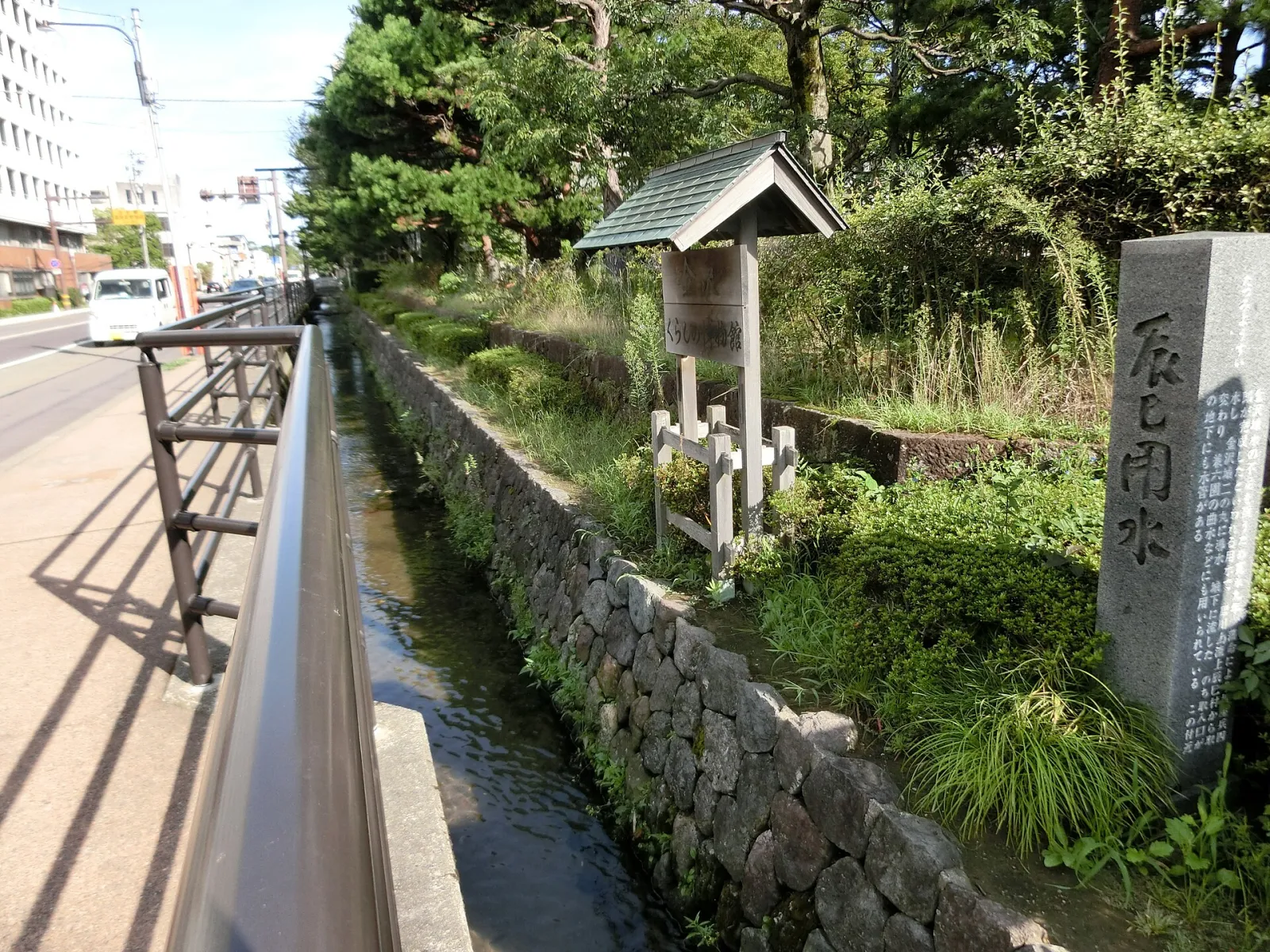
The Tatsumi Canal and its stone marker in the city. Source: Wikimedia Commons (Public domain)
Gyokusen’inmaru Garden inside the castle was a daimyo garden that Toshitsune began in Kan’ei 11 (1634). It lasted until the end of the Edo period, was lost after the domains were abolished, and was recreated in 2015 on the basis of excavation and old plans12. Its name comes from Gyokusen’in (Ei-hime), the wife of the second lord Toshinaga, who had her residence there; at the top of the “shikishi-tanzaku” stone wall behind it is a stepped waterfall fed by the Tatsumi Canal12.
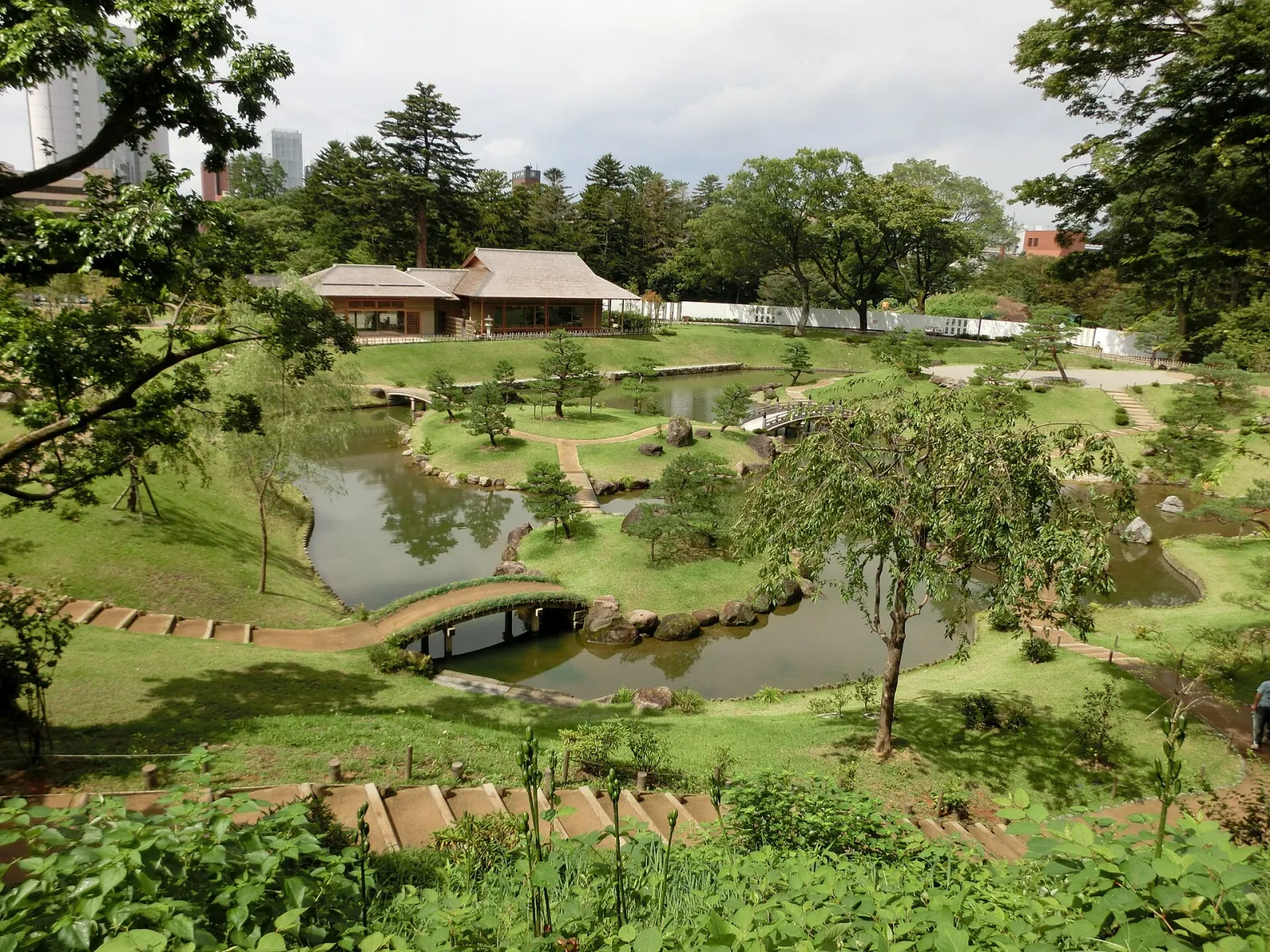
The present garden is a reconstruction based on excavation and old plans. Source: Wikimedia Commons (Public domain)
Ozaki Shrine was originally a Tōshōgū that the fourth lord, Maeda Mitsutaka, established in the Kitanomaru of Kanazawa Castle with shogunal permission. Built by Kaga carpenters to a design by the Kihara family, the shogunate’s chief carpenters, it was completed in Kan’ei 20 (1643); Kanazawa City describes it as one of the earliest Tōshōgū buildings with separate main and worship halls13. It was moved to its present site in Meiji 11 (1878)13.
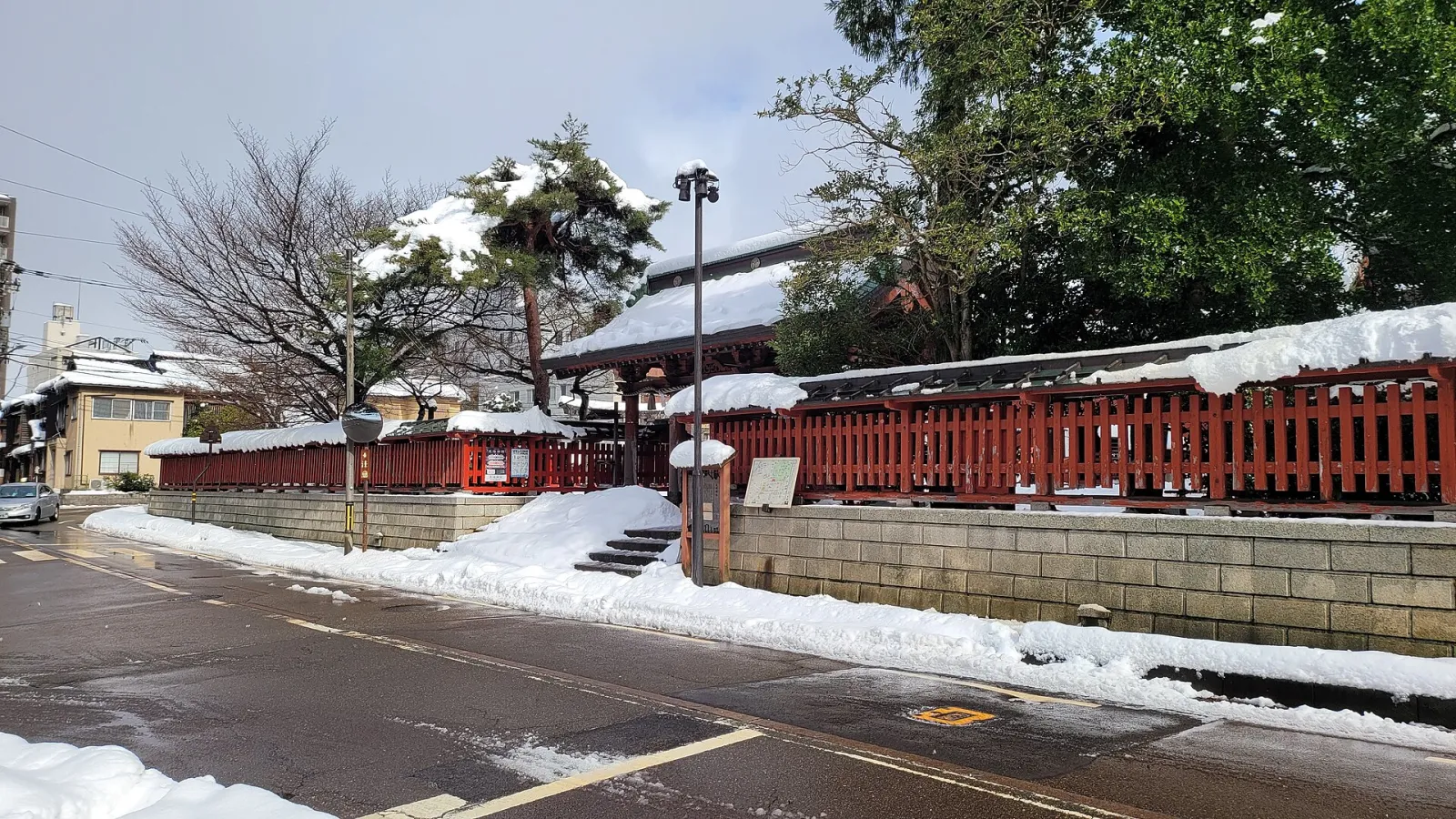
The vermilion fence of Ozaki Shrine in snow. Source: Wikimedia Commons (CC0)
According to the Ishikawa Prefectural Library, the domain’s town plans based on surveys are thought to have begun after the shogunate ordered them submitted in the Shōhō era (1644–48). The domain’s building office produced large maps of the town in Manji 3 (1660), Kanbun 7 (1667), and the Enpō era (1673–81); since the 1660 map has not been found, the Kanbun 7 map is the oldest surviving large map of the town14. The Kanbun map, over 5.6 m across, is drawn at one bu to one ken (1:600) and seems to have been made to show where people granted residential land by the lord lived. Compared with the Enpō map, it shows about seven years of change, including the formation of the yoriki quarter outside the outer moat, the spread of the town, and a sharp rise in tax-paying commoner districts14. Both are Ishikawa Prefecture cultural properties14.
4. Village Tax Documents and Levies
The Ishikawa Prefectural Museum of History notes that the Kaga domain treated the kaisakuhō reforms as its founding agricultural law2. The Toyama Prefectural Library explains that goinmono, also called mura-goin or mononari-jō, were sealed tax-assessment documents issued to each village, bearing the lord’s monogram and seal, and kept carefully in the village headman’s house. The Toyama domain issued them in Jōō 4 (1655), while villages in Niikawa district, which were Kaga lands until an exchange in Manji 3 (1660), kept using the Kaga documents issued in Meireki 2 (1656)15. The Ishikawa museum’s permanent exhibition also shows a mura-goin of Kanbun 10 (1670)2.
The mura-goin of Nishimata in the Komatsu City Museum comes with the museum’s full transcription. It opens “加州能美郡西又村遠山奥貮拾五ヶ村之内,” gives the assessed yield as 292 koku at a tax rate (men) of 3 tsu 3 bu, then lists the fixed rice levy, amounts to be paid in silver in instalments, a silver levy for labour obligations (fugin), and “壱貫八拾目 山役” (a mountain levy of one kan eighty monme of silver). It states that whatever magistrates, district headmen, or village headmen might say, “此印面之外/一圓承引仕間鋪候” (nothing beyond this sealed document is to be accepted)16. It ends “寛文十年/九月七日御印.” The museum explains that this sheet is actually a reissue by the domain’s accounts office in the fourth month of Kan’en 3 (1750): during the Hōei era (1704–1711), when the headman’s house caught fire, the document was left outside, forgotten, and damaged by rain, so a new copy was issued16. Yields, rates, and extra levies differed by village, so only this one village is quoted here.
5. 1668: The Eighteen Hakusan Foothill Villages Become Shogunal Land
According to the Komatsu city history, the right to repair the shrine buildings on the summit of Mount Hakusan had been disputed among villages since the Sengoku period, and the dispute flared again in Meireki 1 (1655). It arose directly between Ozō village in Kaga and Ushikubi and Kazarashi villages held in trust by the Fukui domain, but it also involved soma-tori rights, covering timber cutting tied to the building and repair of the summit shrines, and the border between the two domains, and both Kaga and Fukui immediately pressed their cases with the shogunate17. Around Kanbun 6 (1666) the fifth lord, Tsunanori, worked with his father-in-law Hoshina Masayuki and the shogunate’s finance commissioner Okada Yoshimasa to settle it, arranging for eighteen villages, including two Kaga villages, Ushikubi, Kazarashi, and the five Nishitani villages, to become shogunal land. This took formal effect in Kanbun 8 (1668), and the five Nishitani villages came under the Kasamatsu intendant in Mino, Sugita Kurōbei17. The history adds that, perhaps because the transfer followed the political logic of the rulers, it did not resolve the underlying dispute and had a large effect on local people who lived by cultivating distant fields, some of whom had to move to Noto; conflict in the Hakusan foothills only settled after a shogunal ruling in the mid-eighteenth century17.
The Edo-period narrative history Mitsubo Kikigaki, volume 21, “On the Hakusan Gongen Shrine,” also records the matter. In the tenth month of Kanbun 8, Sugita Kurōbei came from Edo as an official envoy to inspect Hakusan, and in the end “彼是御公領に相定り” (these were all made shogunal land); in exchange for Kaga’s villages of Ozō and Aratani, land was handed over at Kaizu in Ōmi18.
6. Maeda Tsunanori and the Hyakkō Hishō
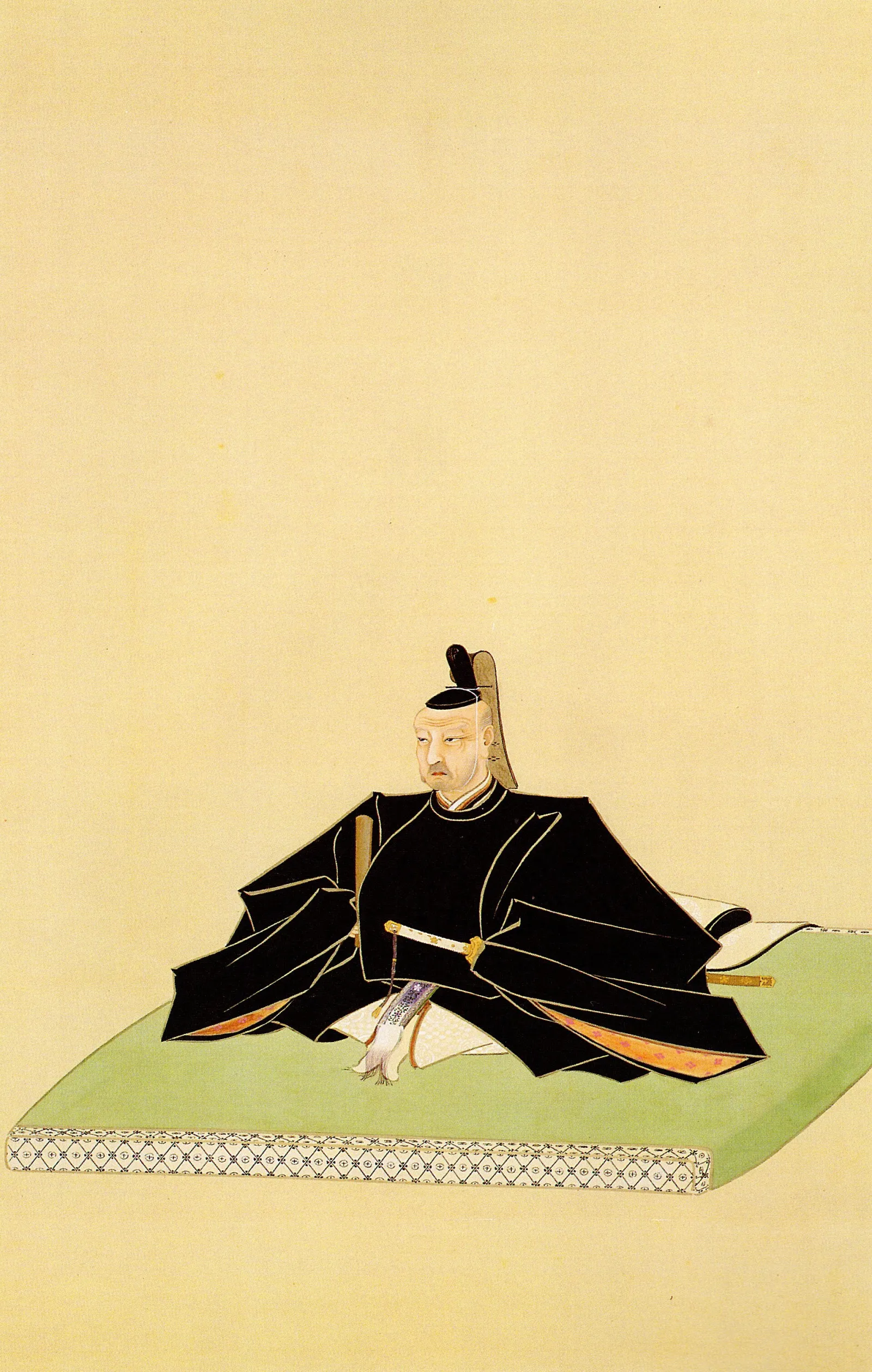
Maeda Tsunanori, fifth lord of Kaga. This is by the modern painter Shimomura Kanzan, not a likeness from Tsunanori’s lifetime. Source: Wikimedia Commons (Public domain)
Maeda Tsunanori, the fifth lord, succeeded in Shōhō 2 (1645) and died in Kyōhō 9 (1724)19. The Agency for Cultural Affairs database says he worked to promote learning and the fine and applied arts, collecting old and new books and newly arrived Chinese texts; to encourage crafts he had specimens made of every kind of decorative technique on paper, wood, bamboo, textiles, leather, and metal, labelling samples from around Japan with their place of origin. The resulting organised collection is the Hyakkō Hishō19. The Ishikawa Prefectural Library’s exhibition text adds that Tsunanori named it himself, hyakkō meaning the many crafts or craftsmen and hishō meaning comparison; collecting continued after his death, and its roughly 2,800 items are kept in ten boxes plus one supplementary box. Boxes 3 and 5 hold architectural metal fittings used in Kaga domain buildings such as Komatsu Castle and the Edo residences20. The Hyakkō Hishō is an Important Cultural Property owned by the Maeda Ikutokukai19.
7. The Toyama Domain: Maeda Masatoshi, Medicine, and Alternate Attendance
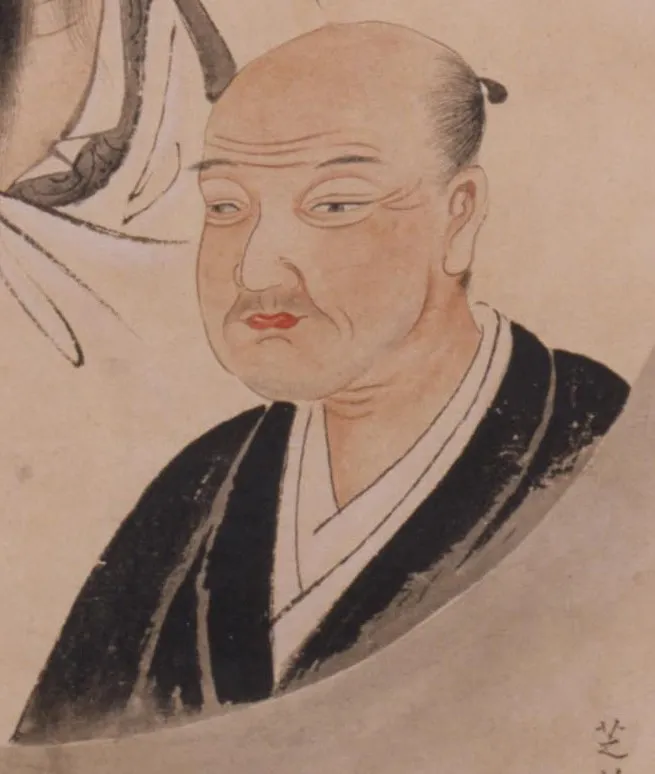
Maeda Masatoshi, second lord of Toyama. Source: Wikimedia Commons (Public domain)
Maeda Masatoshi (1649–1706), second lord of the Toyama domain, succeeded his father in Enpō 2 (1674)2122. The Toyama Municipal Folk Museum’s newsletter says he is known as the founder of the Etchū medicine trade, and that he also started ironworking, brought in craftsmen to teach their skills, and encouraged new rice-field development, cutting new irrigation channels for it21. The Toyama Medicine Museum’s chronology records a story that in Genroku 3 (1690) Masatoshi cured a certain daimyo’s stomach ache in Edo Castle4. The same chronology says that around the Genroku era the domain surveyed the Hangontan medicine sellers and began to regulate the trade; the Hangontan office was set up only later, in the late Edo period, in Bunka 13 (1816)4. A statue titled “Maeda Masatoshi, Second Lord of the Toyama Domain” stands in Toyama Castle Park23.
According to Toyama City, a revision of the Buke Shohatto in Kan’ei 12 (1635) set the system of alternate attendance for tozama daimyo: a year’s residence in Edo, changing over in the fourth month. The Toyama domain ranked highest among the branch houses; it travelled between Edo and home in the opposite rotation to Kaga and at important moments acted as Kaga’s representative. The changeover, first in the fourth month, was moved to the eighth or ninth month from Genroku 6 (1693)24.
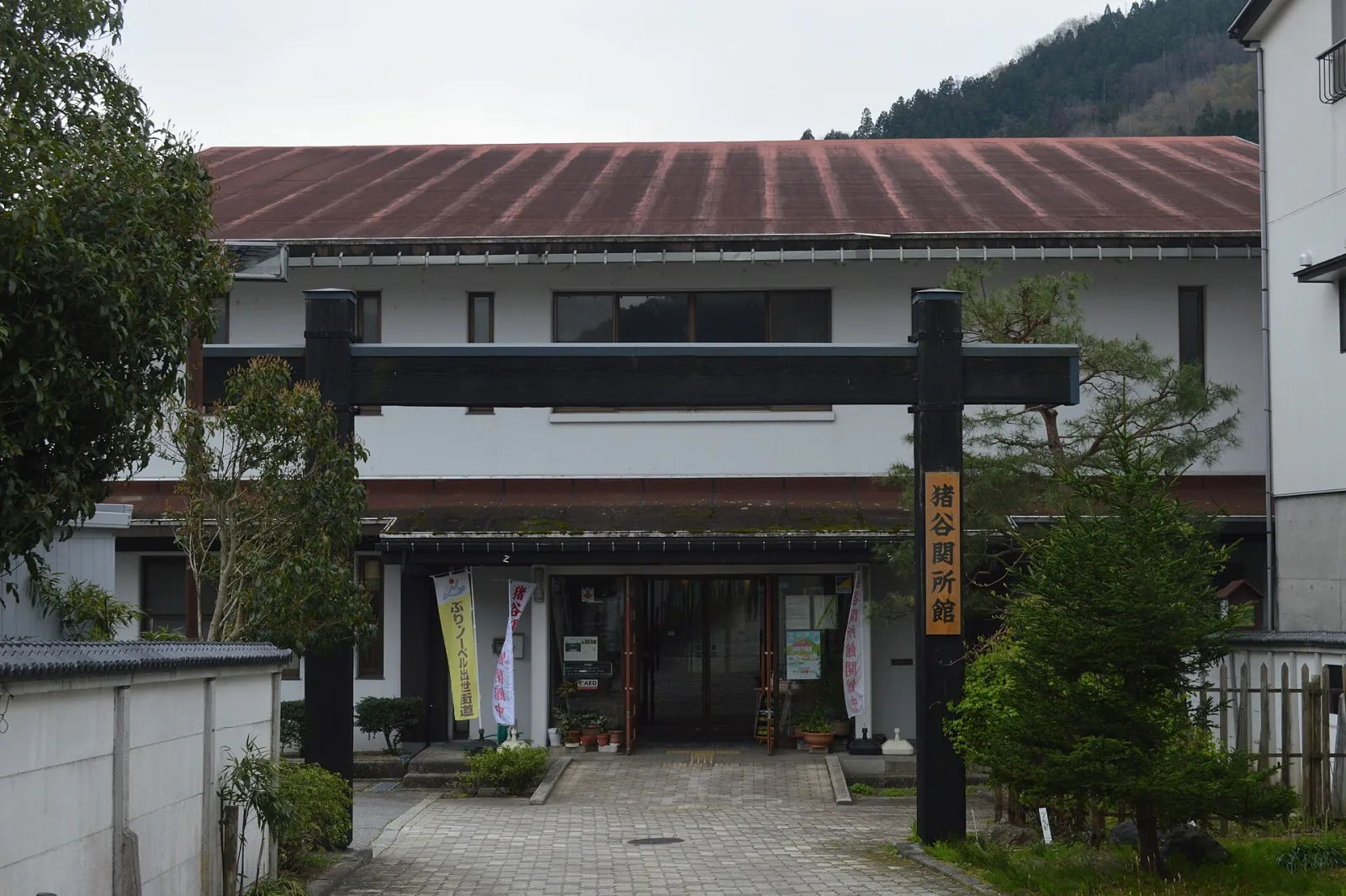
The checkpoint museum on the Hida road. Photo: Asturio Cantabrio, licensed under CC BY-SA 4.0, resized and converted to WebP. Source: Wikimedia Commons
Toyama City explains that the Hida road between Etchū and Hida was long an important route. In the Edo period the Toyama domain set up the West Inotani checkpoint on the left bank of the Jinzū River, and the Kaga domain the East Inotani checkpoint on the opposite bank. The Hashimoto and Yoshimura families served for generations as keepers of the West Inotani checkpoint, watching travellers and charging a toll (kuchiyakusen) on goods such as rice, salt, fish, and timber25. The Inotani Checkpoint Museum displays related documents and a large model of the checkpoint25.
8. 1689: Bashō in Hokuriku, and Chiyo-jo
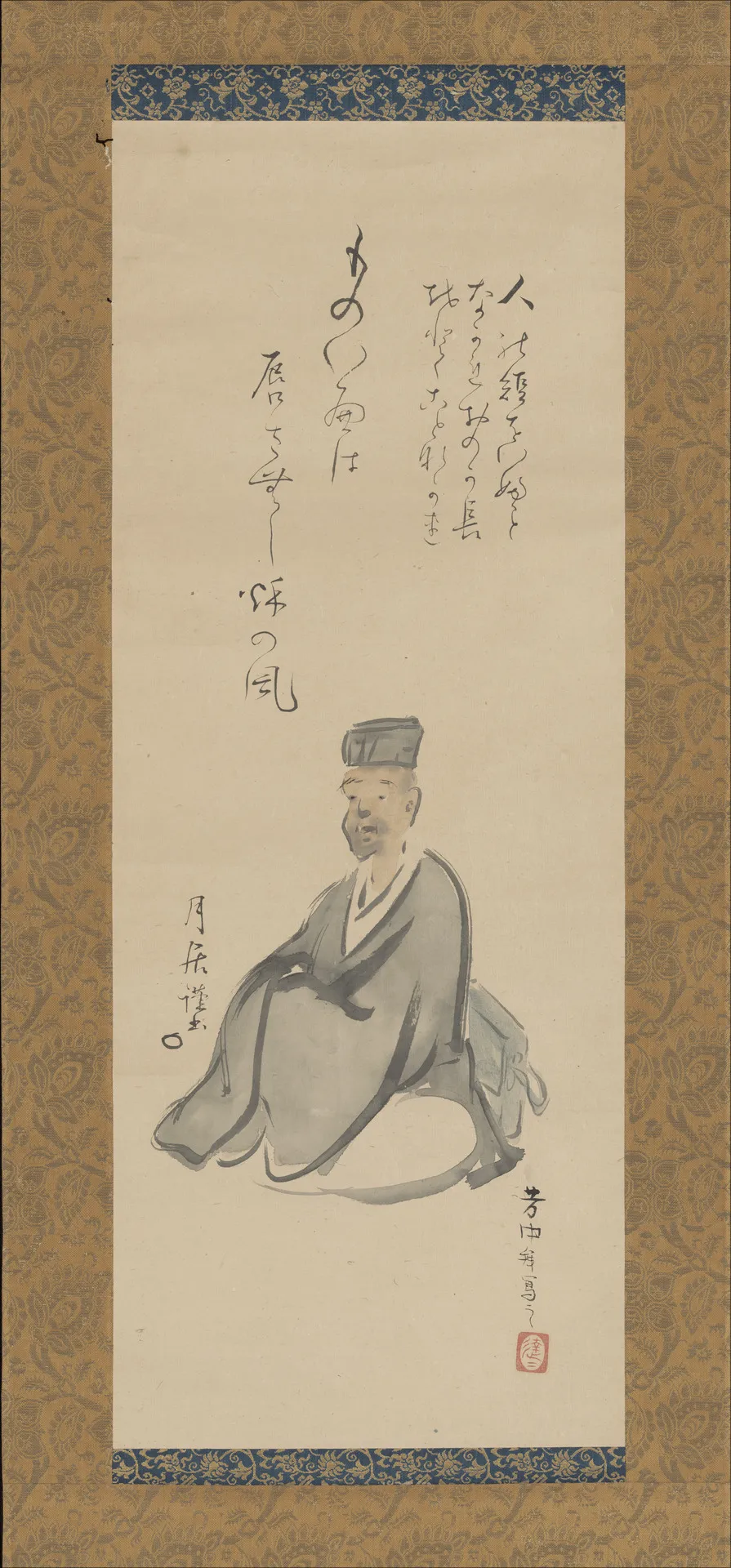
A portrait of Bashō by a later painter. Source: Wikimedia Commons (Public domain)
Oku no Hosomichi is the travel account of Matsuo Bashō’s journey through Ōshū and along the Hokurikudō in Genroku 2 (1689), setting out from Edo with his disciple Kawai Sora26. Entering Kaga he wrote “わせの香や分入右は有磯海”; crossing Unohanayama and the Kurikara valley, he reached Kanazawa on the fifteenth day of the seventh month27. The annotation gives this as 29 August in the solar calendar27. The Kurikara pass from the Heian note appears here as a place on Bashō’s road.
In Kanazawa Bashō learned that Isshō, a haikai poet of some reputation, had died young the previous winter. Isshō’s elder brother held a memorial gathering, and Bashō wrote “塚も動け我泣聲は秋の風” (Shake, grave mound; my weeping voice is the autumn wind)27. Ganen-ji in Nomachi, Kanazawa, is the family temple of the Kosugi (Isshō’s family); a stone with this verse stands at the gate and an Isshō mound in the grounds. Visitors may enter the grounds only, and on some days not at all28.
At Komatsu he wrote “しほらしき名や小松吹萩すゝき”27. At Tada Shrine he saw the helmet of Saitō Bettō Sanemori and wrote “むざんやな甲の下のきり/″\す” (How pitiful: beneath the helmet, a cricket)27. In his text Bashō writes that the helmet was offered to the shrine by Kiso Yoshinaka together with a prayer after Sanemori’s death27. The Battle of Shinohara, where Sanemori died, falls within the Heian note.
The helmet at Tada Shrine is a national Important Cultural Property, and the grounds have a verse stone. The treasure house requires advance booking and charges 500 yen; the helmet is shown to the public at the Kabuto Festival in late July29. Also in Komatsu are Suwamae Bashō Park, with a verse stone, and Kenshō-ji, which holds a wooden statue of Bashō (a Komatsu City cultural property) said to have been carved by his travelling companion and disciple Tachibana Hokushi; viewing it requires advance booking30.
According to Hakusan City’s chronology, Chiyo-jo was born in Genroku 16 (1703) into a family of scroll mounters in Mattō, Kaga. In Kyōhō 4 (1719) Kagami Shikō, one of Bashō’s ten leading disciples, visited and stayed with her, guiding her into haikai. In Hōreki 4 (1754) she became a nun, taking the name Soen. In Hōreki 13 (1763), when the shogunate made the Kaga domain responsible for receiving the Korean embassy, the domain chose her verses as gifts for the envoys, writing 21 of them on six hanging scrolls and fifteen fans31. She died in An’ei 4 (1775)31.
9. The Eighteenth Century: The Shōtoku Uprising, the Kaga Disturbance, the Hōreki Fire, and Festival Floats
On the tenth day of the eighth month of Shōtoku 2 (1712), a strong wind carrying salt from the sea blew across Kaga and damaged the rice crop3233. That year there were farmers’ protests in both the Kaga and Daishōji domains.
- Ishikawa district, Kaga domain: Nonoichi City’s account says farmers asked the domain to inspect the damage so that their tax rice could be reduced, but Ishikawa district, including Nonoichi, was left out of the inspection. In the ninth and tenth months large numbers of farmers demanding an inspection converged on Kanazawa, and the protest became an uprising. The domain jailed 22 people in Ishikawa district32.
- Enuma district, Daishōji domain: the Komatsu city history says the domain inspected the fields and decided not to reduce the tax. On the fourth day of the tenth month several hundred people gathered at Yatano, and on the sixth they attacked the inspecting officials lodged in Nata village, wrecked the Nata village headman’s house and Natadera’s Fudō-in, and obtained a written promise that “six tenths will be waived”33. Tax rice was in the end cut by sixty percent. The next spring twelve people were beheaded, all on charges unrelated to the uprising, and finally only Gonshirō, headman of Nata village, was beheaded as its leader33. The history notes similar disturbances the same year in Ishikawa district and in Tonami district in Etchū33.
The history lists as sources for the uprising accounts circulated secretly among commoners, such as the Natadera Tsuya Monogatari and Domin Sōranki, and domain records such as the Goyōban Nikki and Seirinki33.
Within the Kaga domain, the Kaga disturbance followed the death of the sixth lord, Maeda Yoshinori. Nantō City’s account of a memorial stone says that Ōtsuki Denzō, who had risen in Yoshinori’s favour, was confined to his house after Yoshinori’s death in Enkyō 2 (1745) on grounds including improper conduct during the lord’s illness, was exiled to Soyama village in Gokayama in the fourth month of Kan’en 1 (1748), and later took his own life in confinement34. The Ishikawa Prefectural Museum of History summarises the affair differently: Ōtsuki, who had risen from Yoshinori’s personal attendant to the senior hitomochi rank (3,800 koku), was exiled to Gokayama in Etchū for an alleged affair with Yoshinori’s concubine Shinnyoin; it adds that the domain’s finances deteriorated from about this time2. The two sources give different grounds for his punishment, so both are noted here. Maeda Naomi (1714–1774), fifth head of the Maeda Tosa-no-kami house, is said to have led the attack on Ōtsuki Tomomoto (Denzō)35. To restore its finances the domain issued paper money called ginsatsu in Hōreki 5 (1755), which instead threw the economy into confusion; within the domain there was continuing debate over whether to return to the kaisakuhō or try new approaches such as promoting local products2.
In Hōreki 9 (1759) a great fire in the town burned Kanazawa Castle completely10.
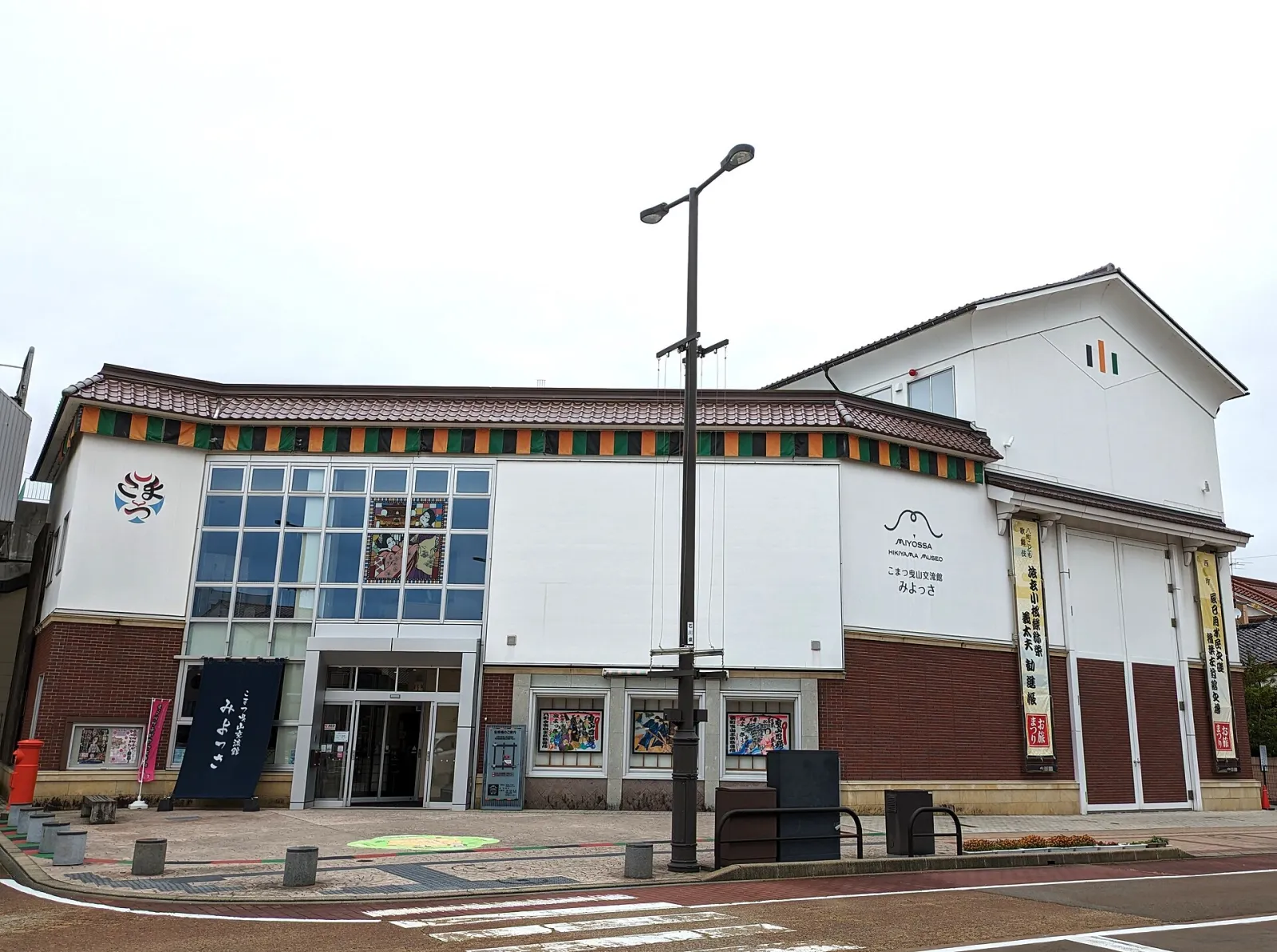
The hall where two festival floats are on permanent display. Photo: Suikotei, licensed under CC BY 4.0, resized and converted to WebP. Source: Wikimedia Commons
Komatsu City says the Hikiyama children’s kabuki performed on festival floats is said to have begun in Meiwa 3 (1766) in Ryūsuke-machi and Nishi-machi. At its height there were 16 to 18 floats; by about Bunka 10 there were 10, and two were lost in two great fires in the Shōwa period, leaving eight today7. Miyossa displays two of the floats permanently7.
From about 1780 the period is counted as late Edo; in Kanazawa the domain school was founded in Kansei 4 (1792), and the Ninomaru palace burned completely in Bunka 5 (1808)1036.
10. Places You Can Visit Today
| Area | Place | Type | Notes |
|---|---|---|---|
| Kanazawa | Gyokusen’inmaru Garden | Garden (recreated) | Begun 1634, recreated 2015; free entry12 |
| Kanazawa | Tatsumi Canal walking path | Canal / path | Completed 1632; about 2 km from Nishiki-machi to Daidōwari11 |
| Kanazawa | Ozaki Shrine | Shrine / Important Cultural Property | The castle’s Tōshōgū, completed 164313 |
| Kanazawa | Ganen-ji | Temple / verse stone | Bashō’s “Tsuka mo ugoke” stone and Isshō mound; grounds only, closed on some days28 |
| Komatsu | Komatsu Castle keep base | Castle site | Turret-base wall of Toshitsune’s retirement castle, on Komatsu High School grounds; ask before visiting6 |
| Komatsu | Komatsu Tenmangū | Shrine | Built by Toshitsune in 16578 |
| Komatsu | Tada Shrine | Shrine / verse stone | Sanemori’s helmet; treasure house by appointment29 |
| Komatsu | Kenshō-ji and Suwamae Bashō Park | Temple / park | Bashō statue by appointment; verse stone in the park30 |
| Komatsu | Komatsu Hikiyama Exchange Hall Miyossa | Museum | Two festival floats on permanent display7 |
| Komatsu | Natadera | Temple | Restored by Toshitsune in 1640; scene of the 1712 Shōtoku uprising533 |
| Takaoka | Zuiryū-ji | Temple / National Treasure | Toshinaga’s family temple; Buddha hall, lecture hall, and gate are National Treasures9 |
| Toyama | Toyama Castle Park (statue of Maeda Masatoshi) | Park / statue | Seat of the Toyama domain; Masatoshi statue in the park323 |
| Toyama | Toyama Medicine Museum, Toyama Folk Crafts Village | Museum | 9:00–17:00, adults 100 yen; closed 24–27 November 202637 |
| Toyama | Inotani Checkpoint Museum | Museum | Documents and model of the Hida road checkpoint; adults 150 yen; closed Mondays (except public holidays), the day after a public holiday (except weekends), and 28 December–4 January25 |
References
Footnotes
-
Edo period (1603–1868; early, middle, late, and final subdivisions): https://ja.wikipedia.org/wiki/%E6%B1%9F%E6%88%B8%E6%99%82%E4%BB%A3 ↩ ↩2
-
Ishikawa Prefectural Museum of History, permanent exhibition “Early Modern” (formation and lands of the Kaga domain; treatment close to the senior Tokugawa houses; mura-goin of Kanbun 10; the Kaga disturbance, Ōtsuki Denzō and Shinnyoin; ginsatsu of 1755; kaisakuhō and local-products policy): https://www.ishikawa-rekihaku.jp/exhibition/04.html ↩ ↩2 ↩3 ↩4 ↩5
-
Toyama City, “Outline of the Toyama Domain and Toyama Castle” (created Kan’ei 16; Toshitsugu 100,000 koku and Toshiharu 70,000 koku; abandoned Hyakuzuka castle; Toyama Castle as seat): https://www.city.toyama.toyama.jp/etc/maibun/toyamajyo/edo-toyamahan/syoukai/syoukai2.htm ↩ ↩2 ↩3
-
Toyama Medicine Museum, “Chronology of the Toyama Medicine Trade” (separation in 1640; the 1690 stomach-ache story; survey of Hangontan sellers around Genroku; Hangontan office 1816): https://www.city.toyama.toyama.jp/etc/minzokumingei/baiyaku/baiyaku_nenpyou.html ↩ ↩2 ↩3
-
Komatsu City, “Places Associated with the Maeda Family” (permission for the retirement castle in Kan’ei 16; move the next year; death in Manji 1; Ashi-jō and the floating castle; Natadera restored Kan’ei 17; Nōjun at Komatsu Tenmangū; Unagibashi Gate at Raishō-ji): https://www.city.komatsu.lg.jp/soshiki/1016/bunka_rekishi/2/2170.html ↩ ↩2 ↩3 ↩4
-
Komatsu City, “Komatsu Castle Site” (major rebuilding from Kan’ei 16; Unagibashi Gate and turret-base wall at Komatsu High School; excavated walls, moats, and smoked tiles; ask each facility about access): https://www.city.komatsu.lg.jp/soshiki/1052/kokabetsurekishijiman/chisho_koka/8937.html ↩ ↩2 ↩3
-
Komatsu City, “Kabuki Town” (Toshitsune’s retirement in Kan’ei 17 and growth of the town; Hikiyama children’s kabuki from Meiwa 3 in Ryūsuke-machi and Nishi-machi; number of floats; two floats at Miyossa): https://www.city.komatsu.lg.jp/soshiki/1006/siseiyouran/2553.html ↩ ↩2 ↩3 ↩4
-
Komatsu Tourism Navi, “Komatsu Tenmangū” (built by Toshitsune in Meireki 3; on the northeast line from Komatsu and Kanazawa castles): https://www.komatsuguide.jp/spot/detail_169.html ↩ ↩2
-
Takaoka City, “Takaoka-san Zuiryū-ji” (Toshinaga’s Takaoka Castle in 1609 and death in 1614; Toshitsune’s rebuilding from Shōhō 3; Yamagami Zen’emon Yoshihiro; Takaoka Machizu no Ben; the Jōō 2 view; National Treasure buildings; gate rebuilt in Bunsei 1): https://www.city.takaoka.toyama.jp/gyosei/kanko_bunka_sports/rekishi_bunkazai/9/3/5928.html ↩ ↩2 ↩3 ↩4
-
Ishikawa Prefecture Kanazawa Castle and Kenroku-en Management Office, “History” chronology (castle burned Kan’ei 8; Tatsumi Canal Kan’ei 9; great fire and total loss of the castle Hōreki 9; Kansei 4; Ninomaru palace burned Bunka 5): https://shiro-niwa.pref.ishikawa.lg.jp/history.html ↩ ↩2 ↩3
-
Kanazawa City, “Tatsumi Canal” (completed Kan’ei 9; the Hōsenji fire in the Mitsubo Kikigaki; tunnel and inverted siphon; wooden then stone pipes; intake at Kamitatsumi-machi; Kenroku-en stream; 2 km path from Nishiki-machi to Daidōwari): https://www4.city.kanazawa.lg.jp/soshikikarasagasu/rekishitoshisuishinka/gyomuannai/1/1/18478.html ↩ ↩2 ↩3 ↩4
-
Kanazawa Tabimonogatari, “Gyokusen’inmaru Garden” (begun by Toshitsune in Kan’ei 11; recreated 2015; origin of the name; shikishi-tanzaku wall and stepped waterfall; free entry): https://www.kanazawa-kankoukyoukai.or.jp/everyone/spot/detail_52485.html ↩ ↩2 ↩3
-
Kanazawa City, “Ozaki Shrine” (Tōshōgū established by Maeda Mitsutaka in the Kitanomaru; Kihara design; completed Kan’ei 20; one of the earliest with separate halls; moved Meiji 11): https://www4.city.kanazawa.lg.jp/soshikikarasagasu/bunkazaihogoka/gyomuannai/3/1/2/5025.html ↩ ↩2 ↩3
-
Ishikawa Prefectural Library, “Kanazawa in Large Maps” (shogunal order in the Shōhō era; maps of Manji 3, Kanbun 7, and Enpō; Kanbun 7 map the oldest surviving; 1:600; changes seen in the Enpō map; prefectural cultural properties): https://www.library.pref.ishikawa.lg.jp/shosho/digicolle/curation/DIGICOLLE04 ↩ ↩2 ↩3
-
Toyama Prefectural Library, “Village tax documents (goinmono) of Jōō 4 and Meireki 2” (goinmono as mura-goin or mononari-jō; kept by headmen; Toyama issue of Jōō 4; Niikawa villages using Kaga’s Meireki 2 seals; copies made in Bunkyū 2): https://www.lib.pref.toyama.jp/gallery/collection/intro.aspx?isnvmngcd=1%3A1052 ↩
-
Komatsu City Museum, “Mura-goin of Nishimata village” (reissued by the accounts office in Kan’en 3; seal of the 7th of the 9th month of Kanbun 10; museum transcription and note): https://jmapps.ne.jp/kmthk/det.html?data_id=364 ↩ ↩2
-
Komatsu City, Zusetsu Komatsu no Rekishi, Early Modern 13, “The Eighteen Hakusan Foothill Villages Become Shogunal Land and the Nishitani Villages,” pp. 86–87 (renewed dispute in Meireki 1; Ozō versus Ushikubi and Kazarashi; Tsunanori, Hoshina Masayuki, and Okada Yoshimasa; transfer in Kanbun 8; Sugita Kurōbei; effects on residents; shogunal ruling in the mid-18th century): https://www.city.komatsu.lg.jp/material/files/group/39/313hakusanroku.pdf ↩ ↩2 ↩3
-
Mitsubo Kikigaki, volume 21, “On the Hakusan Gongen Shrine” (envoy Sugita Kurōbei in the 10th month of Kanbun 8; “彼是御公領に相定り”; exchange of Ozō and Aratani for land at Kaizu in Ōmi): Wikisource transcription https://ja.wikisource.org/wiki/%E4%B8%89%E5%A3%BA%E8%81%9E%E6%9B%B8/%E5%B7%BB%E4%B9%8B%E4%BA%8C%E5%8D%81%E4%B8%80 ; 1931 printed edition, NDL: https://dl.ndl.go.jp/pid/1176709 ↩
-
Agency for Cultural Affairs, Database of National Cultural Properties, “Hyakkō Hishō” (Tsunanori succeeded Shōhō 2, died Kyōhō 9; books and Chinese texts; craft specimens; place names; Important Cultural Property; Maeda Ikutokukai): https://kunishitei.bunka.go.jp/heritage/detail/201/7123 ↩ ↩2 ↩3
-
Ishikawa Prefectural Library, “Hyakumangoku Culture Mandala,” section on the Hyakkō Hishō (origin of the name; collecting after Tsunanori’s death; about 2,800 items; ten boxes plus one; fittings from Komatsu Castle and the Edo residences): https://www.library.pref.ishikawa.lg.jp/shosho/curation/KIKAKUTEN0005 ↩
-
Toyama Municipal Folk Museum, Hakubutsukan Dayori no. 36, collection note “New Year calligraphy by Maeda Masatoshi” (succeeded Enpō 2; founder of the medicine trade; ironworking, craftsmen, new fields): https://www.city.toyama.toyama.jp/etc/muse/tayori/tayori36/tayori36.htm ↩ ↩2
-
Ishikawa Prefectural Library, person record “Maeda Masatoshi” (1649–1706; died on the 19th of the 4th month of Hōei 3): https://www.library.pref.ishikawa.lg.jp/shosho/furucolle/list/prsn11478 ↩
-
Toyama City, “Foreign-language panels for the statue of Maeda Masatoshi and the Chitose-zakura stone in Toyama Castle Park”: https://www.city.toyama.lg.jp/bunka/kanko/1010539/1018250.html ↩ ↩2
-
Toyama City, “Alternate Attendance (the road between Toyama and the Edo residence)” (Buke Shohatto of Kan’ei 12; opposite rotation to Kaga; acting as Kaga’s representative; changeover moved to the 8th or 9th month from Genroku 6): https://www.city.toyama.toyama.jp/etc/maibun/toyamajyo/edo-toyamahan/sankinkoutai/sankinkoutai.htm ↩
-
Toyama City, “Inotani Checkpoint Museum” (Hida road; West and East Inotani checkpoints; Hashimoto and Yoshimura families; kuchiyakusen; hours, closing days, and fees): https://www.city.toyama.lg.jp/bunka/bunka/1010547/1010551/1010554/1007477.html ↩ ↩2 ↩3
-
Oku no Hosomichi (left Edo with Kawai Sora in 1689 for Ōshū and the Hokurikudō): https://ja.wikipedia.org/wiki/%E3%81%8A%E3%81%8F%E3%81%AE%E3%81%BB%E3%81%9D%E9%81%93 ↩
-
Matsuo Bashō, Oku no Hosomichi, annotated by Sugiura Shōichirō, Aozora Bunko (Kaga, Kanazawa, and Ōta Shrine sections with notes): https://www.aozora.gr.jp/cards/002240/files/61619_78128.html ↩ ↩2 ↩3 ↩4 ↩5 ↩6
-
Kanazawa Tabimonogatari, “Ganen-ji” (Kosugi family temple; Bashō verse stone and Isshō mound; grounds only): https://www.kanazawa-kankoukyoukai.or.jp/spot/detail_10077.html ↩ ↩2
-
Komatsu Tourism Navi, “Tada Shrine and Treasure House” (Sanemori’s helmet; verse stone; treasure house by appointment; fee; Kabuto Festival): https://www.komatsuguide.jp/spot/detail_124.html ↩ ↩2
-
Komatsu Tourism Navi, “Following Bashō’s Path in Komatsu” (Suwamae Bashō Park; Kenshō-ji’s Bashō statue and Tachibana Hokushi; booking): https://www.komatsuguide.jp/modelcourse/detail_26.html ↩ ↩2
-
Hakusan City, “Chronology of Chiyo-jo” (born in Mattō 1703; visit of Kagami Shikō 1719; became a nun as Soen 1754; gifts for the Korean embassy 1763; died 1775): https://www.city.hakusan.lg.jp/bunka/bunkashinko/1002773/1002775/1002776.html ↩ ↩2
-
Nonoichi City, “The Shōtoku Uprising and Nonoichi” (strong west wind on the 10th of the 8th month of 1712; Ishikawa district excluded from inspection; march on Kanazawa in the 9th–10th months; 22 jailed): https://www.city.nonoichi.lg.jp/soshiki/37/1362.html ↩ ↩2
-
Komatsu City, Zusetsu Komatsu no Rekishi, Early Modern 19, “The Shōtoku Uprising,” pp. 98–99 (reduction requests in the Daishōji domain; gathering at Yatano on the 4th of the 10th month; the Nata village incident on the 6th; the “six tenths” promise; 60 percent reduction; twelve executions the next year and Gonshirō; similar disturbances in Ishikawa and Tonami; sources): https://www.city.komatsu.lg.jp/material/files/group/39/319shotoku.pdf ↩ ↩2 ↩3 ↩4 ↩5 ↩6
-
Nantō City Culture and Arts Archive, “Memorial Stone of Ōtsuki Denzō” (house confinement after Yoshinori’s death in Enkyō 2 on grounds including conduct during the lord’s illness; exile to Soyama in the 4th month of Kan’en 1; suicide in confinement): https://culture-archives.city.nanto.toyama.jp/culture/bunkazai/bunkazai0199/ ↩
-
Maeda Tosa-no-kami Family Museum, “Successive Heads” (fifth head Naomi, 1714–1774; leader of the attack on Ōtsuki Tomomoto): https://www.kanazawa-museum.jp/maedatosa/about/page_2.html ↩
-
Kanazawa City, “Kaga Domain School Plaques” (Meirindō and Keibukan founded in Kansei 4): https://www4.city.kanazawa.lg.jp/soshikikarasagasu/bunkazaihogoka/gyomuannai/3/1/1/siteibunkazai/2/5914.html ↩
-
Toyama Folk Crafts Village, “Toyama Medicine Museum” (opened 1984; about 6,000 items): https://www.city.toyama.toyama.jp/etc/minzokumingei/baiyaku/baiyaku.html ; Toyama Folk Crafts Village (hours, fees, November 2026 closure notice): https://www.city.toyama.toyama.jp/etc/minzokumingei/ ↩