This note continues the Hokuriku prehistory, Asuka, Nara, and Heian notes. We now move into the Kamakura period (roughly 1185/1192–1333), again focusing on Kanazawa, Toyama, and Komatsu. The Muromachi period and later will be a separate note.
The Heian note ended with Kurikara Pass in 1183 and the fall of the Taira in 1185. In the Kamakura period, the Hokuriku material is more scattered: the Jōkyū War of 1221 made the Hokuriku road a route toward Kyoto again; Ataka in Komatsu kept the legend of Yoshitsune’s northward flight, later taken up by the Noh and kabuki play Kanjinchō; Tateyama preserves an early-Kamakura object of mountain worship; and Shinran’s Jōdo Shinshū becomes important in later Hokuriku history.
1. What Was the Kamakura Period?
There are two common starting points for the Kamakura period: 1185, when the Taira fell and Minamoto no Yoritomo gained the right to appoint shugo (provincial constables) and jitō (land stewards), or 1192, when Yoritomo became shogun; it ends with the fall of the Kamakura shogunate in 13331. The vocabulary of provincial rule changed in this era: the governors and provincial capitals of the Heian period gave way to the shogunate’s shugo — responsible for a province’s military affairs and its housemen — and jitō, who reached down into estates and public lands, while warriors bound to the shogun by vassalage were called gokenin1. Real power in the shogunate soon concentrated in the Hōjō regents.
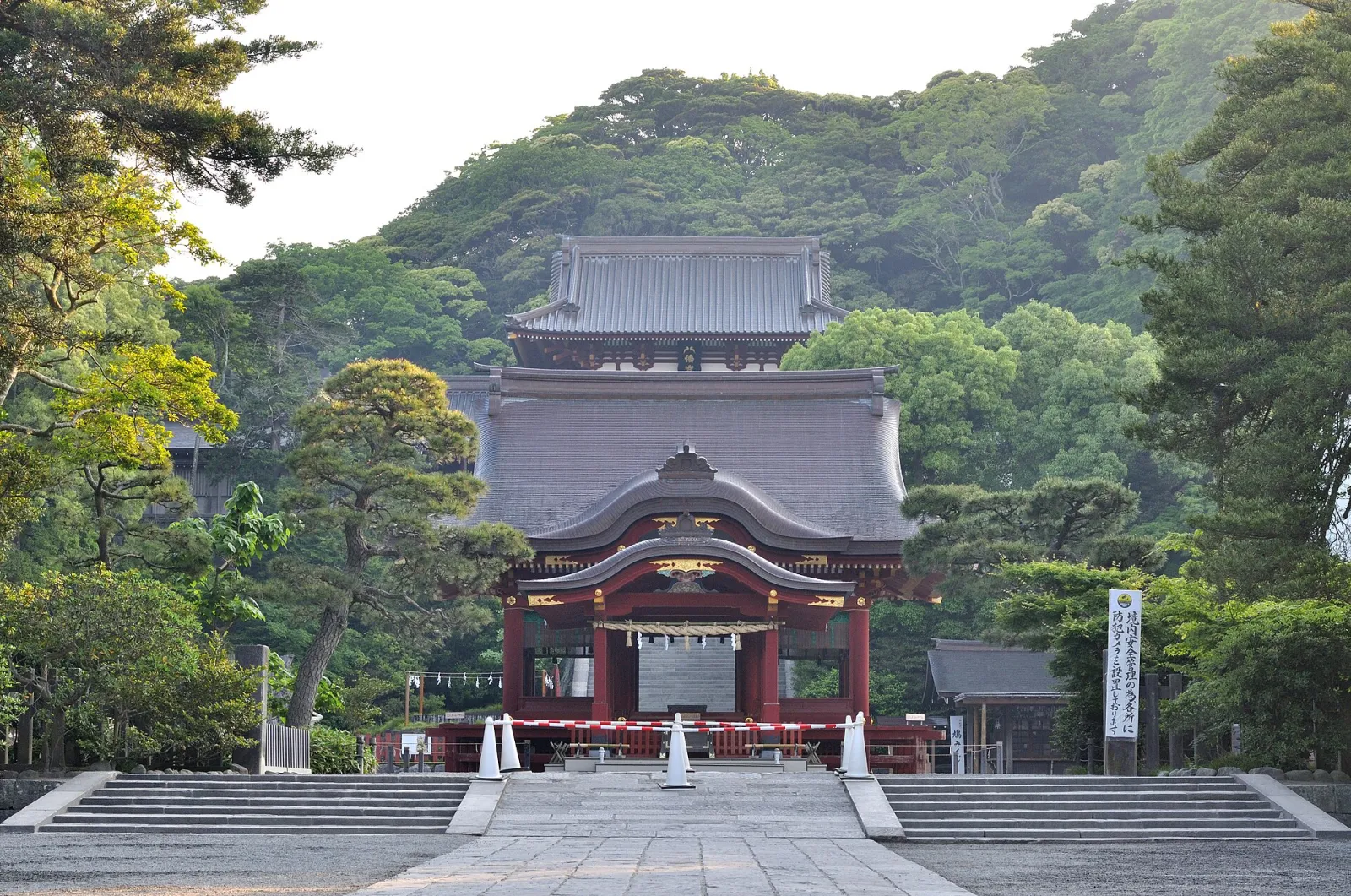
Tsurugaoka Hachimangū in Kamakura. From this era on, Hokuriku’s shugo, jitō, and gokenin all answered to the warrior government here. Source: Wikimedia Commons
For Hokuriku, the period left no famous castles — warrior strongholds were still residences ringed by earthworks and moats, and the Kanazawa and Toyama castles travelers know belong to later ages. What Kamakura-period Hokuriku offers instead is institutions, legend, and religion.
2. The Jōkyū War of 1221: The Hokuriku Road Leads to the Capital Again
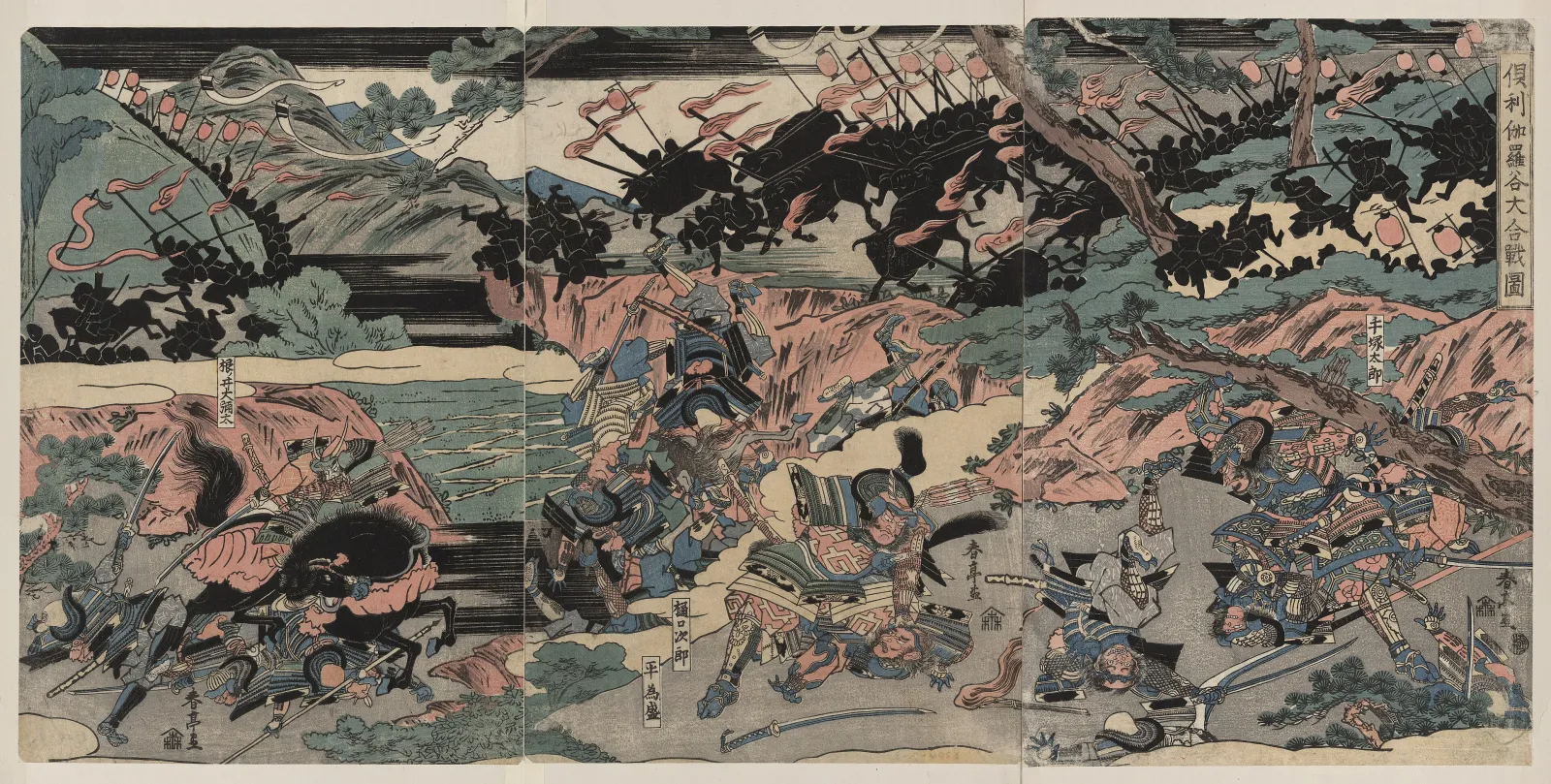
The moment Kamakura-period Hokuriku came closest to national politics was the Jōkyū War of 1221, when the retired emperor Go-Toba raised arms against the regent Hōjō Yoshitoki. The shogunate chose to march on Kyoto, splitting its forces along the Tōkaidō, Tōsandō, and Hokurikudō roads2.
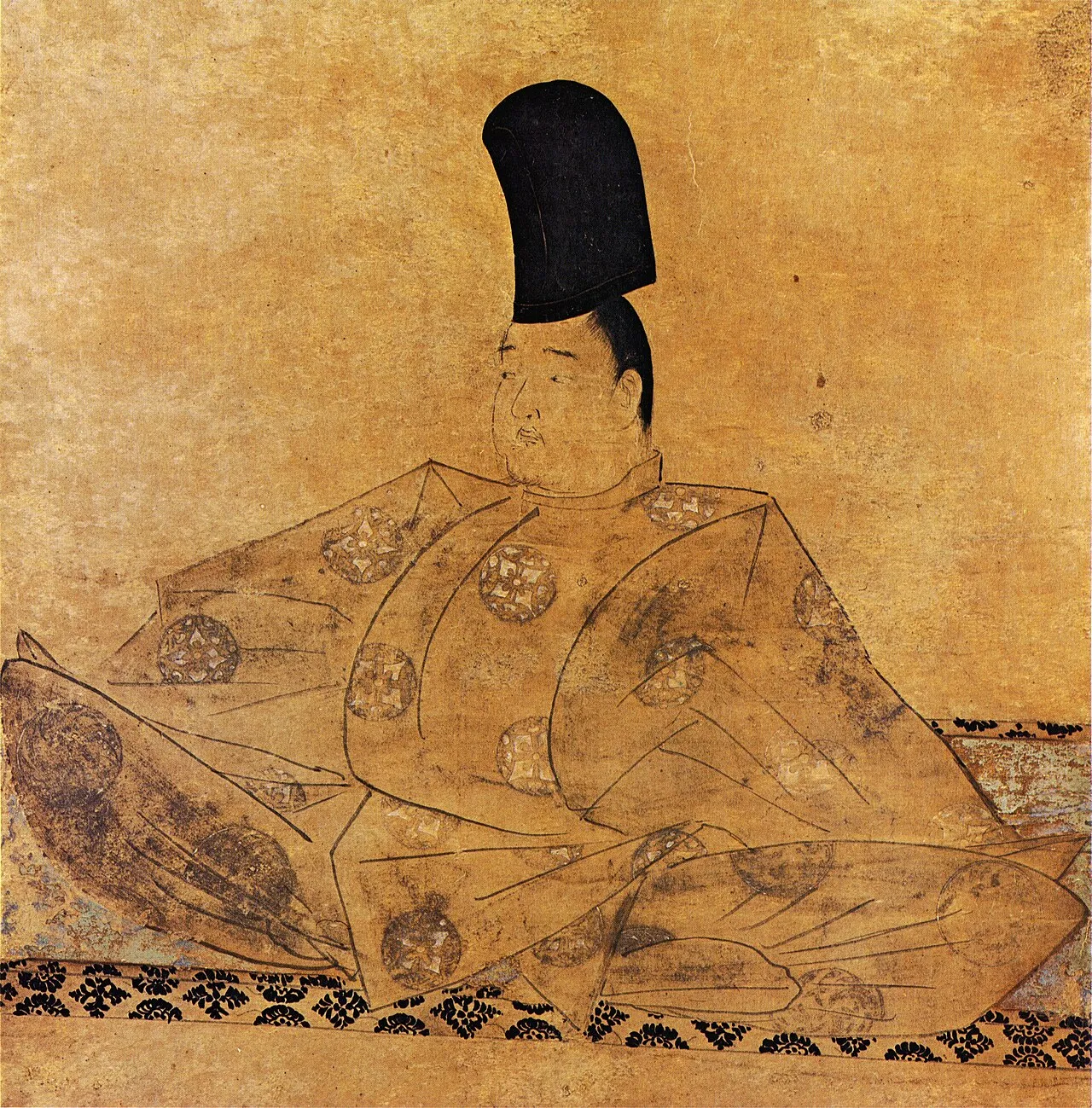
Retired Emperor Go-Toba, exiled to Oki after the defeat. Source: Wikimedia Commons
The Hokuriku army numbered about forty thousand horsemen, commanded by Hōjō Tomotoki — Yoshitoki’s second son and founder of the Nagoe branch of the Hōjō23. The army broke through Echigo at the end of the fifth month, took Miyazaki castle, and entered Etchū; on the 8th day of the sixth month it defeated the court’s forces around the estate of Hannyano in Etchū, forcing the surrender of court-side warriors including Hayashi Jirō and Ishiguro Saburō, then won again at Tonami Mountain and pressed on through Kaga toward Kyoto2.
This route is worth tracing on a map. Hannyano was an estate of the Tokudaiji family, lying along the Shō River roughly between Shōge in today’s Tonami City and Nakada in Takaoka City; the fighting of the Jōkyū War left no dedicated battlefield monument here, and only the general area can be pointed out4. Tonami Mountain is Kurikara Pass — the very place where Yoshinaka ambushed the Taira in 1183. The same road and the same mountain became a national battlefield twice within thirty-eight years. Among the court-side commanders who surrendered at Hannyano, the Hayashi of Kaga were the same local warrior family that had joined Yoshinaka in 1183 (see the Heian note); local powers such as the Hayashi and Ishiguro sided with the court this time, and were defeated2.
For Hokuriku, the institutional changes after the battle mattered more than the battlefield itself. For his service, Tomotoki held the shugo posts of Kaga, Noto, Etchū, and Echigo by 1223, and the Nagoe line remained tied to Hokuriku’s shugo offices for generations3; the confiscated lands of court-side warriors went to eastern gokenin, and newly appointed jitō pushed into Hokuriku’s estates. Landholding in Kaga and Etchū was subsequently redistributed under the shogunate’s institutions.
3. The Ataka Barrier: Yoshitsune, Benkei, and Kanjinchō
For Komatsu, the main Kamakura-period thread is the Yoshitsune legend at Ataka. After the Genpei War, Minamoto no Yoshitsune broke with his brother Yoritomo; tradition has him fleeing north along the Hokuriku road toward Hiraizumi around 1187, disguised as a mountain ascetic. Stopped at Ataka in Kaga by the barrier keeper Togashi, his retainer Benkei read aloud from a blank scroll as if it were a kanjinchō — a subscription letter for the rebuilding of Tōdai-ji — to shield his lord, and Togashi, though seeing through the ruse, was so moved by their loyalty that he let them pass56.
The sources for the “Ataka barrier” need to be taken apart, though. “Ataka” appears early as a place on the road: the Hyōbushiki records an Ataka post station, the Gikeiki an Ataka ferry, the Yakumo mishō an Ataka bridge. The first text to explicitly call Ataka a barrier is the Muromachi-period Noh play Ataka — whether a barrier ever actually stood here is historically doubtful7. What carried the story across the country was the kabuki play Kanjinchō, adapted from the Noh and one of the Eighteen Great Kabuki Plays: it premiered at the Kawarazaki theater in Edo in 1840, with Ichikawa Danjūrō VII as Benkei8. In 1945 Akira Kurosawa filmed it as The Men Who Tread on the Tiger’s Tail8.
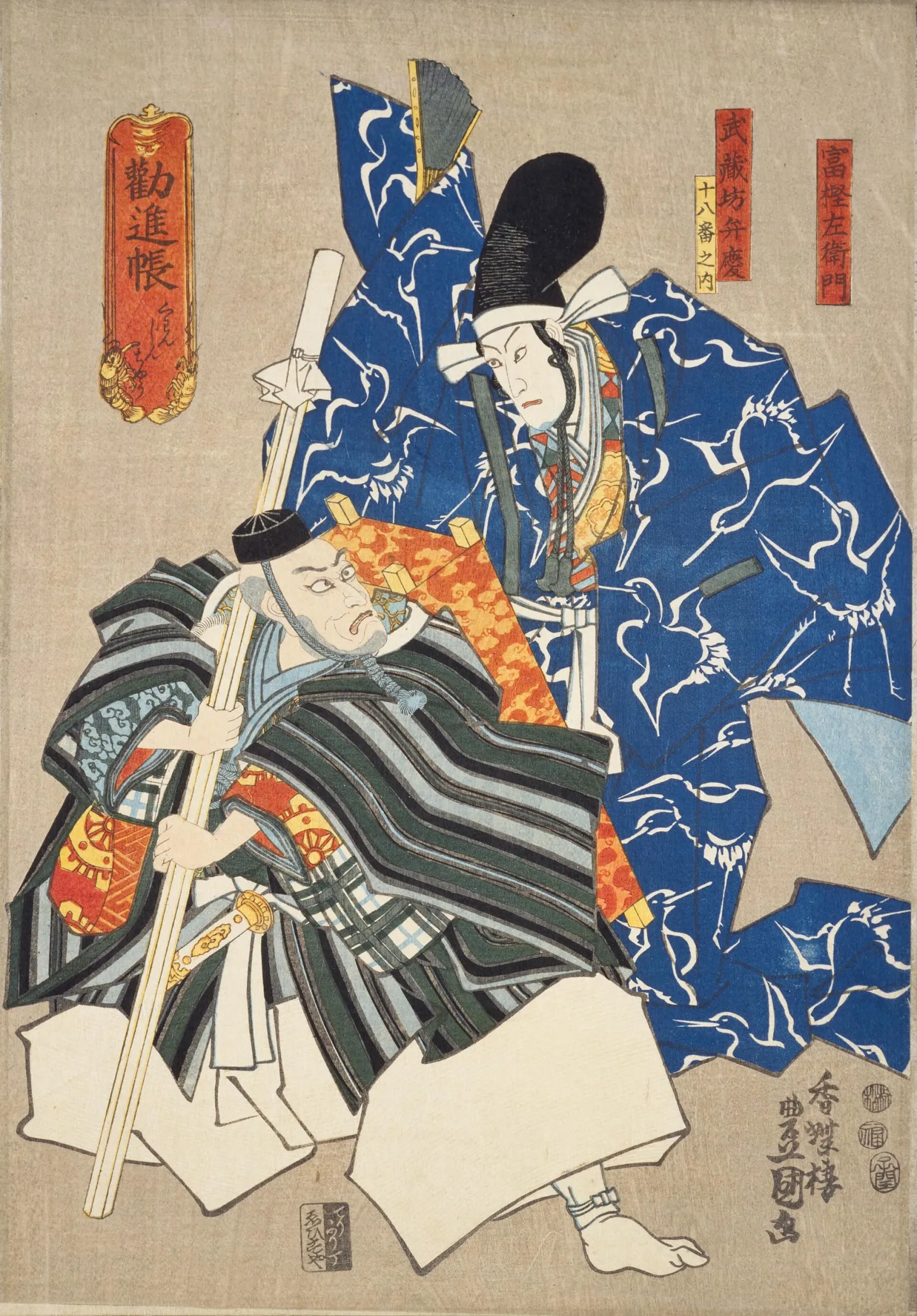
Kanjinchō as drawn by Utagawa Toyokuni III: Ichikawa Ebizō V (the former Danjūrō VII) as Musashibō Benkei, and Ichikawa Danjūrō VIII as Togashi Saemon. Source: Wikimedia Commons
Ataka is less a place where the year 1187 can be reconstructed than a place where the legend remains visible in shrine grounds, statues, and stage tradition. Ataka Sumiyoshi Shrine, by tradition founded in 782, is venerated as a guardian deity of “breaking through difficulties” because of the legend that Yoshitsune’s party overcame theirs here; in its pine grove stand the bronze statues of Benkei, Togashi, and Yoshitsune — “wisdom, benevolence, courage” — and the monument marking the barrier site6. Next door, the “Ataka Barrier” Komatsu Kanjinchō-no-Sato reopened in April 2026 as ATAKA TERRACE, with the Kanjinchō Monogatari-kan free to enter5.
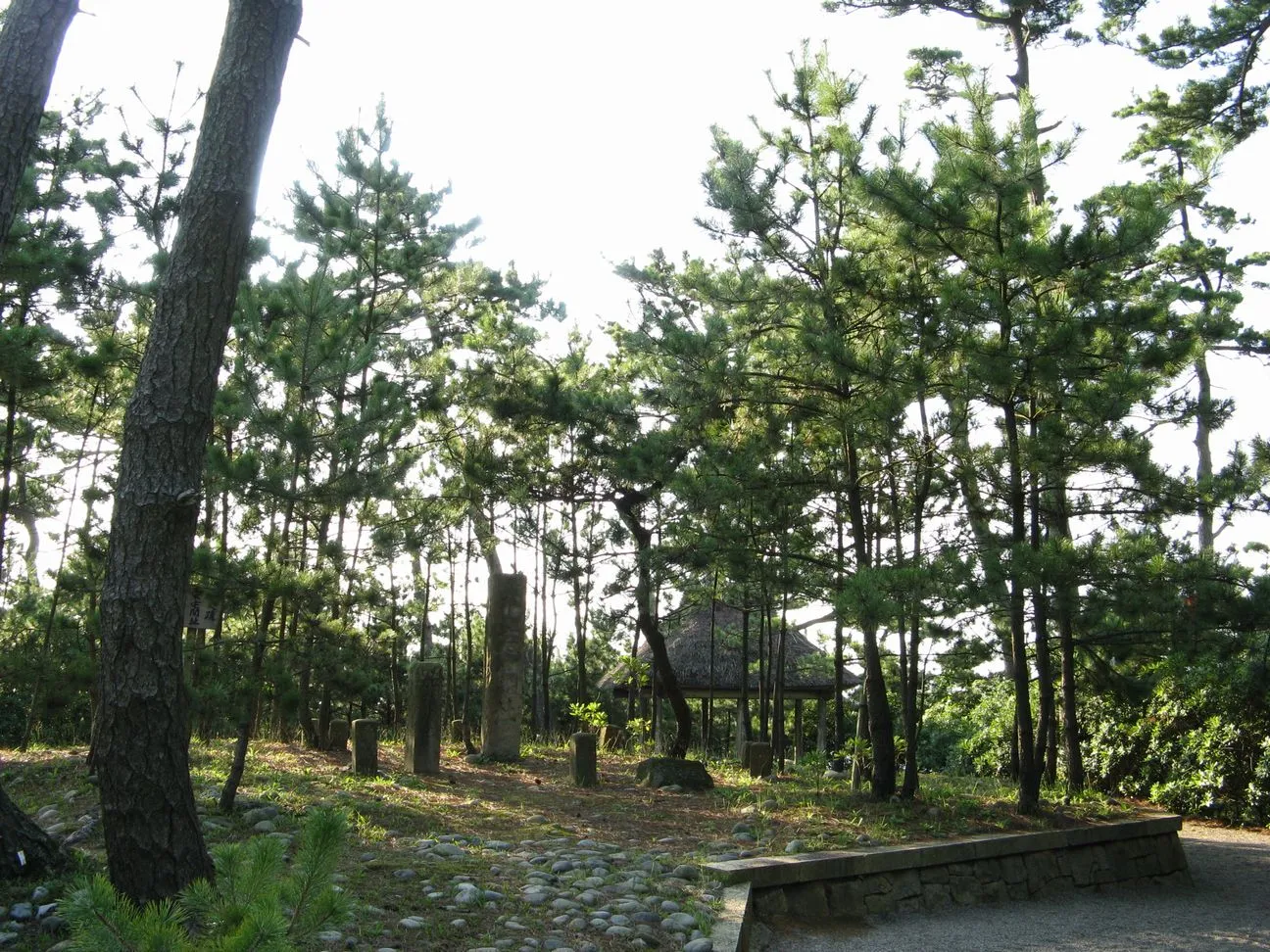
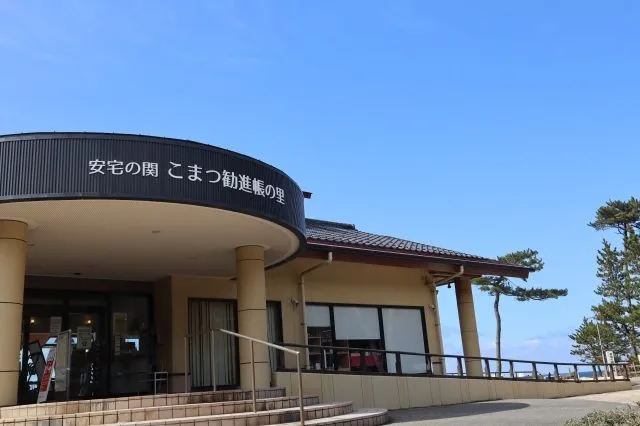
One aside: the document Benkei pretends to read in Kanjinchō is a subscription letter for the rebuilding of Tōdai-ji. Counting the estate maps and Yokoe-no-shō of the Nara note, this is the third time Tōdai-ji has appeared in this series.
4. Kaga’s Local Warriors: The Togashi
The barrier keeper of Kanjinchō is linked by tradition to the Togashi, local warriors of Kaga. According to the city of Nonoichi, the Togashi residence is traditionally said to have been built at Nonoichi by Togashi Iekuni in the mid-Heian period (1009 or 1063 by different accounts); the clan grew rapidly from the end of the Kamakura period, and after Togashi Takaie became shugo of Kaga in 1335 the residence is thought to have doubled as the shugo’s seat, with Ujiharu, Masachika, and others holding the post for generations9. Excavations in 1994 confirmed part of the residence’s moat and recovered an intact bronze mirror from it9.
The Togashi became shugo of Kaga only after the Kamakura shogunate had fallen in 1333, so in the Kamakura section they appear mainly as a growing local warrior family. The location of the Togashi residence is also worth noting: it is in Nonoichi, not in today’s central Kanazawa. Kanazawa was still not a political center in the Kamakura period; estates like Yokoe-no-shō kept operating in its area under the influence of the new jitō system, and the political center would not move onto the Kanazawa upland for several ages yet10.
5. The Kamakura Layer of Tateyama
The most tangible Kamakura-period object in Toyama is kept at Ashikuraji. The Chūgū Kigan-den of Oyama Jinja preserves a wooden seated statue of Jikō Shōnin: a nationally designated Important Cultural Property (designated 1931), estimated to be early Kamakura work, carved from Tateyama cedar in joined-block technique, 87.9 cm tall, and traditionally held to portray the mountain’s opener Jikō Shōnin (Saeki no Ariyori) in old age. It is shown to the public only on New Year’s Day11. The Heian note described the literary imagination of Tateyama’s hell; this statue is the physical object that Tateyama worship left behind in the Kamakura period.
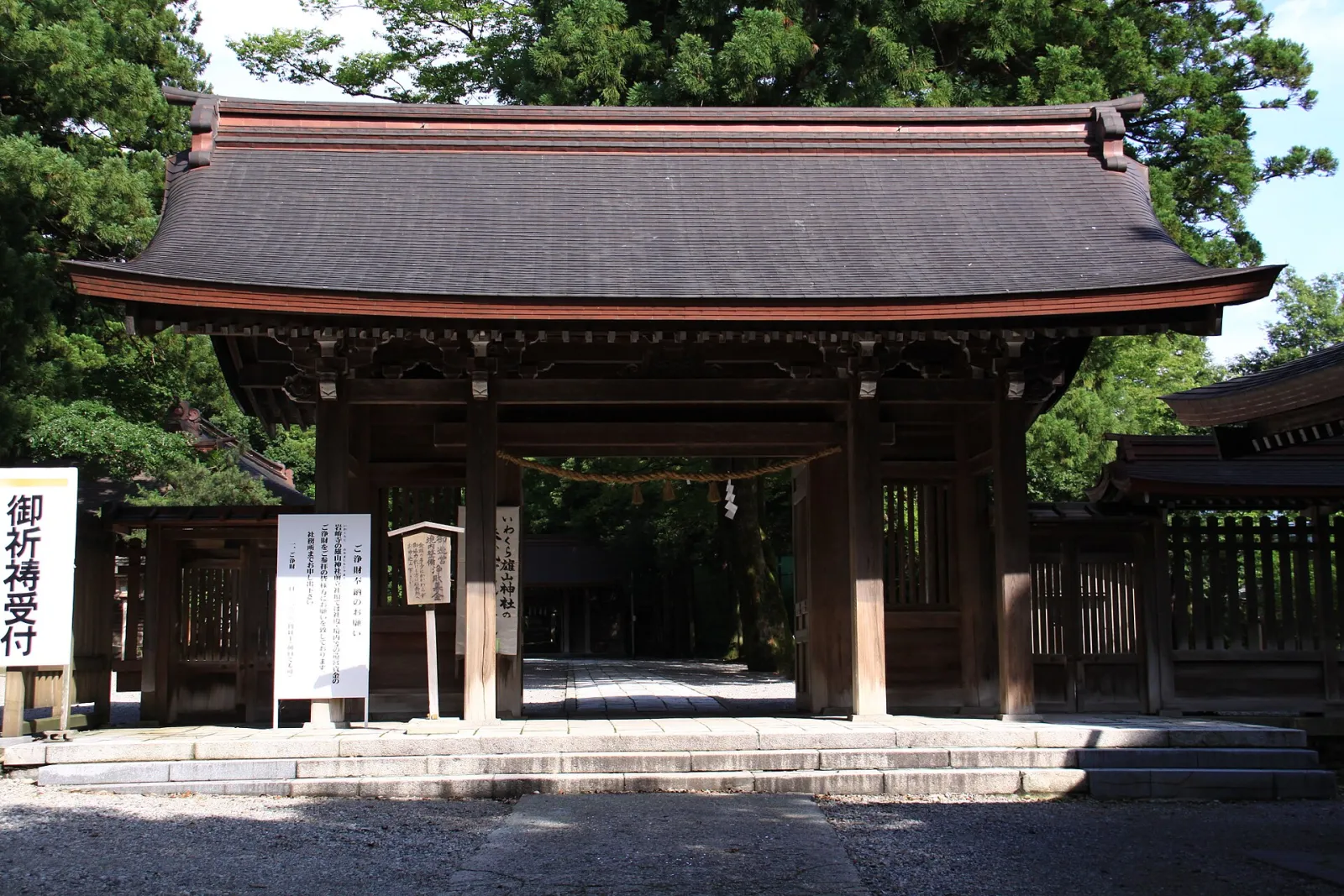
The front gate of the Maedate Shadan at Iwakuraji. Shrine tradition records a rebuilding of the sanctuary by Minamoto no Yoritomo — the relationship between Tateyama worship and the warrior government survives in the form of tradition12. Source: Wikimedia Commons
Institutionally, Etchū came under the shugo rule of the Nagoe Hōjō after the Jōkyū War (section 2); in mountain religion, the two foothill villages of Iwakuraji and Ashikuraji continued as bases for the ascent.
6. Shinran and Jōdo Shinshū: The Distant Cause of the Ikkō ikki
The Kamakura period was also the age of new Buddhism, and the figure with the greatest later impact on Hokuriku is Shinran (1173–1263). Trained on Mount Hiei, he joined Hōnen’s exclusive-nenbutsu movement; when Hōnen’s community was suppressed in 1207 (the Jōgen persecution), Shinran was stripped of clerical status and exiled to Echigo Province, calling himself “neither monk nor layman”13. Pardoned in 1211, he moved to the Kantō to teach, forming communities of nenbutsu followers. The core of his teaching is “other-power” and faith: not accumulating merit through one’s own practice, but entrusting oneself to Amida’s vow — the nenbutsu as gratitude, not transaction13.
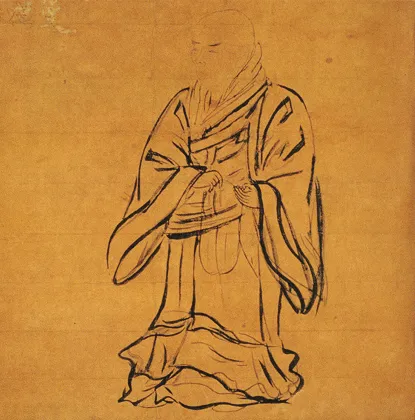
Shinran Shōnin. His exile to Echigo in 1207 was the turn that took him out of the world of Kyoto’s great temples and toward provincial society. Source: Wikimedia Commons
Shinran’s place of exile, Echigo, lies outside this trip’s three areas, and Kamakura-period Kaga and Etchū had no Shinshū political power yet. The Hokuriku connection mainly belongs to the following centuries: in the Muromachi period, Shakunyo, fifth head of Hongan-ji, founded Zuisen-ji in Etchū in 1390 (today’s Inami, Nanto City)14; Rennyo preached from Yoshizaki-gobō in Echizen from 1471 and the Hokuriku congregations grew rapidly15; and the Kaga Ikkō ikki of 1488 overthrew the shugo Togashi Masachika — the same Togashi clan of section 4 — while the stronghold the congregations later built on the Kanazawa upland, Oyama Gobō, became the forerunner of Kanazawa Castle. Those are subjects for the Muromachi note. The Hōonkō, the annual rite commemorating Shinran’s death, remains an important observance of Shinshū communities in Hokuriku to this day13.
7. Places You Can Visit Today
Kamakura-period Hokuriku has no grand castle ruins; what can be seen clusters at the sites of legend and belief.
| Area | Place | Type | Notes |
|---|---|---|---|
| Komatsu | ”Ataka Barrier” Komatsu Kanjinchō-no-Sato | Museum | ATAKA TERRACE (renewed April 2026); Kanjinchō Monogatari-kan free5 |
| Komatsu | Ataka Sumiyoshi Shrine | Shrine | Guardian of breaking through difficulties; the bronze statues and barrier monument6 |
| Nonoichi | Togashi residence site monument | Monument | Traditional seat of the Togashi of Kaga, by Nonoichi-Kōdaimae station9 |
| Tateyama | Oyama Jinja Chūgū Kigan-den | Shrine | Home of the wooden statue of Jikō Shōnin (ICP, early Kamakura); shown on New Year’s Day11 |
| Tateyama | Oyama Jinja Maedate Shadan | Shrine | Shrine tradition of rebuilding by Yoritomo; Iwakuraji base of Tateyama worship12 |
| Tateyama | Tateyama Museum of Toyama | Museum | Dispersed museum devoted to Tateyama worship16 |
| Awara | Yoshizaki-gobō site | Historic site | Rennyo’s Hokuriku base; Muromachi-period, worth a stop as contrast15 |
References
Footnotes
-
The Kamakura period (1185/1192 starting points; shugo, jitō, gokenin): https://ja.wikipedia.org/wiki/%E9%8E%8C%E5%80%89%E6%99%82%E4%BB%A3 ↩ ↩2
-
The Jōkyū War (three-route advance, Hokuriku army of 40,000, the fighting at Hannyano and Tonami Mountain): https://ja.wikipedia.org/wiki/%E6%89%BF%E4%B9%85%E3%81%AE%E4%B9%B1 ↩ ↩2 ↩3 ↩4
-
Hōjō Tomotoki (founder of the Nagoe line, Hokuriku commander, holding the shugo posts of Kaga, Noto, Etchū, and Echigo by 1223): https://ja.wikipedia.org/wiki/%E5%8C%97%E6%9D%A1%E6%9C%9D%E6%99%82 ↩ ↩2
-
The Hannyano estate (Tokudaiji family holding, between Shōge in Tonami and Nakada in Takaoka): https://jlogos.com/ausp/word.html?id=7321221 ; Battle of Hannyano (Heian period): https://ja.wikipedia.org/wiki/%E8%88%AC%E8%8B%A5%E9%87%8E%E3%81%AE%E6%88%A6%E3%81%84_(%E5%B9%B3%E5%AE%89%E6%99%82%E4%BB%A3) ↩
-
Komatsu Tourism Guide, “Ataka Barrier” Komatsu Kanjinchō-no-Sato: https://www.komatsuguide.jp/spot/detail_2.html ↩ ↩2 ↩3
-
Ataka Sumiyoshi Shrine (traditional founding in 782; worship for breaking through difficulties): https://ataka.or.jp/ ↩ ↩2 ↩3
-
The Ataka barrier (Ataka station in the Hyōbushiki, ferry in the Gikeiki, bridge in the Yakumo mishō; historical existence of a barrier doubted): https://ja.wikipedia.org/wiki/%E5%AE%89%E5%AE%85%E9%96%A2 ↩
-
Kanjinchō (based on the Noh play Ataka; premiered 1840 at the Kawarazaki theater with Ichikawa Danjūrō VII; Kurosawa’s The Men Who Tread on the Tiger’s Tail): https://ja.wikipedia.org/wiki/%E5%8B%A7%E9%80%B2%E5%B8%B3 ↩ ↩2
-
City of Nonoichi, “Togashi residence site”: https://www.city.nonoichi.lg.jp/soshiki/9/2617.html ; “Nonoichi and the Togashi”: https://www.city.nonoichi.lg.jp/soshiki/37/64613.html ↩ ↩2 ↩3
-
City of Kanazawa, “(Nationally designated) Tōdai-ji estate Yokoe-no-shō site”: https://www4.city.kanazawa.lg.jp/soshikikarasagasu/bunkazaihogoka/gyomuannai/3/1/1/siteibunkazai/5/5816.html ↩
-
Town of Tateyama, “Cultural properties of Tateyama” (wooden statue of Jikō Shōnin, national designation 1931): https://www.town.tateyama.toyama.jp/soshikikarasagasu/kyoikuka/bunkataiikugakari/2/3/841.html ; Oyama Jinja (statue estimated early Kamakura, joined-block Tateyama cedar, 87.9 cm): https://ja.wikipedia.org/wiki/%E9%9B%84%E5%B1%B1%E7%A5%9E%E7%A4%BE ; Tateyama Kurobe Alpine Route official tour guide, “Walking Ashikuraji” (the statue is “shown only on New Year’s Day each year”): https://www.alpen-route.com/tateco/tour/1389/ ↩ ↩2
-
Oyama Jinja Maedate Shadan (shrine tradition of rebuilding by Yoritomo): https://www.oyamajinjya-maetateshadan.org/ ↩ ↩2
-
Shinran (exiled to Echigo in the Jōgen persecution of 1207; “neither monk nor layman”; other-power and faith; the Hōonkō): https://ja.wikipedia.org/wiki/%E8%A6%AA%E9%B8%9E ↩ ↩2 ↩3
-
Zuisen-ji (founded 1390 by Shakunyo of Hongan-ji; Inami, Nanto City): https://ja.wikipedia.org/wiki/%E7%91%9E%E6%B3%89%E5%AF%BA_(%E5%8D%97%E7%A0%BA%E5%B8%82) ↩
-
Yoshizaki-gobō (Rennyo’s Hokuriku base from 1471): https://ja.wikipedia.org/wiki/%E5%90%89%E5%B4%8E%E5%BE%A1%E5%9D%8A ↩ ↩2
-
Tateyama Museum of Toyama: https://tatehaku.jp/ ↩