This note continues the Hokuriku prehistory, Asuka, and Nara notes. We now move into the Heian period (794–1185), again focusing on Kanazawa, Toyama, and Komatsu. The Kamakura period and later will be a separate note.
For these three areas, two events reshaped the landscape of the Heian period. The first comes at its beginning: in 823, Kaga Province was split off from Echizen, giving the region of Kanazawa and Komatsu a province of its own for the first time, with the leading candidate site for its capital in Komatsu1. The second comes at its end: in 1183, Kiso Yoshinaka and the Taira army clashed at Kurikara Pass on the Kaga–Etchū border, and for a moment the Hokuriku road became the turning point of national politics. The three centuries in between were the age of estate management and of the formation of worship around two sacred mountains, Hakusan and Tateyama.
1. What Was the Heian Period?
The Heian period conventionally runs about four hundred years, from Emperor Kanmu’s move of the capital to Heian-kyō in 794 to the establishment of the Kamakura shogunate around 11852. Politically it shifted from the ritsuryō system to regency politics and then rule by retired emperors; in land tenure, private estates (shōen) expanded alongside public land; culturally, the kana syllabaries and court culture matured. From mid-period, the belief that the world had entered the age of final dharma (mappō) spread, and Pure Land devotion made “hell” and “paradise” questions that concerned everyone — a point directly connected to Toyama’s Mount Tate, as we will see. At the end of the period, the warrior class rose, and the Jishō–Juei War of 1180–1185 (the Genpei War) ended the age of aristocratic rule3.
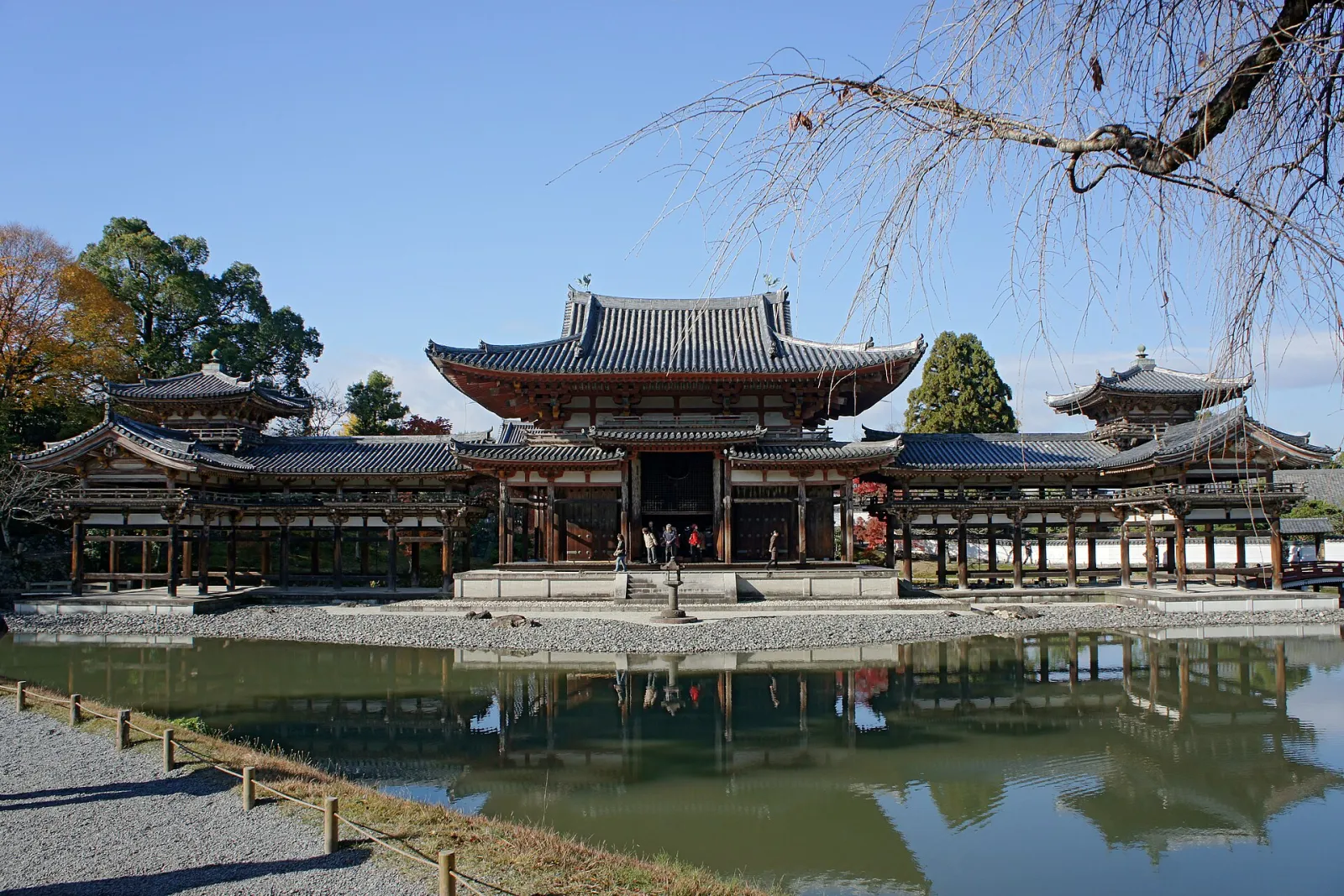
The Phoenix Hall of Byōdō-in in Uji, completed in 1053, the representative building of mid-Heian Pure Land devotion4. In the same imagination, Hokuriku’s Mount Tate played the opposite role: the location of hell. Source: Wikimedia Commons
The Nara note ended by observing that written records for Kanazawa and Komatsu only increase after the founding of Kaga Province in 823. This note starts from that year.
2. 823: The Birth of Kaga Province
The driving force behind the founding of Kaga was Ki no Suenari, governor of Echizen. Appointed in 821, he engineered the separation of the Enuma and Kaga districts from Echizen in 823 to create Kaga Province, and in the same year the two districts were further divided to add Nomi and Ishikawa, making four districts5.
Komatsu’s “Kaga Kokufu BOOK” lists four reasons for the split: the Echizen capital was too far away; great rivers in between cut off traffic during floods; when local magnates misbehaved, commoners could hardly travel to a distant capital to appeal; and the province was too large to inspect5. The same booklet points to another political aim: the redistricting weakened local magnate clans such as the Michi no Kimi of Kaga district and the Enuma no Omi of Enuma district — and the Michi no Kimi did in fact decline thereafter5. This Michi no Kimi is the same northern-Kaga clan that appeared in the prehistory note in connection with the traditions around Emperor Keitai.
The new province moved quickly: in 825 Kaga was promoted from a middle province to an upper province, and in 839 Minamoto no Hiroshi became its first dedicated governor5. The leading candidate site for the capital is the Kofu upland along the middle Kakehashi River, around Isobe Shrine, about 7.5 km from the port of Ataka at the river mouth (the exact location has not been confirmed); along the Hokuriku road within Kaga, six post stations were established, from north to south Fukami, Tagami, Hiraka, Ataka, Ushiozu, and Asakura5. In 841 an existing temple called Shōkō-ji was converted into the Kaga provincial temple (same name as, but unrelated to, the Shōkō-ji in Takaoka)5. The production base that supported all this was still the South Kaga kilns: the ceramics belt covered in earlier notes operated into the late Heian period, firing tiles for the provincial temple and inkstones for government offices after the founding of the province56.
Traces of capital culture reaching the provincial seat also survive. The mountain temple site of Jōsuiji in Hachiman, Komatsu, yielded a Chinese ewer carried up from the capital, and the Urushimachi C site produced a wooden tablet inscribed with a spell5. The list of Kaga’s governors includes familiar names: Fujiwara no Yoshifusa, the first Fujiwara regent; Sugawara no Michizane, who held the concurrent post of provisional governor of Kaga in 883; Fujiwara no Ienari, a pillar of the Toba retired emperor’s government; and Fujiwara no Toshinari (Shunzei), compiler of the Senzai Wakashū5. Michizane’s post was a concurrent appointment, so we cannot assume he ever came to Kaga; but the list shows that the governorship of Kaga had become a station in the career of Kyoto aristocrats.
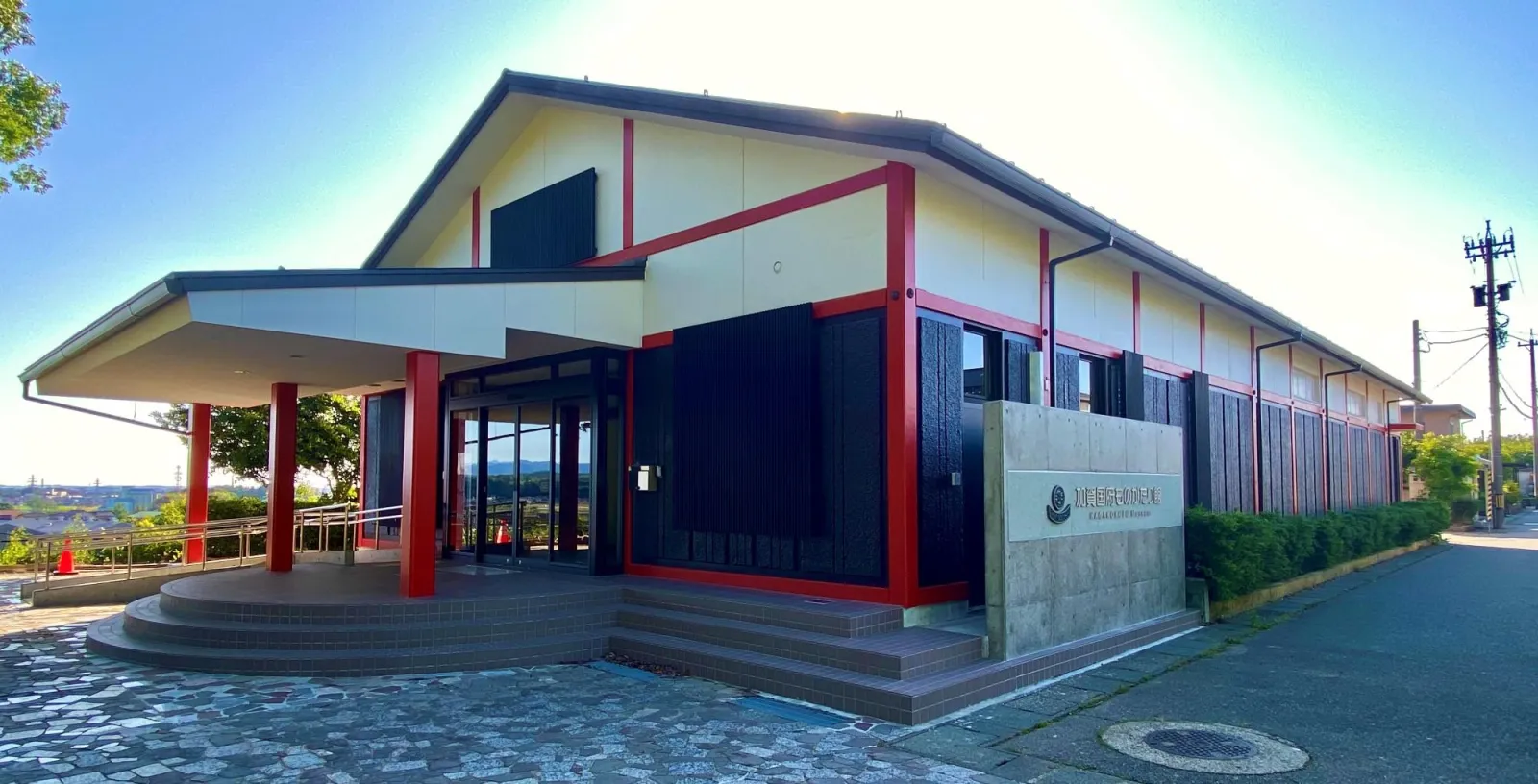
The Kaga Kokufu Monogatari-kan, the exhibition gateway to the founding of Kaga, its capital, and its provincial temple. Source: City of Komatsu
3. The Tamefusa-kyō-ki: A Governor’s Working Visit to Kaga
From mid-Heian on, absentee governorship became the norm; most governors never went to their provinces. That is what makes Fujiwara no Tamefusa’s record precious: appointed governor of Kaga in 1090, he actually traveled down to the Kaga capital the following June, and his diary, the Tamefusa-kyō-ki (held by the Cabinet Library of the National Archives of Japan), preserves the itinerary5.
As organized in the “Kaga Kokufu BOOK”: on the 1st day of the 7th month he performed the monthly offering and a rain-prayer sutra reading at the Funan-sha (the provincial sōja shrine); on the 8th he attended the Hakusan rite; on the 10th he read the Great Wisdom Sutra at the Funan-sha; on the 15th he attended the rite at the provincial temple. Over the following three days he visited nine shrines in the province, announcing his return to the capital and the land survey; on the 18th he deposited the key to the box holding the provincial seal in the storehouse; on the 19th he reached the anchorage of Awazu and handled business concerning imperial-edict fields; and on the 20th he set out back to Kyoto5.
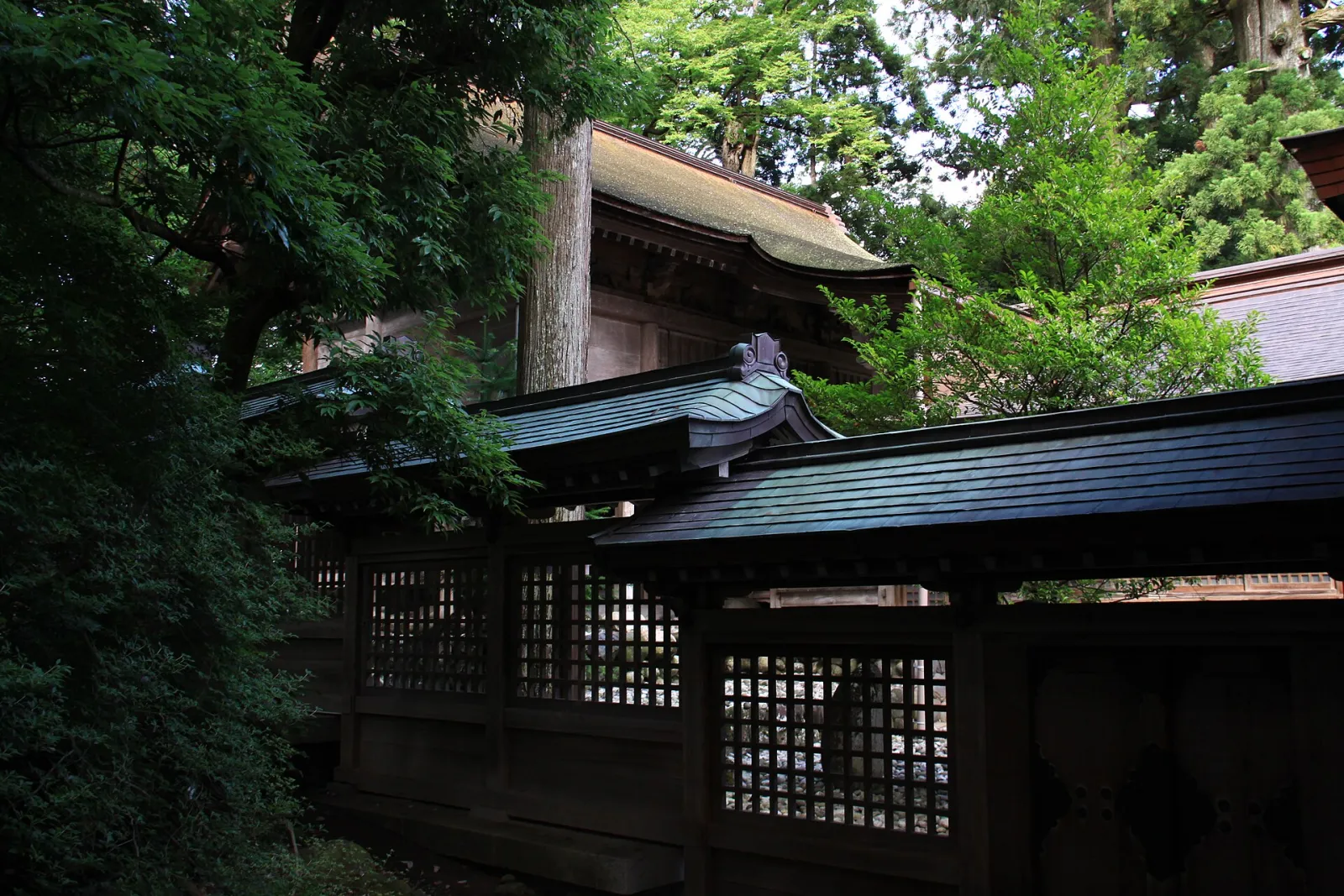
Within three weeks he had covered the sōja shrine, Hakusan, the provincial temple, the provincial seal, the land survey, and the port. A provincial capital was not an abstract administrative term but a place where ritual, land administration, and logistics overlapped — and the fact that the Hakusan rite came early in his schedule shows that Hakusan worship was already part of the business of governing Kaga. Stringing together the Kaga Kokufu Monogatari-kan, Isobe Shrine (the presumed Funan-sha site), and Shirayama Hime Jinja today roughly retraces this diary.
4. Kanazawa: The Age of Estates and Lagoon Shipping
Kanazawa in the Heian period was still not a city. The Tōdai-ji estate of Yokoe-no-shō, introduced in the Nara note, entered its heyday after the donation to Tōdai-ji in 818: the estate office, workshops, navigable canal, and boat landing at Kami-Araya, together with the tag-shaped tablets recording the origins and destinations of goods, show the daily workings of an early-Heian estate78. On the lagoon coast of western Kanazawa, the Uneda-Nabeta site produced Heian-period storehouse rows and wooden tags bearing the names of marine products, and is thought to have been a hub of seaborne trade9.
In other words, Heian-period Kanazawa was Tōdai-ji’s fields, a canal, and a lagoon port. Its rise to political center would wait for the Ikkō ikki of the medieval period and the castle town of the Kaga domain in the early modern one.
5. Hakusan: From Sacred Peak to Power
The Nara note mentioned the tradition of Taichō opening Mount Haku in 717. In the Heian period this worship was institutionalized. The chronology of Shirayama Hime Jinja records that in 832 the “three bases” (sanbaba) for Hakusan ascent — in Kaga, Echizen, and Mino — were opened, and that in 848 shrine and temple buildings were erected by imperial order and the mountain designated a site of prayer for the protection of the state (both from the Hakusan no ki)10. The center of the Kaga base was Shirayama Hime Jinja — today the first shrine of Kaga and head shrine of all Hakusan shrines nationwide1011.
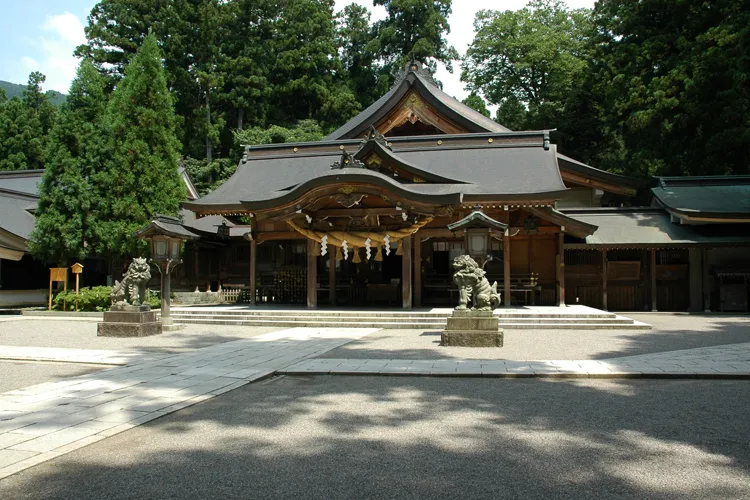
The main sanctuary of Shirayama Hime Jinja, center of the Kaga base of Hakusan worship. Source: Wikimedia Commons
Komatsu’s Natadera lies on this same line. The temple chronology records that around 989–992 the retired emperor Kazan, after his pilgrimage of the western provinces, traveled to Hokuriku, and that legend has him renaming Iwaya-dera as “Natadera” on that occasion (a tradition from the Hakusan no ki)12. The caves of the Kigan Yusenkyō rock face are exactly the landscape evoked by the old name Iwaya-dera, “cave temple.”
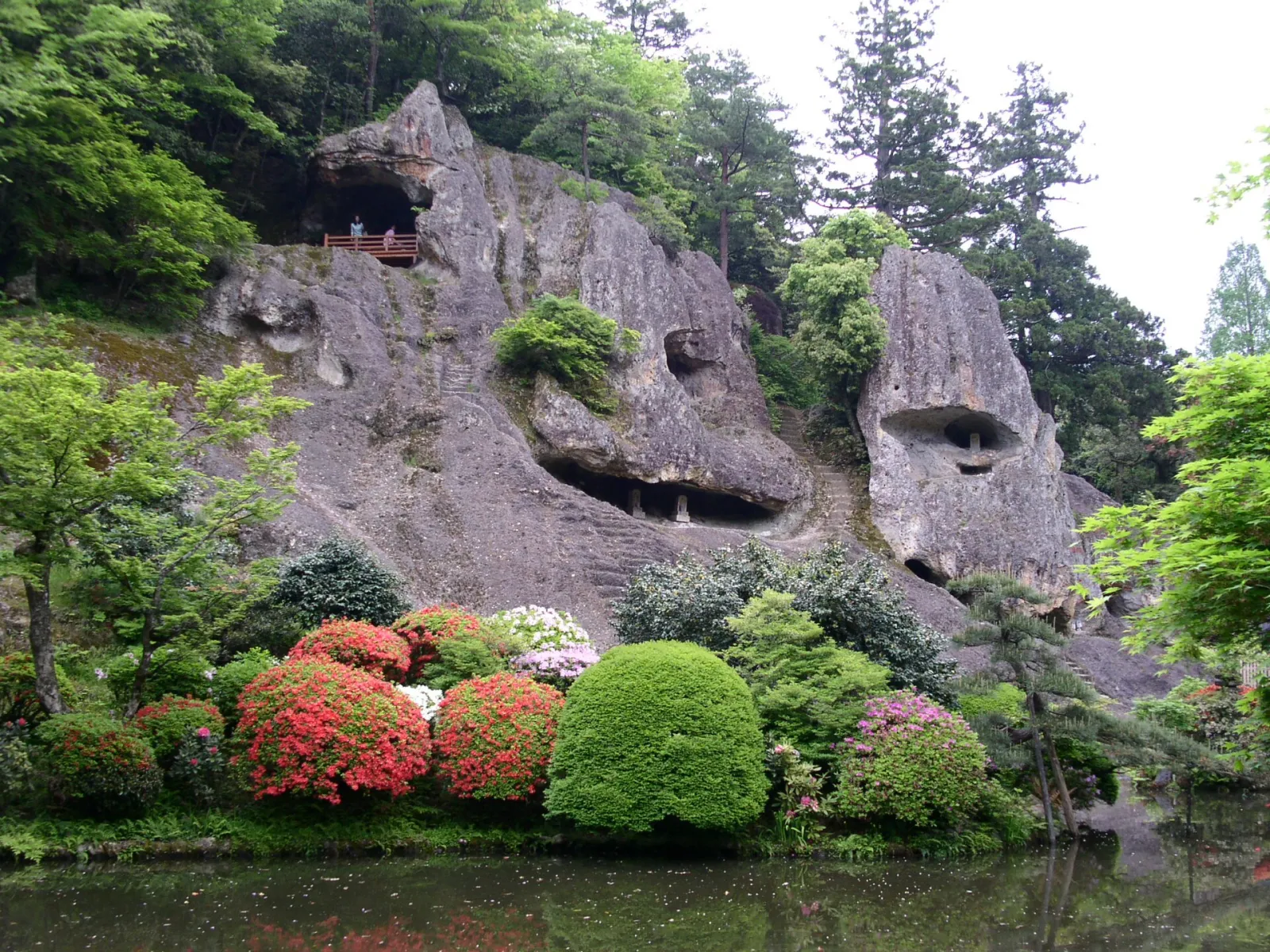
The Kigan Yusenkyō rocks at Natadera. The cave sanctuary was one of the strongholds of Hakusan worship in southern Kaga. Source: Wikimedia Commons
By late Heian, Hakusan was not only a faith but a power. In 1147 the Hakusan main shrine became a branch temple of Enryaku-ji on Mount Hiei, joining the Tendai temple network10; in 1176 (the Angen incident) the deputy governor Fujiwara no Morotsune clashed with the Hakusan shrine and burned its branch temple Yūsen-ji, provoking a mass protest by the Hakusan clergy5. Friction between governors and temple-shrine power is a miniature of provincial society on the eve of the Genpei War.
6. Tateyama: Hell in Etchū
Toyama’s Heian storyline moves from the Nara-period capital and the Man’yō poems to Mount Tate.
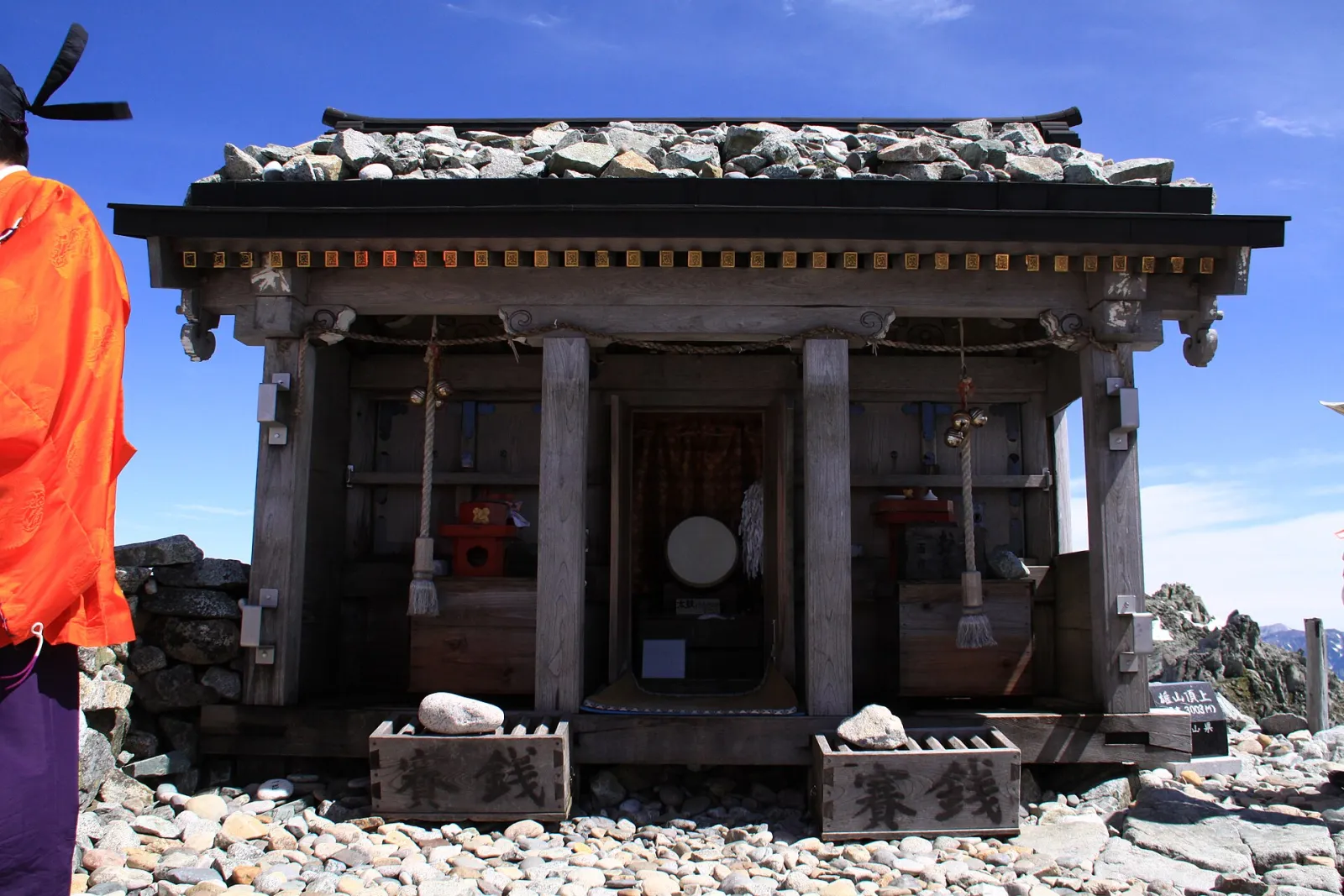
The core of Tateyama worship is Oyama Jinja, made up of three shrines: the summit shrine on Oyama, the main peak of Tateyama (3,003 m); the Chūgū Kigan-den at Ashikuraji; and the Maedate Shadan at Iwakuraji. Shrine tradition holds that in 701 the boy Saeki no Ariyori, son of the governor of Etchū, was led by a white hawk to open the mountain13. Oyama Jinja appears in the Engishiki register of shrines and has at times been styled the first shrine of Etchū13. The founding legend is later shrine tradition, but the structure — two foothill villages, Iwakuraji and Ashikuraji, serving as bases for the ascent — continues to this day.
What made Tateyama famous nationwide was “hell.” In the volcanic wasteland of Jigokudani (“hell valley”), formed by the activity of the Midagahara volcano, sulfurous gas vents from bare ground. As mappō thought and visions of posthumous hell spread in mid-Heian, this landscape was read as the actual location of hell. The Konjaku Monogatarishū, compiled in the Heian period, states that “the people of Japan who commit sins often fall into this hell of Tateyama,” and includes tales of women who fell into it; Tateyama’s name spread across the country this way14. Byōdō-in gave concrete form to paradise; the Tateyama of the Konjaku Monogatarishū was hell. Both come from the same Pure Land imagination.
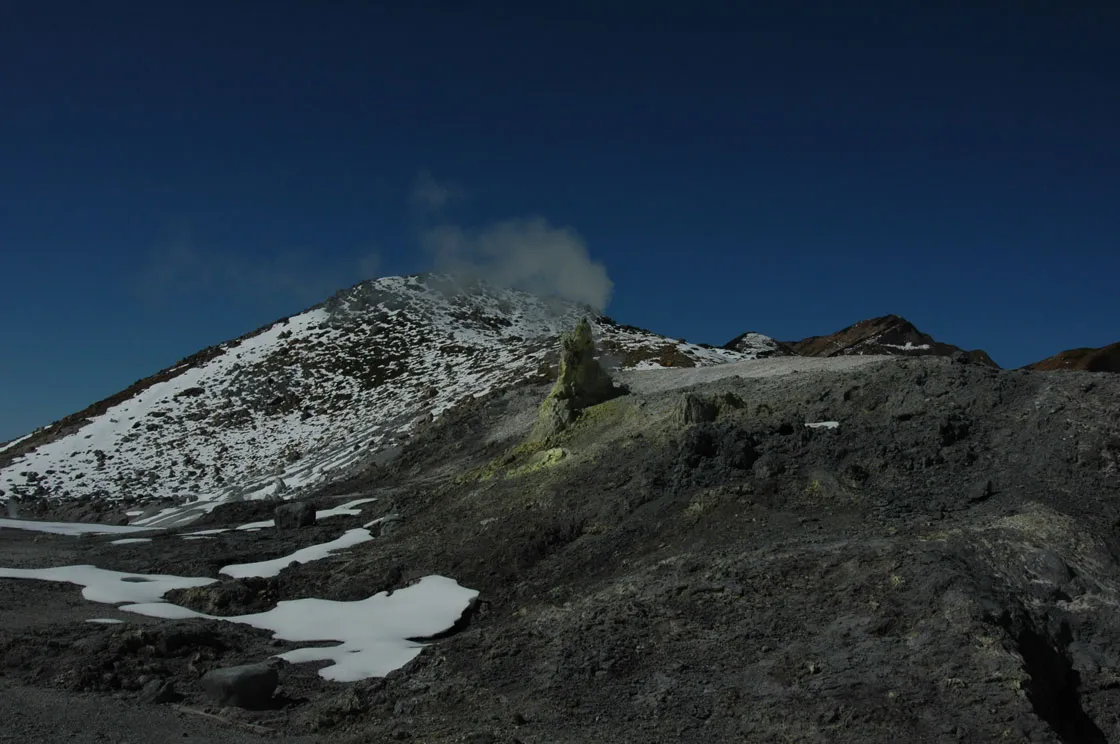
The fumarole landscape around Jigokudani on Tateyama. The Konjaku Monogatarishū described this as the hell into which sinners fall. Due to volcanic gas restrictions, it can now usually be viewed only from a distance. Source: Wikimedia Commons
On the plains, early-Heian Toyama continued the administration and settlements of the Nara period: the Yoneda-Daikaku site, identified as the Niikawa district office, centers on the ninth century and yielded 208 ink-inscribed potsherds and stone belt fittings, while the settlement at Tōmi-Miyata lasted into the early tenth century15.
7. 1183: Kurikara Pass
At the very end of the Heian period, the Hokuriku road suddenly became a battlefield the whole country watched.
The background is the Jishō–Juei War that began in 1180: after Taira no Kiyomori seized control of the court, Prince Mochihito’s call to arms set off risings of Minamoto forces across the country3. Kiso Yoshinaka, who had risen in Shinano, extended his power along the Hokuriku road, and in 1183 the Taira sent a great army north under Taira no Koremori — Kiyomori’s grandson and heir of Shigemori16. On the 11th day of the 5th month, the armies faced each other at Kurikara Pass on Tonami Mountain, on the Kaga–Etchū border. Yoshinaka attacked at night; the Taira army broke in the darkness, men plunging into the deep ravines below the pass, and the great army collapsed17.
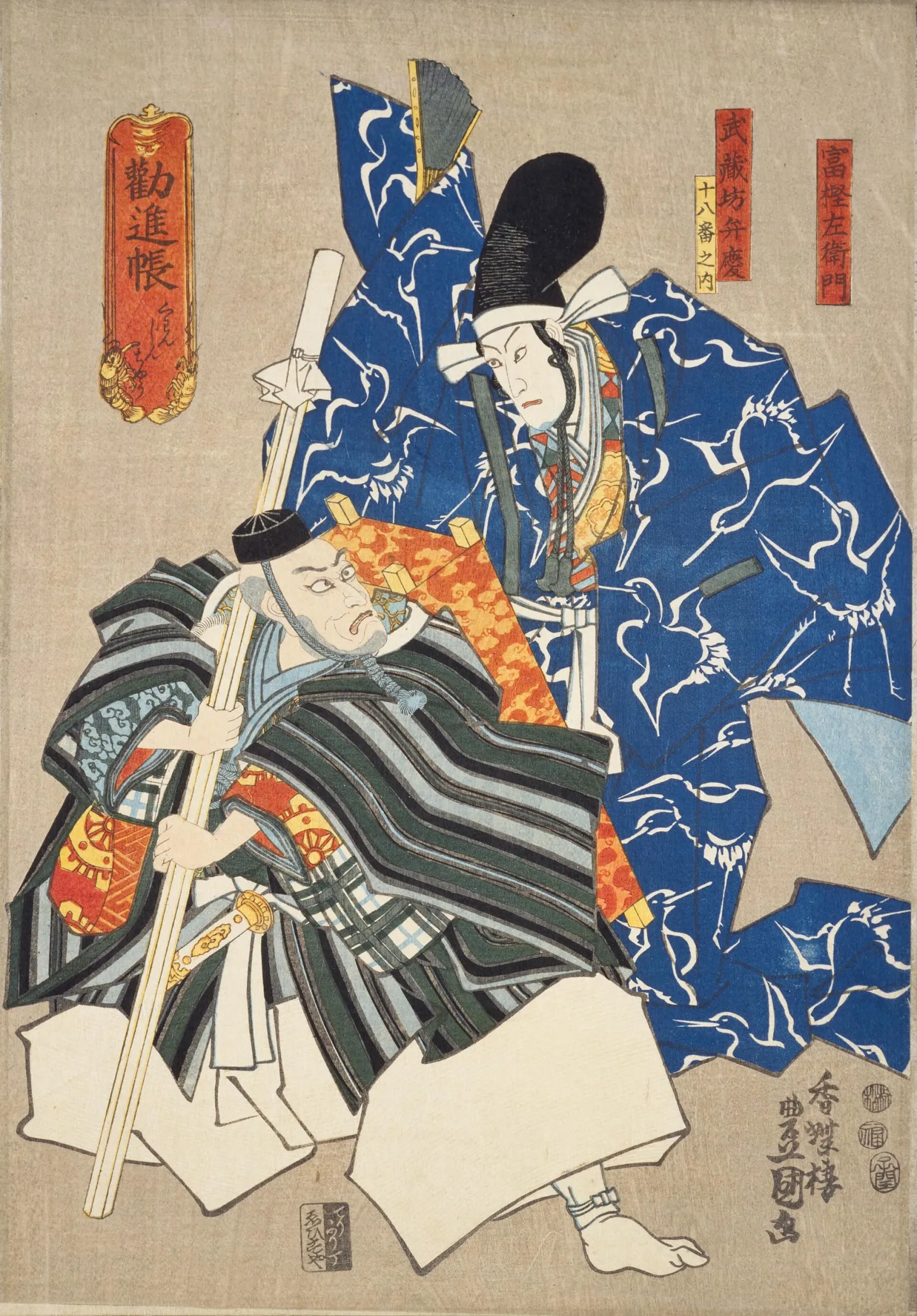
War tales turned the night attack into legend. The Genpei Seisuiki describes Yoshinaka tying torches to the horns of four or five hundred oxen and driving them into the Taira camp — the town of Tsubata’s guide adopts this “fire-oxen stratagem,” and a local folk performing art, the Usshaibō, commemorates the requisitioned oxen18. The fire-oxen scene does not, however, appear in the older texts of the Heike Monogatari, and is generally regarded as literary embellishment by later war chronicles17. Before the battle, Yoshinaka is said to have prayed for victory at Hanyū Gokoku Hachimangū on the Oyabe side1819.
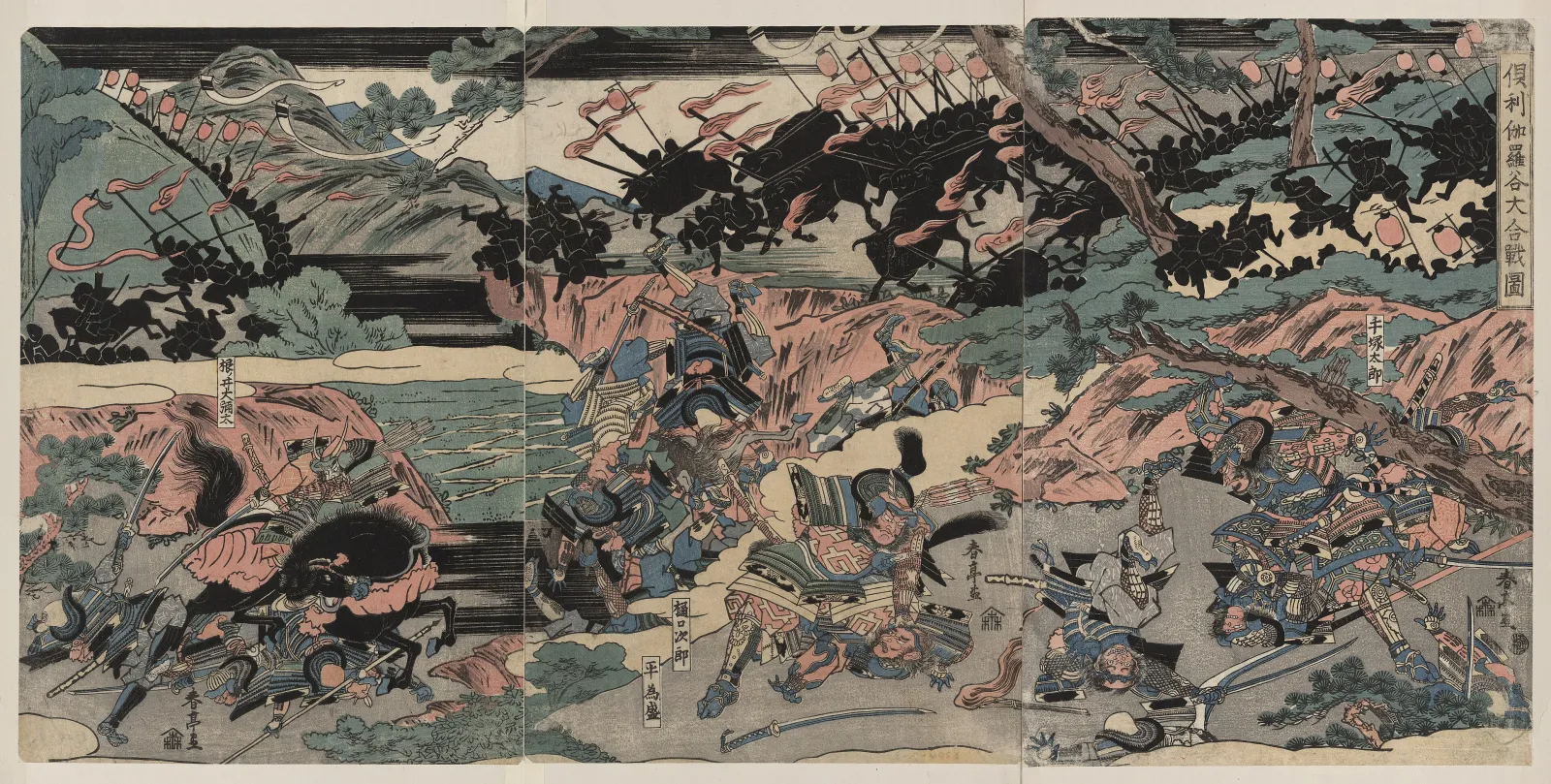
Katsukawa Shuntei’s triptych print of the battle of Kurikaradani. In the center, fire-oxen with torches bound to their horns charge the Taira camp; name labels identify Higuchi Jirō, Taira no Tamemori, and others. Edo-period prints were still repainting this night attack of 1183. Source: Wikimedia Commons
After Kurikara, Yoshinaka’s army pursued the Taira to Shinohara in Kaga (today’s Kaga City), where the Taira veteran Saitō Sanemori, in his seventies, dyed his white hair black, fought, and fell. Tradition holds that Yoshinaka dedicated Sanemori’s helmet to Tada Jinja in Komatsu; the helmet is a nationally designated Important Cultural Property520. Five hundred years later, Bashō saw this helmet at Tada Jinja on the Oku no Hosomichi journey and left the verse “muzan ya na / kabuto no shita no / kirigirisu” (“How pitiful — beneath the warrior’s helmet, a cricket”)20. Natadera and Tada Jinja both lie on the route of the Oku no Hosomichi; this is Bashō’s third appearance in this series.
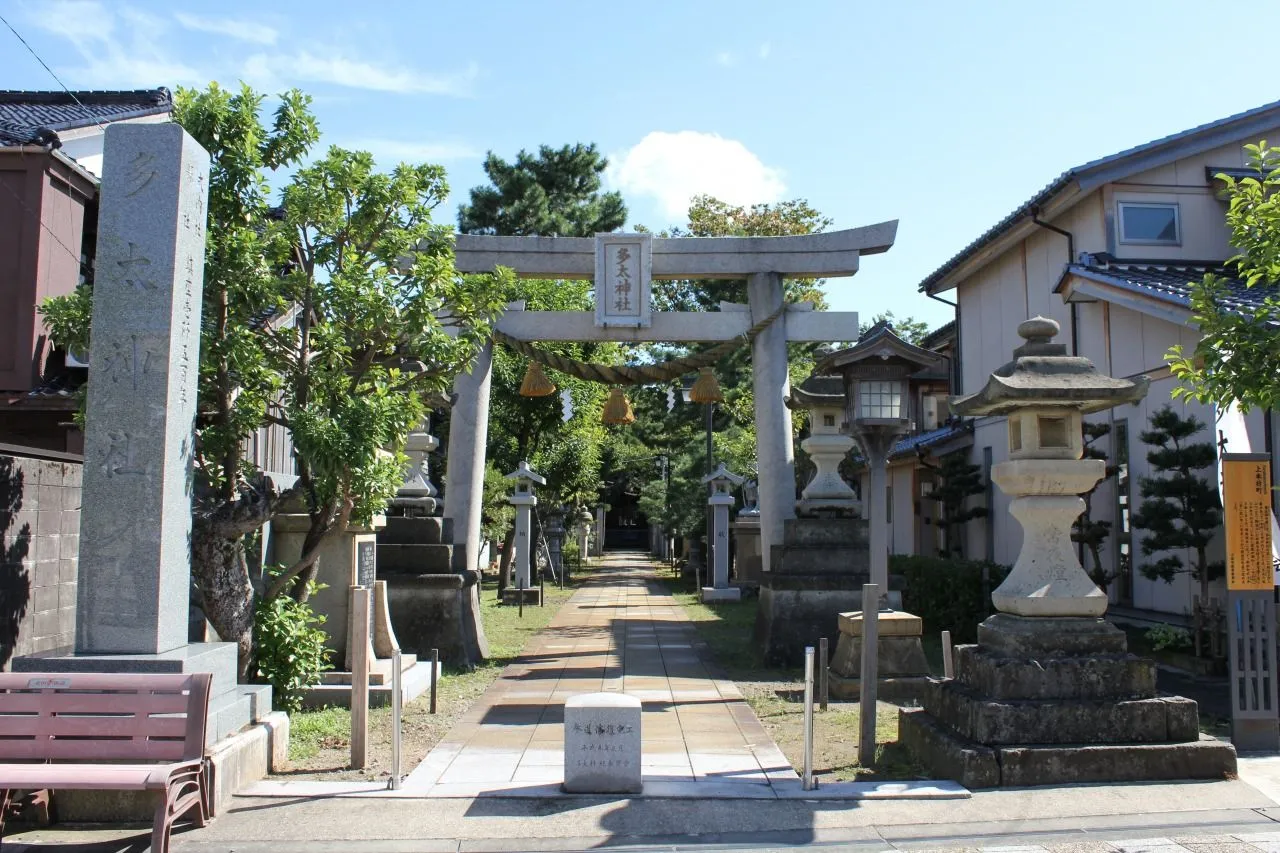
Tada Jinja in Komatsu, where tradition says Yoshinaka dedicated Saitō Sanemori’s helmet (an Important Cultural Property), and the setting of Bashō’s “muzan ya na” verse. Source: Komatsu Tourism Guide
The victory at Kurikara carried Yoshinaka to Kyoto and drove the Taira from the capital; but Yoshinaka soon fell out with Minamoto no Yoritomo’s camp and died in defeat in 1184, and in 1185 the Taira were destroyed at Dan-no-ura. The age of warrior government began — the starting point of the next note, on the Kamakura period.
8. Places You Can Visit Today
Heian-period Hokuriku is far easier to see on the ground than the Nara period: most of the battlefields, shrines, and temples are still where they were.
| Area | Place | Type | Notes |
|---|---|---|---|
| Komatsu | Kaga Kokufu Monogatari-kan | Museum | Free; gateway to the founding of Kaga, its capital, and the Tamefusa-kyō-ki21 |
| Komatsu | Tada Jinja | Shrine | Saitō Sanemori’s helmet (Important Cultural Property) and Bashō’s verse monument20 |
| Komatsu | Natadera | Temple | Kigan Yusenkyō; site of the Kazan renaming legend12 |
| Hakusan | Shirayama Hime Jinja | Shrine | First shrine of Kaga, head shrine of all Hakusan shrines; center of the Kaga base10 |
| Kanazawa | Kami-Araya historic site park | Historic site park | Where the canal and tablets of the Yokoe-no-shō estate were found8 |
| Tsubata / Oyabe | Kurikara Prefectural Park and battlefield | Battlefield | Fire-oxen monument, battlefield markers, and Kurikara Fudō-ji18 |
| Oyabe | Hanyū Gokoku Hachimangū | Shrine | Where Yoshinaka is said to have prayed for victory19 |
| Tateyama | Oyama Jinja Maedate Shadan and Chūgū Kigan-den | Shrines | The foothill bases of Tateyama worship at Iwakuraji and Ashikuraji13 |
| Tateyama | Tateyama Museum of Toyama | Museum | A dispersed museum devoted to Tateyama worship14 |
References
Footnotes
-
City of Komatsu, “1200 Years of Kaga Province”: https://www.city.komatsu.lg.jp/soshiki/1052/kagarikkoku1200nensai_1/index.html ↩
-
Heian-kyō: https://ja.wikipedia.org/wiki/%E5%B9%B3%E5%AE%89%E4%BA%AC ↩
-
The Jishō–Juei War (1180–1185): https://ja.wikipedia.org/wiki/%E6%B2%BB%E6%89%BF%E3%83%BB%E5%AF%BF%E6%B0%B8%E3%81%AE%E4%B9%B1 ↩ ↩2
-
Byōdō-in (Phoenix Hall completed 1053): https://ja.wikipedia.org/wiki/%E5%B9%B3%E7%AD%89%E9%99%A2 ; official site: https://www.byodoin.or.jp/ ↩
-
City of Komatsu, “Kaga Kokufu BOOK” PDF (founding of Kaga, capital and six stations, governors, the 1091 itinerary in the Tamefusa-kyō-ki, the Angen incident, Sanemori’s helmet): https://www.city.komatsu.lg.jp/material/files/group/43/kagakokuhubook.pdf ↩ ↩2 ↩3 ↩4 ↩5 ↩6 ↩7 ↩8 ↩9 ↩10 ↩11 ↩12 ↩13
-
City of Komatsu, “South Kaga ceramic production sites”: https://www.city.komatsu.lg.jp/soshiki/1052/kokabetsurekishijiman/aw_k/mnm_pt.html ↩
-
Ishikawa Prefecture, “Tōdai-ji estate Yokoe-no-shō site”: https://www.pref.ishikawa.lg.jp/kyoiku/bunkazai/siseki/20161004.html ↩
-
City of Kanazawa, “(Nationally designated) Tōdai-ji estate Yokoe-no-shō site”: https://www4.city.kanazawa.lg.jp/soshikikarasagasu/bunkazaihogoka/gyomuannai/3/1/1/siteibunkazai/5/5816.html ↩ ↩2
-
Comprehensive Database of Archaeological Site Reports, “Uneda-Nabeta site”: https://sitereports.nabunken.go.jp/ja/cultural-property/24905 ; Ishikawa Prefectural Library SHOSHO (Hokkoku Shimbun, 2000-11-22): https://www.library.pref.ishikawa.lg.jp/shosho/detail/orgn/D000110741 ↩
-
Shirayama Hime Jinja, “About” (chronology: three bases in 832, state-protection sanctuary in 848, Enryaku-ji branch in 1147): https://www.shirayama.or.jp/about/ ↩ ↩2 ↩3 ↩4
-
Shirayama Hime Jinja, “Hakusan worship”: https://www.shirayama.or.jp/about/hakusan-worship/ ↩
-
Natadera, “Chronology” (Kazan’s progress around 989–992 and the renaming legend): https://natadera.com/about/history/ ↩ ↩2
-
Oyama Jinja Maedate Shadan (origins, three shrines, Engishiki listing): https://www.oyamajinjya-maetateshadan.org/ ↩ ↩2 ↩3
-
Tateyama Museum of Toyama, “Culture and history of Tateyama” (the Konjaku Monogatarishū and Tateyama hell): https://tatehaku.jp/culture_and_history/ ↩ ↩2
-
Toyama City Archaeological Center, “The history of Toyama City through archaeology: the ancient period”: https://www.city.toyama.toyama.jp/etc/maibun/center/rekishi/kodai/kodai.htm ↩
-
Taira no Koremori (grandson of Kiyomori, heir of Shigemori): https://ja.wikipedia.org/wiki/%E5%B9%B3%E7%B6%AD%E7%9B%9B ↩
-
Battle of Kurikara Pass (the fire-oxen stratagem appears in the Genpei Seisuiki, not in older Heike Monogatari texts): https://ja.wikipedia.org/wiki/%E5%80%B6%E5%88%A9%E4%BC%BD%E7%BE%85%E5%B3%A0%E3%81%AE%E6%88%A6%E3%81%84 ↩ ↩2
-
Tsubata Town Tourism Association, “Kurikara battlefield”: https://www.town.tsubata.lg.jp/site/kankou/6181.html ↩ ↩2 ↩3
-
City of Oyabe, “Yoshinaka and Tomoe,” history: https://www.yoshinaka.info/?page_id=2 ↩ ↩2
-
Komatsu Tourism Guide, “Tada Jinja and treasure hall”: https://www.komatsuguide.jp/spot/detail_124.html ; National Cultural Properties Database (Sanemori’s helmet): https://kunishitei.bunka.go.jp/bsys/maindetails/411/00004182 ↩ ↩2 ↩3
-
City of Komatsu, “Kaga Kokufu Monogatari-kan”: https://www.city.komatsu.lg.jp/soshiki/1052/2300.html ↩