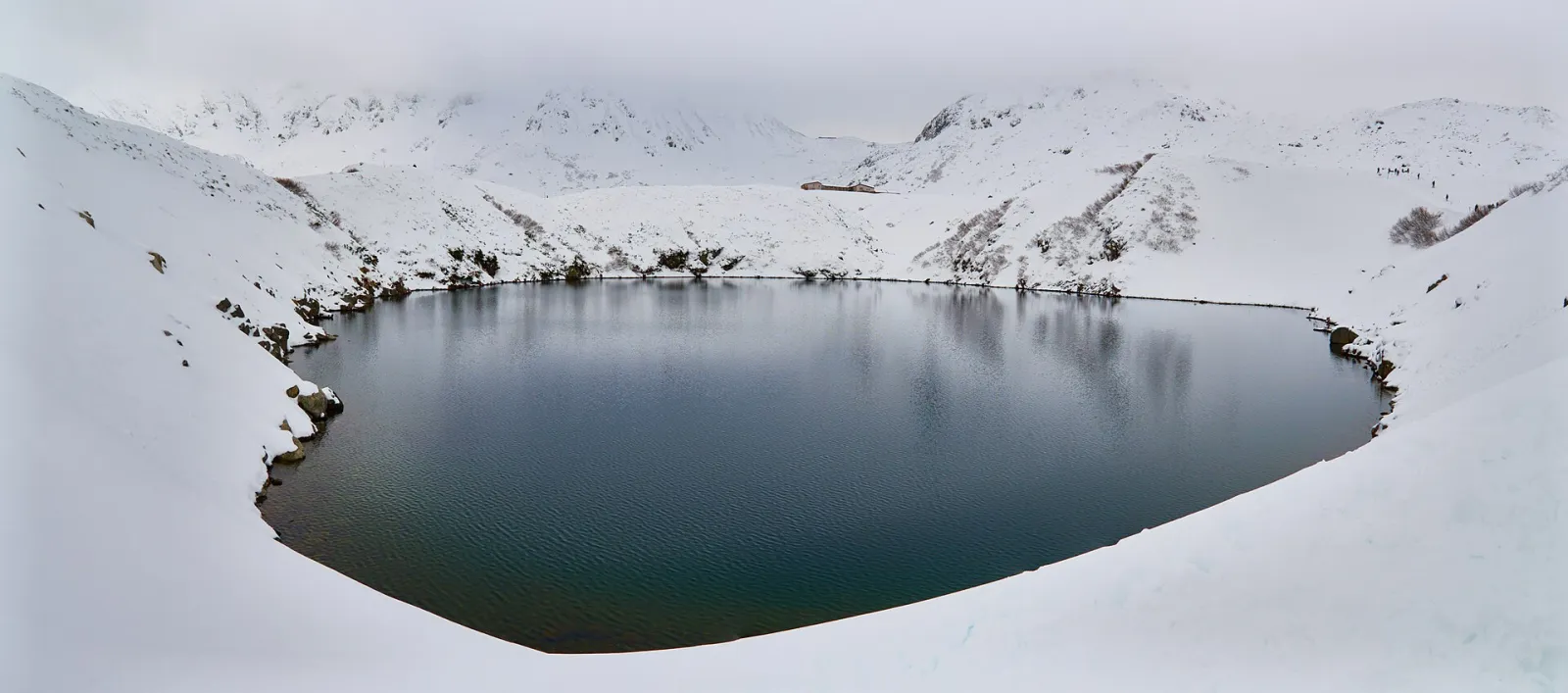
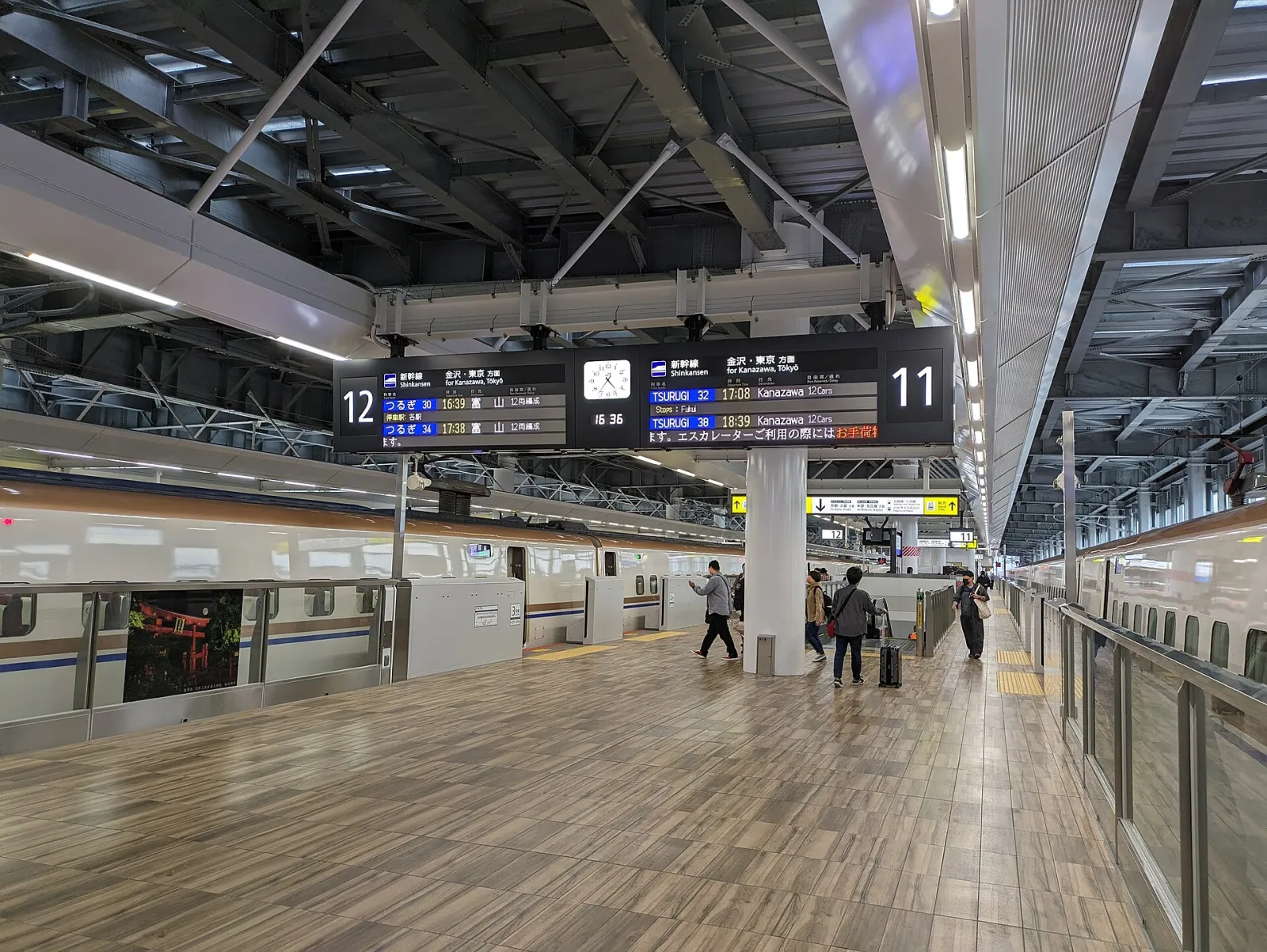
The Hokuriku history notes run from prehistory to Reiwa in fifteen notes, one per period. This is the overview: it lists the notes in order, gathers the themes that recur across periods, and adds crafts and townscapes the notes did not cover. The focus is Kanazawa, Toyama, and Komatsu. Sources for facts already covered are in the footnotes of each note; material new to this overview has its own footnotes.
People lived in Kanazawa, Toyama, and Komatsu from prehistoric times, but the three places entered the written record, and became regional centers, at different times. In the Nara period the most records come from Fushiki in Takaoka, where the Etchū provincial capital stood; when Kaga Province was founded in the Heian period, the likely site of its capital was in Komatsu. Kanazawa first appears in writing in 1546 as the “Kanazawa bōsha,” and became the center of Kaga only after Maeda Toshiie entered its castle in 1583. Toyama got its castle in the Sengoku period, was the castle town of the Toyama branch domain in the Edo period, and was separated from Ishikawa as Toyama Prefecture in the Meiji era. The map below puts the main places from each note together, colored by period.
1. The fifteen notes
| Period | Years | Main changes in the three places | Note |
|---|---|---|---|
| Prehistory | c. 30,000 years ago–7th century | Paleolithic tool scatters, Kanazawa’s ring of posts, the moated settlement at Yōkaichi-jikata in Komatsu, Toyama’s zenpō-kōhō-fun (square-front, square-rear mounded tombs) | prehistory note |
| Asuka | late 6th century–710 | Sue ware and charcoal kilns in Komatsu, ink-inscribed pottery and government-related sites in Toyama; “Koshi” brought into the provincial system | Asuka note |
| Nara | 710–794 | The Etchū provincial capital and Ōtomo no Yakamochi, Tōdai-ji estate maps; Kanazawa and Komatsu still part of Echizen | Nara note |
| Heian | 794–1185 | Kaga Province founded in 823, Hakusan and Tateyama worship, Kurikara Pass in 1183 | Heian note |
| Kamakura | 1185–1333 | The shogunate’s Hokuriku army in the Jōkyū War, the Ataka and Kanjinchō tradition, the rise of the Togashi | Kamakura note |
| Muromachi | 1336–1573 | The Togashi as shugo of Kaga, Honganji followers and the Ikkō ikki, the Kanazawa Midō of 1546, the Jinbo family’s Toyama Castle | Muromachi note |
| Late Sengoku | 1570s–1600 | Nanao Castle, the Battle of Suemori, Sassa Narimasa, the Battle of Asainawate in 1600 | late Sengoku note |
| Early and middle Edo | 1600–c. 1780 | Maeda Toshitsune’s branch domains and retirement in Komatsu, the Kanazawa castle town, the Toyama domain and its medicine trade, Bashō’s Hokuriku road | early and middle Edo note |
| Late Edo and bakumatsu | c. 1780–1868 | Kenroku-en, Zeniya Gohei, revived Kutani, the Hietsu earthquake, the Hokuetsu campaign | late Edo note |
| Meiji | 1868–1912 | Toyama Prefecture separated in 1883, the Fourth Higher School, the 9th Division, the Toyama and Takaoka fires | Meiji note |
| Taishō | 1912–1926 | The rice riots, the Maeda marquises, Komatsu Seisakusho, Saigawa Bridge and the old prefectural office | Taishō note |
| Early Shōwa | 1926–1945 | Modern Kanazawa, the 9th Division’s move to Taiwan, the naval airfield at Komatsu, the firebombing of Toyama | early Shōwa note |
| Late Shōwa | 1945–1989 | Occupation, Kanazawa University inside the castle, the Uchinada struggle, Kurobe Dam, the itai-itai disease lawsuits | late Shōwa note |
| Heisei | 1989–2019 | The 21st Century Museum, Gokayama’s World Heritage listing, the Hokuriku Shinkansen to Kanazawa, flights to Taipei | Heisei note |
| Reiwa | 2019– | North–south tram through service at Toyama Station, the shinkansen extended to Tsuruga, the Noto Peninsula earthquake | Reiwa note |
Practical matters for the trip (November operating conditions, tickets for the Tateyama Kurobe Alpine Route and the Kurobe Gorge Railway, places for children, and restaurants) are in the Hokuriku travel guide.
2. Place names and administration
Ancient Hokuriku was called “Koshi.” From the late seventh century it was divided into provinces such as Echizen, Etchū, and Echigo, and Noto split from Echizen in 718. In the Nara period Toyama belonged to Etchū, whose capital was around today’s Fushiki in Takaoka; Kanazawa and Komatsu belonged to Echizen (Asuka note, Nara note). Kaga Province split from Echizen in 823, and the leading candidate for its capital is the area around Isobe Shrine on the Kofu upland in Komatsu (Heian note).
The three place names enter the written record as follows: Toyama in 1398 as “Toyama-gō,” Kanazawa in 1546 as the “Kanazawa bōsha,” and Komatsu around 1564 (estimated) in the “Komatsu-guchi battle” (prehistory note). The Kanazawa bōsha was the Honganji temple Kanazawa Midō, on the site of today’s Kanazawa Castle Park (Muromachi note).

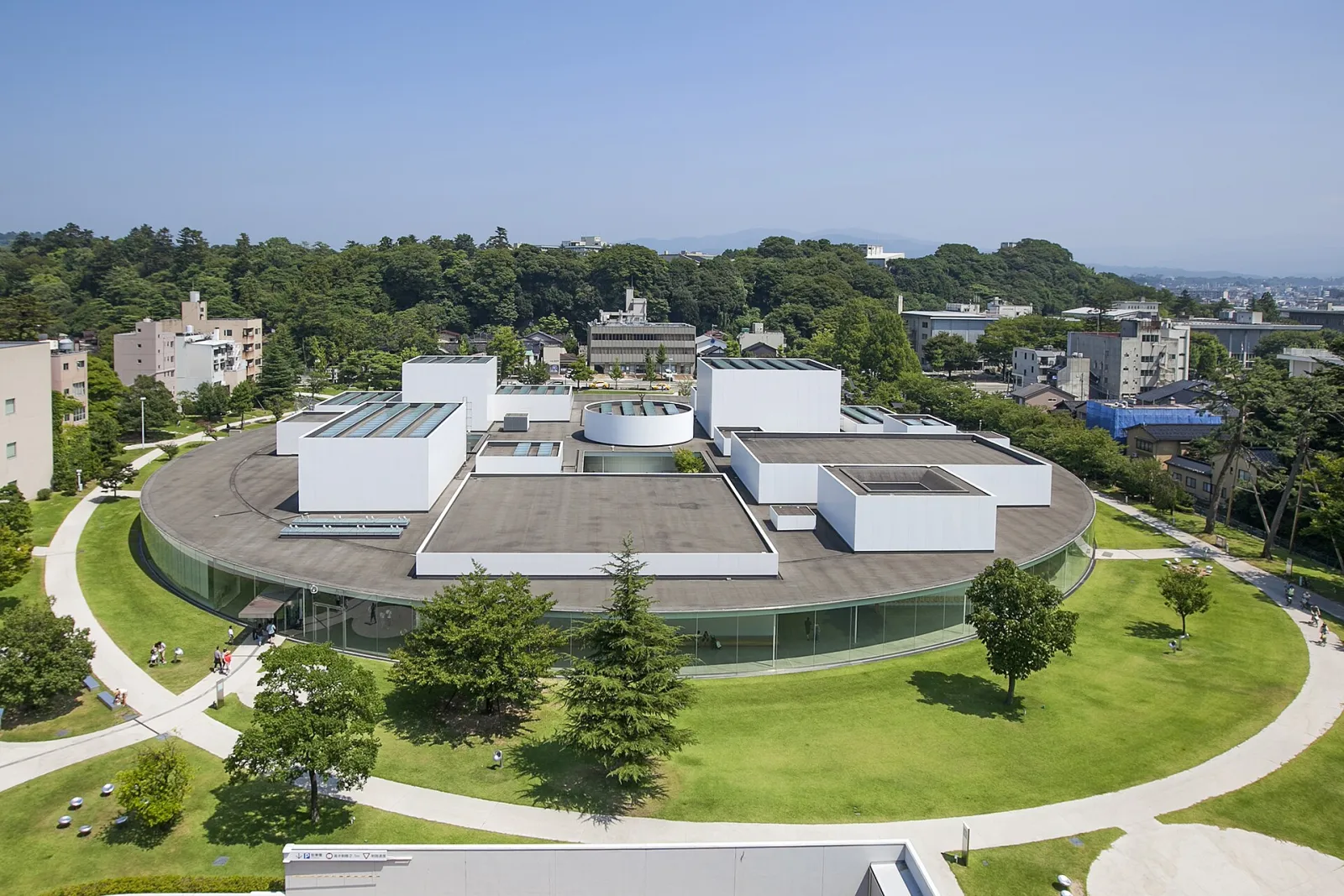
The site of Kanazawa Castle was the Kanazawa Midō and its temple town from 1546, the Maeda family’s castle from 1583, the 9th Division’s base from the Meiji era, and a Kanazawa University campus after the war (see the Muromachi, late Sengoku, Meiji, and late Shōwa notes). Photo: Yusuke.ogawa, public domain. Source: Wikimedia Commons
The political center of medieval Kaga was the Togashi residence, the shugo’s headquarters in Nonoichi, not Kanazawa (Kamakura note, Muromachi note). After the Chōkyō uprising of 1488, Kaga was run by Honganji followers until Oda forces took the Kanazawa Midō in 1580. Maeda Toshiie entered Kanazawa Castle in 1583, and after the Battle of Asainawate in 1600, Nomi district in southern Kaga also passed to the Maeda (late Sengoku note). In 1639 Maeda Toshitsune gave Toyama, worth 100,000 koku, to his second son Toshitsugu and Daishōji, worth 70,000 koku, to his third son Toshiharu, and retired to Komatsu (early and middle Edo note).
In the Meiji era the domains were abolished in 1871; Etchū was merged into Ishikawa in 1876 and separated again as Toyama Prefecture in 1883 (Meiji note). In Toyama Prefecture’s municipal mergers of 2004–2006, Yatsuo joined Toyama City and Toga joined Nanto City (Heisei note).
3. The Hokuriku road and the Sea of Japan
In the Heian period six post stations stood on the Hokuriku road within Kaga (Heian note). Kurikara Pass on the Kaga–Etchū border was where Kiso Yoshinaka ambushed the Taira in 1183; in the Jōkyū War of 1221 the shogunate’s Hokuriku army won at Tonami Mountain (Kamakura note); and in 1689 Bashō crossed the Kurikara valley into Kanazawa (early and middle Edo note).
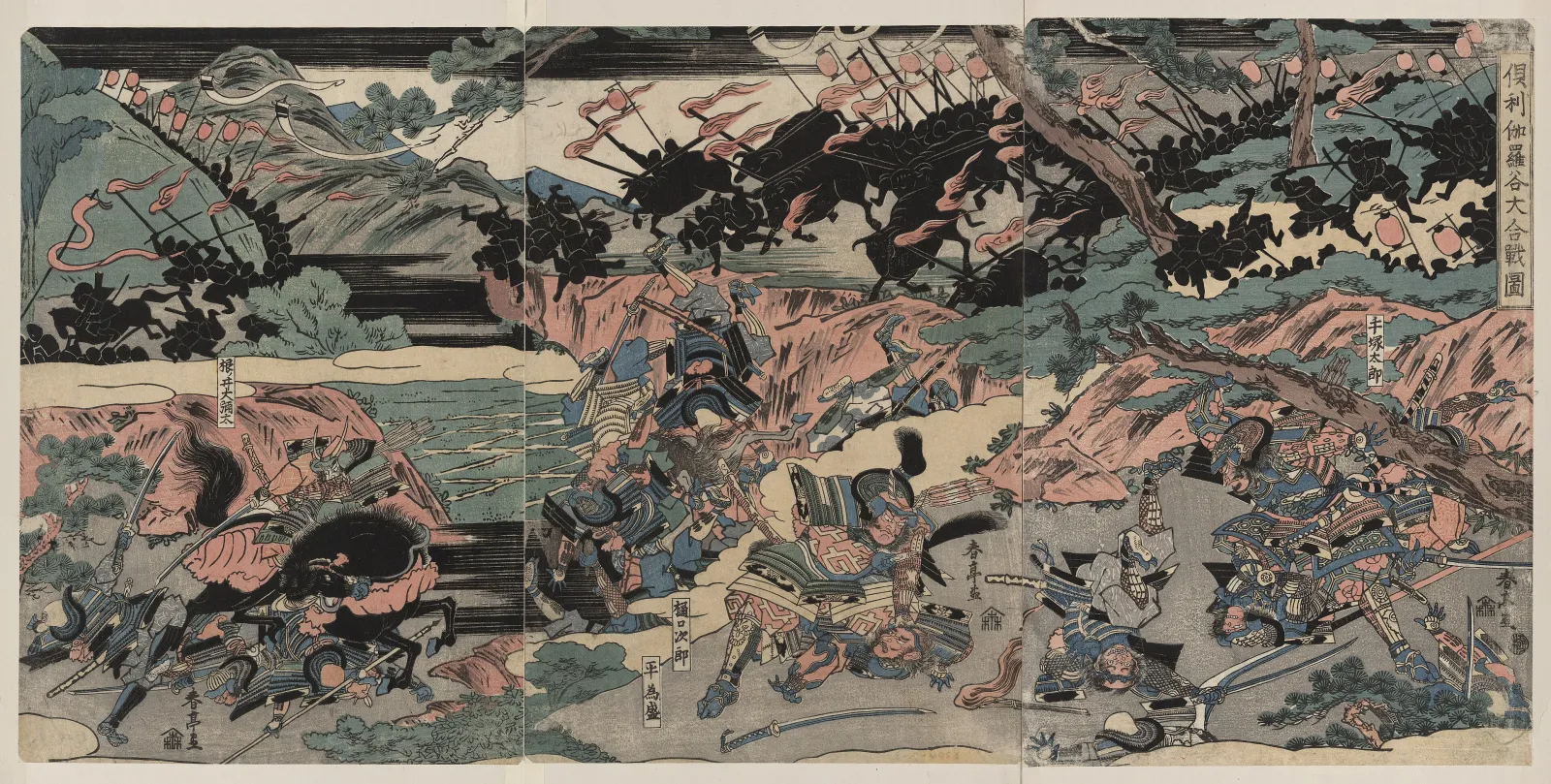
An Edo-period ukiyo-e retelling of the 1183 night attack at Kurikara. The fire-oxen stratagem comes from the Genpei Seisuiki; the older Heike Monogatari texts do not have it (see the Heian note). By Katsukawa Shuntei, Library of Congress, public domain. Source: Wikimedia Commons
By sea, a Goguryeo mission drifted to the “coast of Koshi” in 570 (prehistory note), and envoys from Bohai were received in Kaga district of Echizen in 762 (Nara note). The medieval port of Ataka linked southern Kaga to the Sea of Japan; in 1491 Reizei Tamehiro stayed at Ataka on his way home (Muromachi note). In the late Edo period Zeniya Gohei ran kitamaebune shipping from Miyanokoshi (today’s Kanaiwa) (late Edo note), and in the Meiji era Fushiki became an open port in 1899, with a regular route to Vladivostok from 1900 (Meiji note).
The Hokuriku line reached Kanazawa in 1898, and the whole line from Maibara to Naoetsu opened in 1913 (Meiji note, Taishō note). Komatsu airfield became a joint Self-Defense Forces and civil airport in 1961, Toyama Airport opened in 1963, and the Hokuriku Expressway was completed in 1988 (late Shōwa note). The Hokuriku Shinkansen reached Kanazawa in 2015 (Heisei note) and Tsuruga in 2024 (Reiwa note).
Visitors who came by these routes left many records: Ōtomo no Yakamochi’s poems from five years in Etchū, the travel diary of Fujiwara no Tamefusa, governor of Kaga, from 1091, Bashō’s Oku no Hosomichi of 1689, the Englishman Ernest Satow’s 1867 overland journey from Nanao through Kanazawa and Komatsu to Osaka, and Percival Lowell’s 1891 book on Noto (Nara note, Heian note, early and middle Edo note, late Edo note, Meiji note).
4. Hakusan, Tateyama, and Jōdo Shinshū
Hakusan worship begins with the tradition that Taichō opened the mountain in 717. In 832 the “three bases” for the ascent were opened in Kaga, Echizen, and Mino, with Shirayama Hime Jinja at the center of the Kaga base; in 1147 the Hakusan main shrine became a branch of Enryaku-ji (Heian note). Natadera in Komatsu also belongs to Hakusan worship: by temple tradition it was founded by Taichō, the story of its renaming by the retired emperor Kazan is in the Hakusan no ki, Maeda Toshitsune restored it in 1640 after the Ikkō ikki wars, Bashō visited in 1689, and its Fudō-in was wrecked in the Shōtoku uprising of 1712 (Nara note, Heian note, Muromachi note, early and middle Edo note).
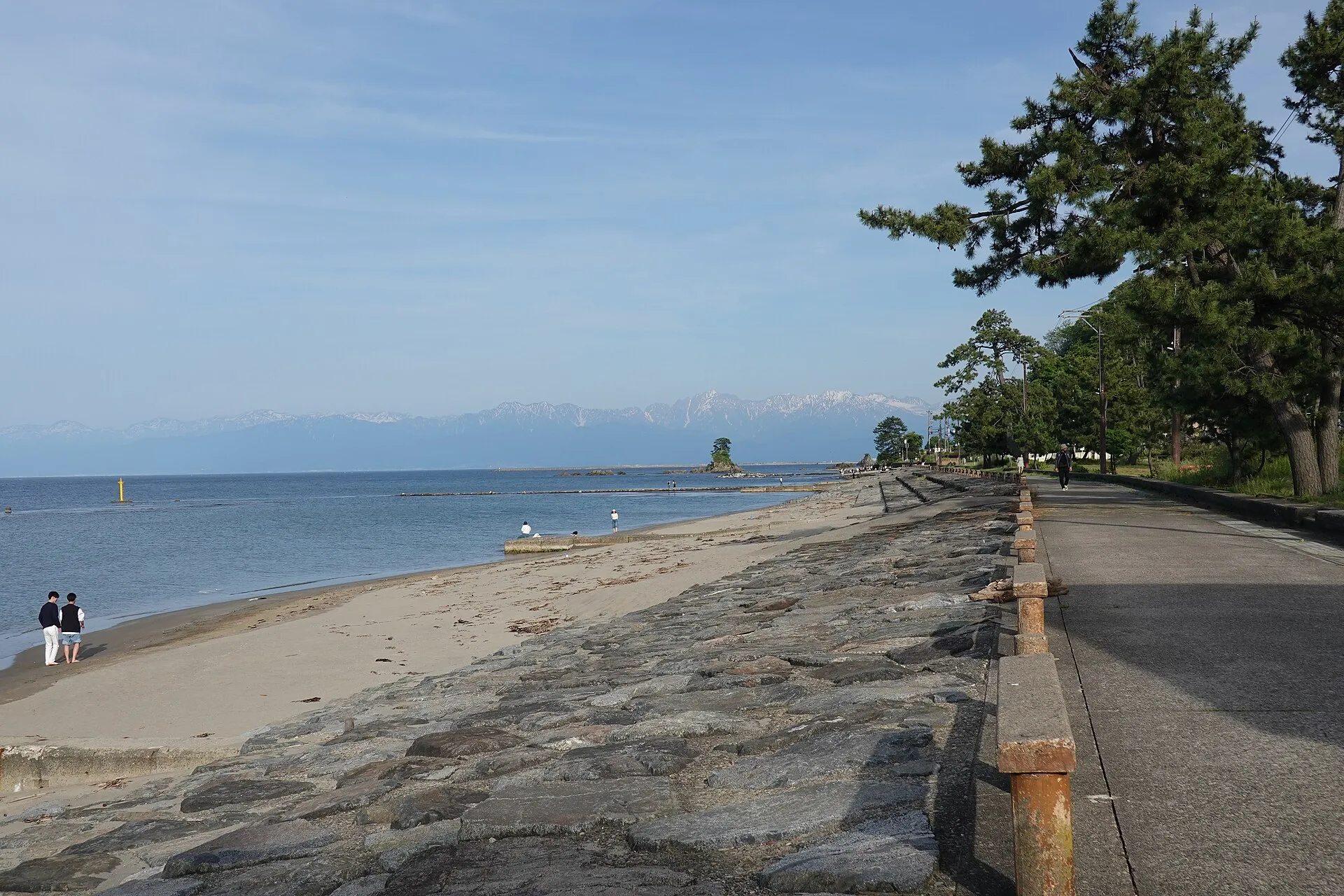
The Tateyama range seen across Toyama Bay from the Amaharashi coast in Takaoka, a landscape in Ōtomo no Yakamochi’s poems in the Nara period (see the Nara note). Photo: Smiley.toerist, licensed under CC BY-SA 4.0, resized and converted to WebP. Source: Wikimedia Commons
For Tateyama, the Heian-period Konjaku Monogatarishū says that “the people of Japan who commit sins often fall into this hell of Tateyama” (Heian note), and the Chūgū Kigan-den of Oyama Jinja at Ashikuraji keeps a seated statue of Jikō Shōnin estimated to be early Kamakura work (Kamakura note). In the Edo period Kaga’s okuyamamawari officers patrolled Tateyama and Kurobe, and in the Hietsu earthquake of 1858 the Tateyama caldera collapsed; two large debris flows followed, and the second broke through the embankments onto the Toyama plain (late Edo note). In 1907 Shibasaki Yoshitarō of the army’s Land Survey Department attempted Mount Tsurugi (Meiji note), and the Tateyama Kurobe Alpine Route opened in full in 1971 (late Shōwa note).
Jōdo Shinshū in Hokuriku starts with Shinran’s exile to Echigo in 1207 (Kamakura note). Shakunyo founded Zuisen-ji at Inami in Etchū in 1390, Rennyo began preaching at Yoshizaki in Echizen in 1471, the Kaga followers overthrew the shugo Togashi Masachika in 1488, and the Kanazawa Midō was founded in 1546. The Midō fell in 1580, and in 1582 the mountain followers holding Torigoe Castle in the Hakusan foothills were crushed, ending the Kaga Ikkō ikki (Muromachi note).
5. The Maeda family
Maeda Toshiie received Noto in 1581, entered Kanazawa Castle in 1583, beat off Sassa Narimasa at Suemori in 1584, and joined Hideyoshi’s campaign into Etchū in 1585 (late Sengoku note). In the Edo period the Kaga domain exceeded a million koku, and the shogunate treated the Maeda nearly on a par with the three senior Tokugawa branch houses (early and middle Edo note).
Most of what the successive lords left can still be seen around Kanazawa Castle: the Gyokusen’inmaru garden and the Tatsumi canal of the third lord Toshitsune, the Tōshōgū (today’s Ozaki Shrine) of the fourth lord Mitsutaka, and the craft specimen collection Hyakkō Hishō of the fifth lord Tsunanori (early and middle Edo note). The twelfth lord Narinaga named Kenroku-en, the thirteenth lord Nariyasu enlarged Kasumigaike pond and built Seisonkaku for his mother, and the fourteenth lord Yoshiyasu set up a hospital and a welfare house on Mount Utatsu (late Edo note).
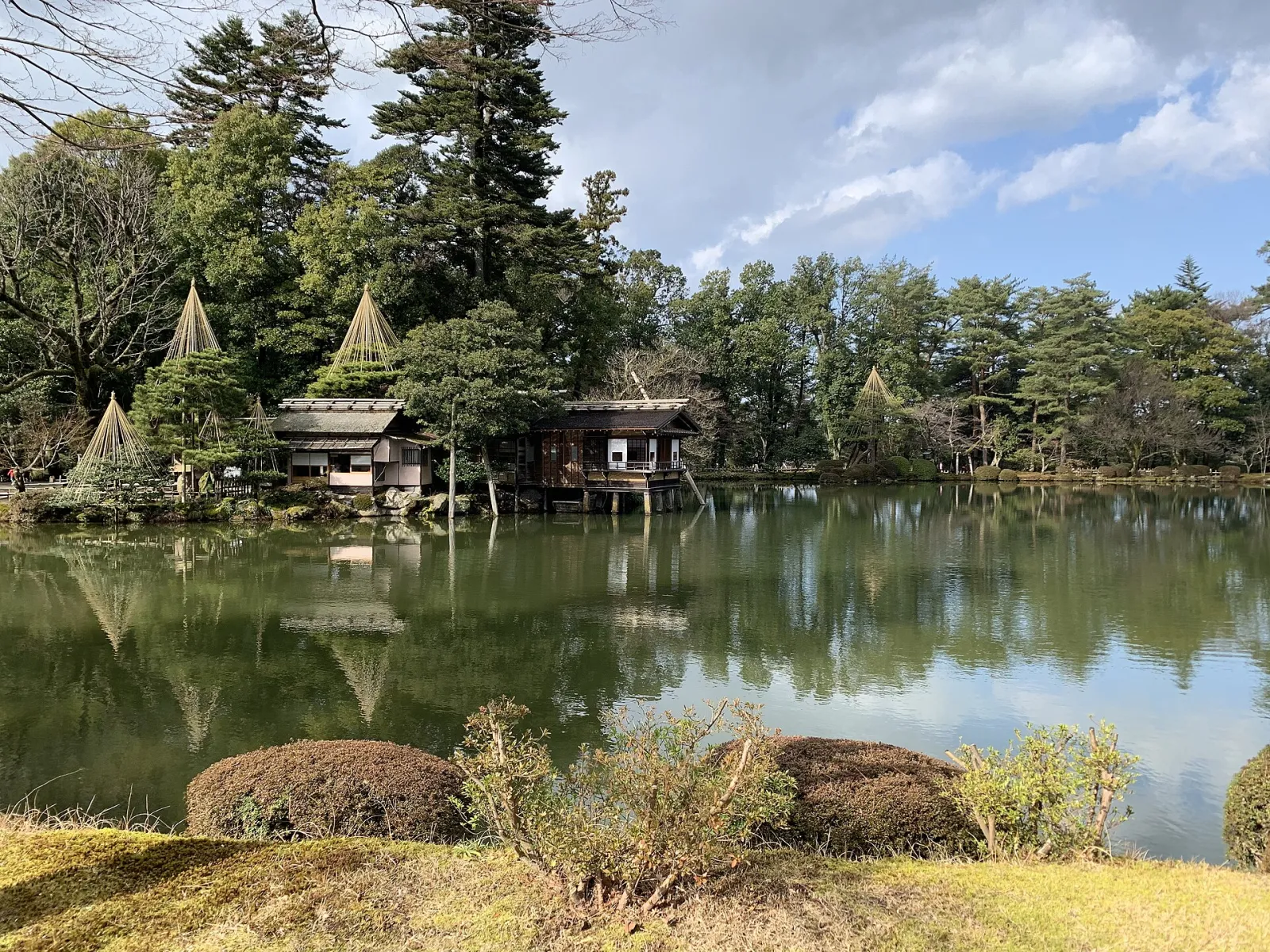
The pond enlarged by the thirteenth lord Nariyasu. Kenroku-en got its name in 1822 and took its present form in 1860, when it was joined with the Renchi garden (see the late Edo note). Photo: Tbatb, licensed under CC BY-SA 4.0, resized and converted to WebP. Source: Wikimedia Commons
After the domains were abolished, the Maeda became marquises and lived at Hongō in Tokyo. The fifteenth head, Toshitsugu, set up an editorial office in 1883 to collect the old domain’s records; the sixteenth, Toshinari, founded the Ikutoku Zaidan (today’s Maeda Ikutokukai) in 1926; that year the Hongō residence went to Tokyo Imperial University, and a new residence at Komaba was completed in 1929–1930. The records were donated to Kanazawa City in 1948 as the Kaetsunō Collection (Taishō note). The statue of Yoshiyasu put up in Kenroku-en in 1930 was given up for metal collection in 1944 (early Shōwa note), and on his 1947 tour of Hokuriku the Shōwa emperor stayed at Seisonkaku (late Shōwa note).
6. Toyama: castle, medicine, and water
Toyama Castle was built by the Jinbo, deputy governors of Etchū; the date is disputed, and 1543 is the strongest theory (Muromachi note). Sassa Narimasa entered it in 1581; when Hideyoshi surrounded it in 1585, Narimasa surrendered without a fight and the castle was pulled down (late Sengoku note). When the Toyama domain was created in 1639, its lord Toshitsugu first planned a new castle at Hyakuzuka, then gave it up and made Toyama Castle his seat until the end of the shogunate (early and middle Edo note). The present keep was built in 1954 to mark the postwar reconstruction and houses the Toyama Municipal Folk Museum (early Shōwa note).
The medicine trade came under domain control from the time of Maeda Masatoshi, second lord of Toyama, and a Hangontan office was set up in 1816 (early and middle Edo note). Medicine sellers followed their kakebachō ledgers around fixed rounds of customers and had reached the Matsumae domain in Hokkaido by the Bunsei era (late Edo note). In 1891 Lowell heard that Toyama’s medicine was sold all over Japan (Meiji note), and a 1918 newspaper reported that many dealers shipped medicine to Korea and Taiwan (Taishō note).
Flood control on the Jōganji River runs through several periods: the “Sassa embankment” said to have been built by Sassa Narimasa (late Sengoku note), the debris flows after the 1858 Hietsu earthquake (late Edo note), the Dutch engineer de Rijke’s 1891 proposal to merge the intakes (Meiji note), and the prefectural power business and Kamidaki power station from 1920 (Taishō note). Kurobe Dam on the Kurobe River was completed in 1963 (late Shōwa note). The itai-itai disease of the Jinzū basin won the first victory in a Japanese pollution lawsuit in 1971 (late Shōwa note).
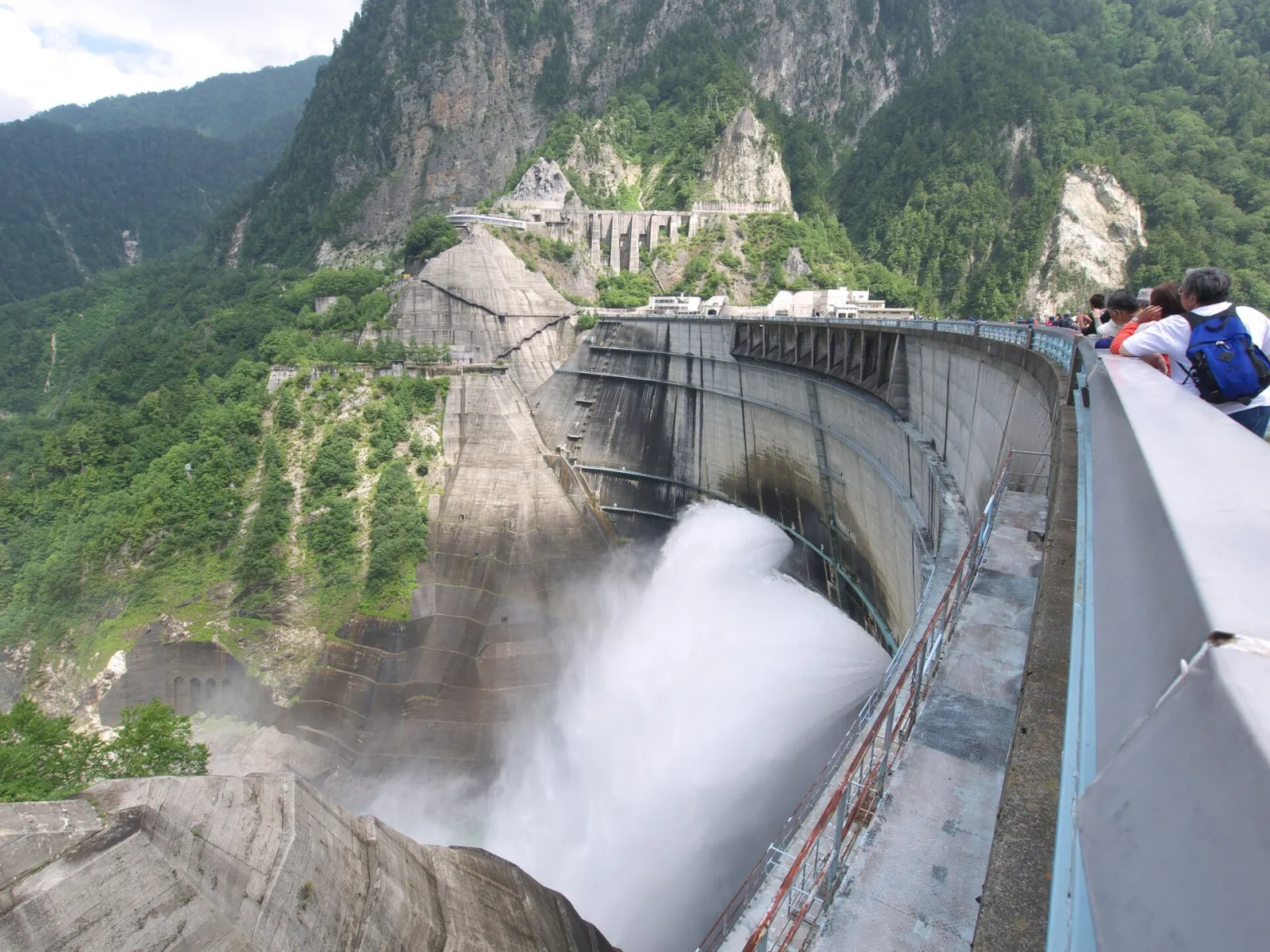
Kansai Electric’s Kurobe Dam, completed in 1963, 186 m high (see the late Shōwa note). Photo: elminium, licence: CC BY 2.0, resized and converted to WebP. Source: Wikimedia Commons
After the fire of 1899 the road by the Ōte gate was widened and straightened (Meiji note), and the air raid of 2 August 1945 destroyed 99.5% of the urban area (early Shōwa note). The rebuilt center got the Toyama Light Rail in 2006, and in 2020 the trams began running through Toyama Station from north to south (Heisei note, Reiwa note).
7. Komatsu: kilns, port, and airport
The hills of eastern Komatsu produced Sue ware for nearly 500 years, from the middle Kofun period to the late Heian period, and more than 270 kilns have been confirmed (Asuka note, Nara note). From the late Heian period the same area made the medieval stoneware called Kaga ware (Muromachi note). Ataka at the mouth of the Kakehashi River was a medieval port and the setting of Kanjinchō (Kamakura note, Muromachi note).
In the early modern period Komatsu was first the battlefield of Asainawate in 1600 (late Sengoku note) and then Maeda Toshitsune’s place of retirement: Toshitsune moved into Komatsu Castle in 1640 and built Komatsu Tenmangū in 1657, and the children’s kabuki on festival floats is said to date from 1766 (early and middle Edo note). The Wakasugi kiln, which fired porcelain from Hanasaka stone in 1811, was one of the revived Kutani kilns (late Edo note).
In modern times the Ogoya mine opened in 1880 (Meiji note), and the ironworks Takeuchi Meitarō set up for the Yūsenji copper mine became Komatsu Seisakusho in 1921 (Taishō note). Komatsu became a city in 1940, and a naval airfield was built outside it during the Pacific War (early Shōwa note). After the war it became Komatsu Airport, shared by the Self-Defense Forces and civil aviation (late Shōwa note), with scheduled flights to Taipei from 2008 (Heisei note).
8. Crafts
Crafts covered in the notes include Komatsu’s Sue ware and Kaga ware, Maeda Tsunanori’s Hyakkō Hishō, the Wakasugi kiln of revived Kutani, the “Japan Kutani” exported to Europe and America in the Meiji era, and the Kanazawa College of Arts and Crafts, opened in 1946 in a former army arsenal (early and middle Edo note, late Edo note, Meiji note, late Shōwa note). In 2009 Kanazawa was named a UNESCO City of Crafts (Heisei note).
The notes did not cover Ko-Kutani. The Ishikawa Prefectural Museum of Art explains that Ko-Kutani is the earliest overglaze-enameled porcelain among Kutani wares, fired in the early Edo period; its kiln was opened around 1655 (Meireki 1) by Gotō Saijirō on the orders of the Daishōji domain, a branch of Kaga, and production is thought to have lasted about fifty years1. Daishōji is the domain Toshitsune gave to his third son Toshiharu in 1639. The revived Kutani kilns in the late Edo note, such as Wakasugi, started afresh after Ko-Kutani.
Nor did they cover Kanazawa gold leaf. Kanazawa City says its history goes back to the Azuchi-Momoyama period and that it grew rapidly after the Meiji era thanks to skilled techniques and good water; today more than 99% of Japan’s gold leaf and all of its silver and imitation leaf is made in Kanazawa2. The same document traces the background of Kanazawa’s crafts to the promotion of crafts by the Maeda lords2.
9. Burned towns and surviving townscapes
The Kanazawa castle town had large fires in the Edo period, in 1631 and 1759 among others (early and middle Edo note), but Ishikawa Prefecture was hardly bombed in the Pacific War (early Shōwa note). Kanazawa today has four national Important Preservation Districts for Groups of Traditional Buildings: the teahouse districts of Higashiyama Higashi (selected in 2001) and Kazuemachi (2008), and the temple districts of Utatsuyama-roku (2011) and Teramachi-dai (2012)3. The Utatsuyama-roku district lies at the foot of Mount Utatsu, whose development, verse monuments, and statues are covered in the late Edo note and the Meiji note.
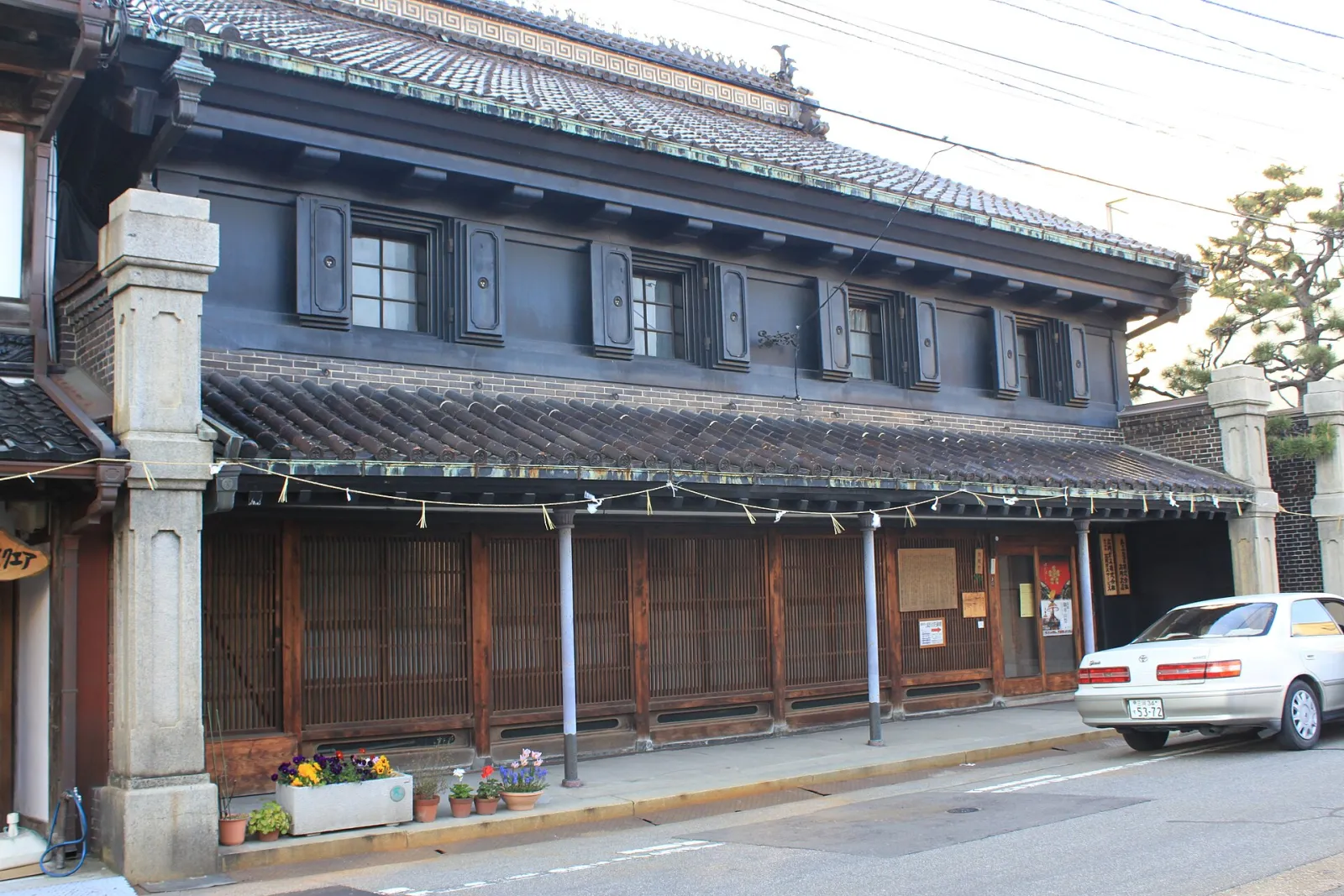
A storehouse-style merchant house rebuilt after the 1900 Takaoka fire (see the Meiji note). The Yamachō-suji area later became an Important Preservation District for Groups of Traditional Buildings. Photo: くろふね, licence: CC BY 3.0, resized and converted to WebP. Source: Wikimedia Commons
Toyama Prefecture’s preservation districts are Ainokura and Suganuma in Gokayama (1994), and Yamachō-suji (2000), Kanaya-machi (2012), and Yoshihisa (2020) in Takaoka3. Yamachō-suji is the street of storehouse-style houses rebuilt after the 1900 Takaoka fire (Meiji note), and Ainokura and Suganuma were listed as World Heritage in 1995 (Heisei note). Central Toyama went through the 1899 fire and the 1945 air raid, and few prewar buildings remain; the 1936 Toyama Denki Building was hit by incendiaries in the raid, but the fire was put out and its exterior survived (early Shōwa note).
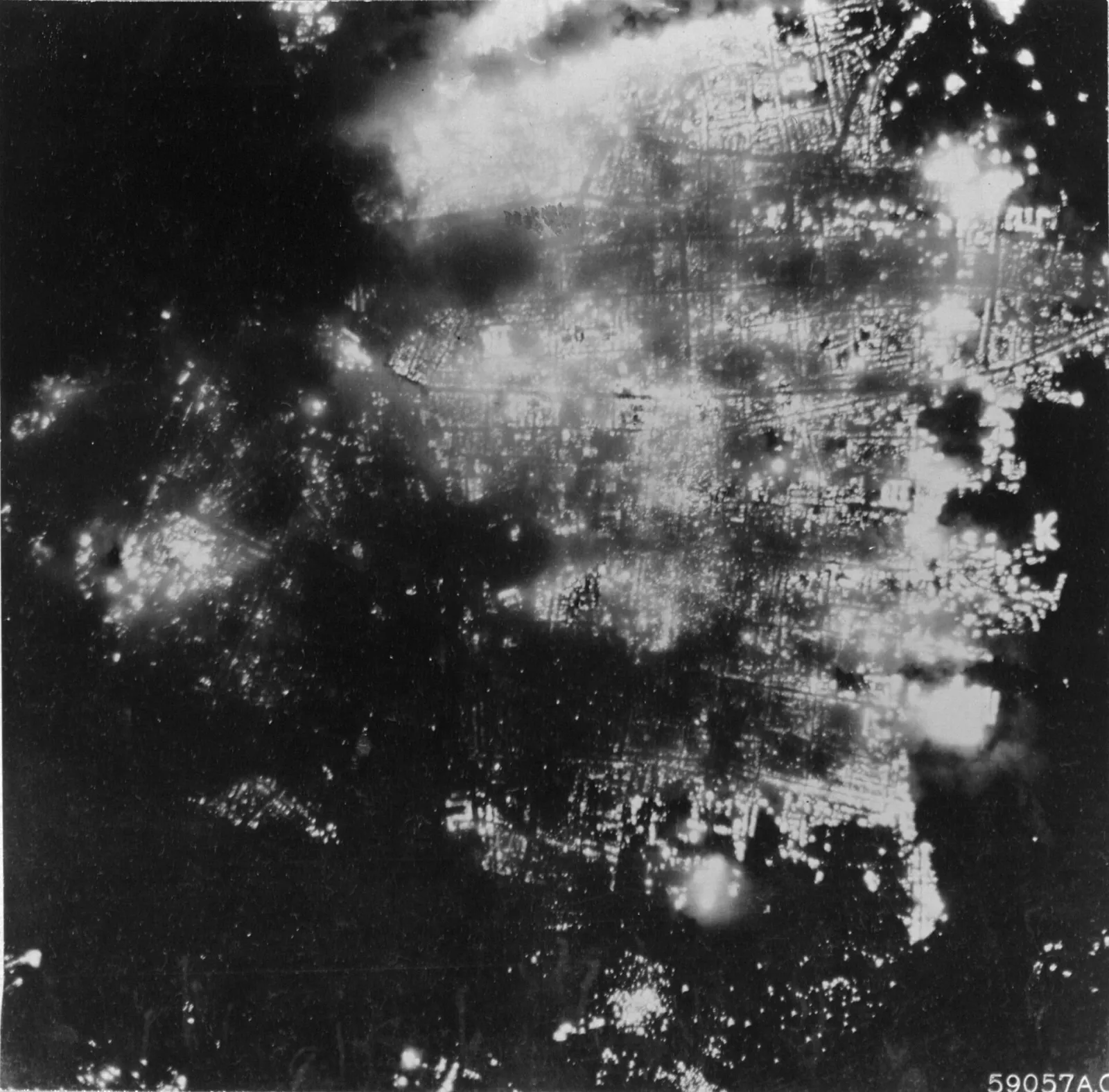
A US photograph of the raid on Toyama, which destroyed 99.5% of the urban area (see the early Shōwa note). Photo: USAAF, public domain, resized and converted to WebP. Source: Wikimedia Commons
10. Disasters
The main disasters covered in the notes, in order: the 1858 Hietsu earthquake and the Jōganji River debris flows (late Edo note); the Toyama fire of 1899 and the Takaoka fire of 1900 (Meiji note); the loss of Saigawa Bridge in the 1922 floods (Taishō note); the 1945 firebombing of Toyama (early Shōwa note); the heavy snow of 1963 and itai-itai disease, recognized as a pollution disease in 1968 (late Shōwa note); the 2004 Fukui floods and the 2007 Noto Peninsula earthquake (Heisei note); and the 2024 Noto Peninsula earthquake and the Oku-Noto floods (Reiwa note).
11. Ties with Taiwan
Taiwan-related items from the notes, in order:
- Meiji: Hatta Yoichi of Kanazawa joined the Government-General of Taiwan in 1910, and the architect Umezawa Sutejirō of Tsurugi went to Taiwan in 1911 (Meiji note).
- Taishō: Hatta led the work on the Chianan irrigation system and the Wushantou reservoir; Qiu Niantai studied at the Fourth Higher School in Kanazawa; in 1924 Kanazawa First Middle School lost to Taipei Commercial School at the national middle-school baseball tournament; Toyama medicine was shipped to Taiwan (Taishō note).
- Early Shōwa: the stage of the Kanazawa Noh theater, completed in 1932, used Alishan cypress; a radiotelephone link between Kanazawa and Taiwan opened in 1934; the 9th Division moved to Taiwan at the end of 1944 and saw the end of the war at Hsinchu (early Shōwa note).
- Late Shōwa: Hayashi Torahiko, born in Taiwan, started a business in Kanazawa in 1950; YKK set up a Taiwan subsidiary in 1966; a memorial service for Hatta was held in 1985 (late Shōwa note).
- Heisei: scheduled flights to Taipei began from Komatsu in 2008 and from Toyama in 2012 (Heisei note).
- Reiwa: after the 2024 Noto Peninsula earthquake, Taiwan sent sympathy and donations, and when eastern Taiwan was hit by an earthquake that April, Ishikawa and Toyama sent their own messages; the Toyama–Taipei scheduled flights resumed in 2026 (Reiwa note).
12. Places on the trip and the notes that cover them
The same place often appears in several notes. The table lists places this trip may pass through and the related notes.
| Area | Place | Periods | Notes |
|---|---|---|---|
| Kanazawa | Kanazawa Castle Park | Muromachi, late Sengoku, Edo, Meiji, Shōwa | Muromachi, late Sengoku, early and middle Edo, Meiji, early Shōwa, late Shōwa |
| Kanazawa | Kenroku-en and Seisonkaku | Late Edo, Shōwa | late Edo, late Shōwa |
| Kanazawa | Ishikawa Prefectural Museum of History and National Crafts Museum | Meiji, Taishō, Shōwa | Meiji, Taishō, late Shōwa |
| Kanazawa | Mount Utatsu, Higashiyama Higashi, Kazuemachi | Late Edo, Meiji, Taishō, Shōwa | late Edo, Meiji, Taishō, early Shōwa |
| Kanazawa | Saigawa and Asanogawa bridges, Shiinoki Cultural Complex | Taishō | Taishō |
| Kanazawa | Kanaiwa (Zenigo-no-Yakata, Zenigo Park) | Late Edo, Taishō | late Edo, Taishō |
| Kanazawa | 21st Century Museum and D. T. Suzuki Museum | Meiji, Heisei | Meiji, Heisei |
| Toyama | Toyama Castle Park | Muromachi, late Sengoku, Edo, Shōwa | Muromachi, late Sengoku, early and middle Edo, early Shōwa |
| Toyama | Toyama Denki Building | Shōwa | early Shōwa, late Shōwa |
| Toyama | Toyama Station and trams | Meiji, Heisei, Reiwa | Meiji, Heisei, Reiwa |
| Toyama | Toyama Medicine Museum (Folk Craft Village) | Edo | early and middle Edo, late Edo |
| Tateyama | Iwakuraji, Ashikuraji, Tateyama Museum | Heian, Kamakura | Heian, Kamakura |
| Tateyama | Tateyama Kurobe Alpine Route and Kurobe Dam | Shōwa | late Shōwa |
| Takaoka | Fushiki (Shōkō-ji, Man’yō Museum) | Nara, Meiji | Nara, Meiji |
| Takaoka | Zuiryū-ji and Yamachō-suji | Edo, Meiji, Taishō, Heisei | early and middle Edo, Meiji, Taishō, Heisei |
| Komatsu | Kaga Kokufu Monogatari-kan | Kofun, Nara, Heian | prehistory, Nara, Heian |
| Komatsu | Ataka Sumiyoshi Shrine and Ataka barrier | Kamakura, Muromachi, late Edo | Kamakura, Muromachi, late Edo |
| Komatsu | Natadera | Nara, Heian, Muromachi, Edo | Nara, Heian, Muromachi, early and middle Edo |
| Komatsu | Tada Shrine | Heian, Edo | Heian, early and middle Edo |
| Komatsu | Yōkaichi-jikata site and Komatsu Airport | Yayoi, Shōwa, Heisei | prehistory, late Shōwa, Heisei |
References
Footnotes
-
Ishikawa Prefectural Museum of Art, “Special feature: Ko-Kutani and revived Kutani” (2002 exhibition; recorded in the National Art Center’s Art Commons: “その九谷焼のなかで最も早く江戸時代前期に焼かれた色絵磁器が古九谷です,” “加賀藩の支藩である大聖寺藩の命を受けた後藤才次郎によって明暦元年(1655)頃に開窯され、生産活動はその後約五十年間程度と考えられています”): https://www.nact.jp/artcommons/user/detail/4491 ↩
-
Kanazawa City, “UNESCO City of Crafts: Kanazawa, the Traditional Crafts of Kanazawa” (Kanazawa leaf: origins in the Azuchi-Momoyama period, growth after Meiji, more than 99% of gold leaf and 100% of silver and imitation leaf made in Kanazawa; the Maeda lords’ promotion of crafts): https://www4.city.kanazawa.lg.jp/material/files/group/30/100324dentou-jpn.pdf ↩ ↩2
-
Agency for Cultural Affairs, “List of Important Preservation Districts for Groups of Traditional Buildings” (Kanazawa: Higashiyama Higashi 14 Nov 2001, Kazuemachi 9 Jun 2008, Utatsuyama-roku 29 Nov 2011, Teramachi-dai 28 Dec 2012; Nanto: Ainokura and Suganuma 21 Dec 1994; Takaoka: Yamachō-suji 4 Dec 2000, Kanaya-machi 28 Dec 2012, Yoshihisa 23 Dec 2020): https://www.bunka.go.jp/seisaku/bunkazai/shokai/hozonchiku/judenken_ichiran.html ↩ ↩2